
Workplace Diversity — Putting Your Money Where Your Mouth Is
How companies can truly support women in the workplace.

The number of female CEOs in the Fortune 500 hits an all-time record.
This headline from a May 2020 Fortune article made me feel elated. Finally, a very significant half of our society that has long been neglected in the corporate world was getting its due — the women.
Yet, when I opened the article, I was saddened to see what we were really celebrating.
The number of women running America’s largest corporations has hit a new high: 37 of the companies on this year’s Fortune 500 are led by female CEOs.
Yes, you read that right. A sum total of 37 out of 500 of the biggest American corporations had women CEOs. That is 7.4 % of the total CEO population under consideration.
Exacerbating the problem, experts have found that the pandemic has disproportionately squeezed women, both socially and economically.
While there is a lot of talk by corporations globally about focusing on diversity, the actions that have been taken have clearly not moved the needle enough. There are some simple yet significant changes that are needed in various areas of the corporate world to truly create a diverse workplace.
Quality professional education
The gaps in the corporate world start to show their first signs right at the level of professional education.
While this varies from country to country with the gender gap being more pronounced in developing nations, the gap exists in developed nations like the UK as well.
- In India, the number of females per 100 males that are enrolled in undergraduate and postgraduate courses has increased to the point of parity or even beyond. Yet, female enrollment in truly professional degrees such as M. Tech, B. Tech (engineering courses) as well as enrollment with the country’s top professional institutes has been lagging behind. Only about ~25% of the enrollments at these top institutes were female students.
- While the situation is definitely worse in developing nations, studies show that the developed world has its issues as well. Research around the gender wage gap indicates that the unexplained part of the wage gap is 74% for non-graduates and 63% for graduates in Greece, and 62% for non-graduates and 59% for graduates in the UK. This means that by going for graduate degrees, women can reduce the gender wage gaps even in these countries.
What companies can do
Instead of trying to bridge the gender gap by artificial measures such as forced diversity hiring in some cases, a better way to help address the root cause would be to identify and mentor female talent at an undergraduate level and invest in them to provide them an equal platform. This will create more organic gender equality at entry-level hiring.
This early show of support will not only help bridge the gap but also build loyalty from these highly talented students and affinity towards these corporates for the longer run.
Policies that support diversity
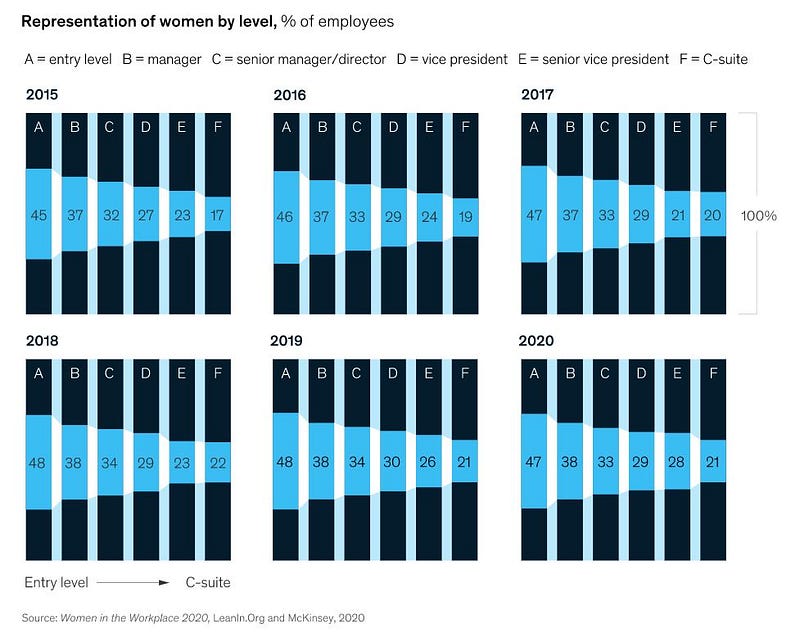
Recent research on Women in Workplace, by McKinsey & Company indicates that the representation of women by level decreases as the level goes higher.
While the improvement over the years has been most pronounced at the more senior levels, there is still a huge amount of work that needs to be done to get to a level of parity. For 2020, the representation of women falls consistently from 47% at the entry-level to about 21% at the C-suite level.
What companies can do
Often the fall in the percentage is a result of multiple factors but primarily the assumed primary responsibility of raising a family falling on the woman or mother. While some women may choose to stay home after motherhood, a good number are forced to do so when they’re unable to balance the personal and professional lives.
There needs to be a conscious effort in terms of supportive policies that not only provide adequate maternity policies, but also added help in reintegrating working women back into the workforce after a short hiatus for any family reasons. Other supportive actions can involve making a truly diverse workplace with facilities like nursing rooms, medical support, parenting consultants, etc. provided to returning mothers.
Women by the natural process of childbirth do the labor force a favor in creating the pipeline for the future, and that very act should be a reason to encourage them instead of becoming a hindrance in their professional careers.
Pro-active diverse lateral hiring processes
Due to the lower ratio of women at the mid-to-senior levels, the lateral hiring processes tend to favor men, as there are more male candidates for the same job due to the skewed ratio. This means that the effects get compounded as lateral hiring will lead to more men joining the senior management positions unless there is a conscious effort made to address that gap.
What companies can do
Intentional policies in mandating the hiring processes to involve a diverse set of candidates and actively searching for suitable women candidates provide a more equal opportunity of getting a suitable and diverse representation among lateral hires.
Additionally, building an organic pipeline of women leaders within an organization and mentoring and guiding them with help from other women leaders and male “allies” can often help enhance the leadership capabilities in the women of the existing workforce.
The pay gap
The gender wage gap refers to the difference in earnings between women and men. Experts have calculated this gap in a multitude of ways, but the varying calculations point to a consensus: Women consistently earn less than men, and the gap is wider for most women of color.
The Center for American Progress summarizes the issue of the gender pay gap that has come to the fore in recent years more than any time in the past. Yet, the gaps in wages at all levels between men and women remain significant.
Analyzing the most recent Census Bureau data from 2018, women of all races earned, on average, just 82 cents for every $1 earned by men of all races. The wage gap is larger for most women of color.
What companies can do
Acceptance and acknowledgment of an issue is the first step towards rectification. Corporates need to bring in transparency towards compensation processes so that there is the accountability that comes with it.
Making your compensation by level and gender transparent to the public and allowing these to be audited by relevant organizations will enhance the accountability and hence provide a significant disincentive to discriminate on the basis of gender or race.
Finally, diversity doesn’t end there
While I’ve focused primarily on one aspect of diversity, there is a lot more work to be done.
Diversity based on all accounts is of paramount importance and is not just imperative but also beneficial to the corporate culture. Diversity of workforce contributes to the diversity of opinions and ideas, leading to more productive and creative solutions and efficiencies.
What companies can do
The essence of being a genuinely diverse company is in being a genuinely equal opportunity employer.
While most organizations have a standard disclosure that says they are “equal opportunity employers” for legal requirements — companies should proactively hire for diversity and make it a core of their culture.
While there have been encouraging efforts to bridge the gaps that exist in the corporate world, the results so far are not enough to rejoice. Instead of celebrating these small wins, we need to continue to make honest efforts and not let companies hide behind small achievements that are used as marketing gimmicks.