
Working Too Hard Makes Your Brain Work Harder
How to find balance and create boundaries for overall well-being

Most of us only think about our brains when we have a headache, it gets bopped on when playing ball, or we bang it into something hard. Sometimes, we cuss it out when the solution to a problem just won’t come, or we forget something important. Mostly, it just sits in our skull doing its thing without our thinking about it.
“You would be dead without your brain, which is why ‘brain dead’ is usually the legal definition of death. Someone is brain dead when there is a lack of reflexive responses controlled by the brain stem, the most fundamental structures at the core of the brain that control the vital functions.” — Bruce Hood, Ph.D.
The brain is a powerful tool that allows us to think, decide, and act throughout our days. Just like any power tool, it requires maintenance to remain in top condition and deliver the performance we need. But unlike our power tools, it doesn’t always get the right attention.
Productivity. Flow states. Focus. Attention. All positive abilities we need for long-term success. We work hard to meet deadlines, juggle conflicting demands on our time and resources, and hold everything together. All this hard work takes a toll on our physical bodies — and our brains.
The Finnish Institute of Occupational Health followed British civil servants for 7 years, using different tests to analyze brain function. The results showed that subjects who worked more than 55 hours per week demonstrated a cumulative decrease in mental function in several areas of the brain, including memory. Office workers aren’t the only ones who run the risk of damaging their brains. People engaged in hard, physical labor are also at risk. While some form of physical activity is beneficial for brain health, prolonged hard labor is not.
“The commonly held myth that backbreaking work is good for body and soul has been debunked by previous studies which show it has a negative effect on heart blood circulation and blood supply to the brain which can lead to the development of problems like high blood pressure, blood clots in the heart, heart cramps and heart failure.” — Bryan E. Robinson Ph.D.
Covid-19 isolation has forced many of us to add even more work to our already burdened schedules. Working from home, taking on our children's education, coping with isolation, losing income, hustling gigs to make enough to just live — we’ve been bombarded for more than a year. Even though many of us can breathe easier as things are improving, albeit slowly, we’re still dealing with levels of stress and burnout we’ve never experienced before. The obvious and most difficult solution is to stop. Just stop working so hard.
I’ll give you a moment to stop laughing.
In order for our brains and bodies to be able to function optimally, we need to balance the demands we place on them and the importance of giving them time to recover. This balance isn’t a 50–50 split; it fluctuates based on meeting the demands of our work while supporting our core values. However, when the demands overwhelm the recovery time, we force our bodies and brains to work harder. The solution comes from discovering and reconnecting to what matters most to us and implementing strategies and boundaries that protect what matters most to us and allow our bodies and brains to unwind and recoup.
“Things which matter most must never be at the mercy of things which matter least.”-Johann Wolfgang von Goethe
What matters most?
Career? Children? Relationships? Money? Fame? Freedom? It doesn’t matter what our answer is; what does matter is that we value it. There’s no right or wrong here. Identifying and reconnecting with our core values makes it easier for us to avoid overworking since we can more easily set and adhere to priorities and goals, weigh conflicting demands on our time, and commit to what we most value in our lives.
I was a high-achieving, ambitious career woman in finance, climbing the corporate ladder, and I was stressed and unhappy every day. It became impossible to focus because I loathed large parts of my job. Stepping back and identifying my core values was an epiphany — my top 2 values are freedom and variety. Freedom and variety aren’t values that most corporations desire in top execs.
Immediately, I knew why I was unhappy and stressed, and it became easy to turn down the next promotion, create a plan to exit my corporate job, and start my business. It took 3 years to lay the foundation and build a consulting and publishing portfolio, but I have never looked back. My top values still govern my decisions today.
I’m not suggesting that everyone toss aside their careers to follow their bliss; that’s not practical for most of us. I suggest we make time and create space for what’s most important in our lives, regardless of what that might be. We need to respect and work with our highest values, instead of against them. In this way, we shift from overwork to smarter work.
How to organize our day to support our values
It’s important to plan our days in ways that give us time for what we value most while meeting our work objectives. A valuable tool is the Eisenhower Matrix.
Dwight D. Eisenhower was the 34th President of the United States and the Allied Forces Supreme Commander during World War II. He is credited with saying: “I have two kinds of problems: the urgent and the important. The urgent are not important, and the important are never urgent.” If it looks familiar, Stephen Covey introduced a variation of the Matrix several decades after Eisenhower.
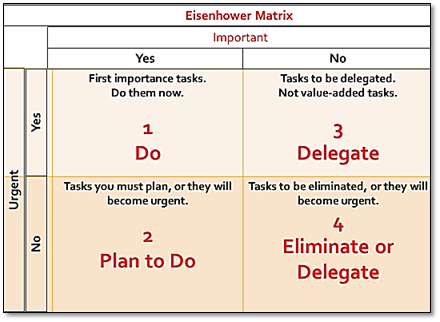
This Matrix helps us integrate our core values into our work and provides guidance for prioritizing our time when there is a conflict between work demands and our core values. We want to identify every activity by quadrant for both our personal and professional lives to ferret out potential conflicts and decide how we will reconcile them.
Focusing on what is most important for us professionally and helps us can establish boundaries — guidelines — that respect and honor what we most value. This leads to less stress and more fulfillment because we have clear guidance about what we will and won’t accept; it becomes easier for us to leave work at work and shift our focus to our personal lives. According to research by Dr. Youngah Park, University of Illinois, Urbana-Champaign, setting boundaries and enforcing them reduces stress and stress-related problems.
“Setting a good boundary between work and regular life is going to help more people and more stakeholders. Overall, it’s critical that individuals manage their work-life boundaries for their own health and well-being, but also for their own productivity and their colleagues’ productivity.” — Youngah Park, Ph.D.
Once we set firm limits that reflect our values and priorities, it’s important to protect them for our self-esteem and self-image. Defending our boundaries requires assertive communication, which is firm, polite, and respectful. The key is to use active listening skills and express our position without becoming argumentative or defensive. We want to take ownership of what we are saying and honestly communicate how we feel. If we are asking someone to respect a boundary, we also must respect it. According to Marvin G. Knittel, Ed.D., writing in Psychology Today:
“So why is it important to have boundaries? It’s important because healthy personal boundaries help maintain a positive self-concept….Clearly established boundaries help us to take care of ourselves emotionally, physically and spiritually.”
What now?
- What are your core values?
- What are your boundaries that support them?
- Where do you need to make different decisions?
Not sure what your values are? The Values Project, a large study that looks into motivational goals led by Professor Julie Lee at The University of Western Australia, offers an online survey to help you reconnect to them. You can take the survey here.