
Working for harmony: A profile of trainer Linda Hoover
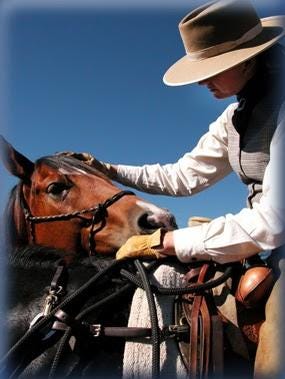
“However you show up in life, you show up with horses. How do you teach someone who is passive to become a leader to her horse?” Linda Hoover poses this rhetorical question while reflecting on horsemanship and life. It reflects her passionate interest in helping her students to develop an awareness of what is important to horses. She observes that we take lessons that teach us to keep our heels down, but “when do we learn how to observe our horses?”
For three decades, Hoover has been working to fill this gap for her amateur students. She notes that the connectedness we feel to horses is almost addictive, but many amateurs struggle with their training programs because of an unacknowledged clash of goals. Often, professional trainers are focused on success in the show ring, even if it means urging the owner to buy a different horse. On the other hand, many adult amateur owners are more interested in creating a better relationship with the horse they already have. In this regard, Hoover can almost be viewed as a relationship counselor for people and their horses. How she came to occupy this niche is an interesting story.
Growing up in the 1960’s in Michigan, Hoover began her involvement with her horses like so many other little girls: She begged her parents to give her riding lessons for her birthday. Her mother made a deal with some neighbors in which Hoover helped them with their , including an unbroke stallion, in exchange for riding time. So one of her early riding experiences was helping to break a stallion. By the time she was in her teens in the mid 1970’s, Hoover and her family had moved to Texas and she was regularly training for others.
Because she had started out riding Saddleseat at the Morgan barn, Hoover purchased a Saddlebred mare upon arrival in Texas. She grew restless showing s, however, and joined some friends who were using a local dude ranch to practice for lower level . She recalls that they dragged out a fire hose to mark off a ring.
As unlikely an eventing prospect as her Saddlebred was, Hoover retrained the mare for the sport. The horse “was never very bold in cross country, though” she notes wryly. Her next eventing mount was an gelding the family had bought as a trail horse. An athletic jumper, he nevertheless challenged her developing training skills. She recalls that at one event they galloped down to a jump made of barrels. He was wary of the jump, but instead of simply refusing he stopped and put his front feet on the barrels. She made two more attempts, and each time he did the same thing. He finally jumped the barrels on the fourth try, but of course by then it was just a schooling exercise, because she had been eliminated for the three stops.
In 1980 she acquired a Quarter Horse off the track, and looked to a well-respected local horseman for help. The father of one of her eventing friends and a pilot by trade, Roy Phillips headed up an award winning drill team. It was important to him that his horses be well-mannered, she recalls. His influence made her broaden her focus to consider her whole relationship to the horse, not just what happened under saddle. During a brief stint when she worked at a Quarter Horse racing barn, Phillips helped her to start a particularly spooky filly. Hoover liked the feeling of earning the horse’s trust.
The next few years were diverse ones for Hoover as she worked with cutting horses, and Quarter Horses. She continued to reflect on the basic ideas Phillips had taught her, as well as her own astute observations of equine behavior. Each job and horse taught her something. For example, the cutting horse trainer had her trot and lope the young horses in big circles and turns for long stretches of time. This led her to realize that, given the opportunity, a horse will settle into his own rhythm and carriage without artificial aids.
The past two decades have been active ones. Hoover has been in a period of accelerated progress since attending her first Buck Brannaman clinic in 1992. A Western trainer who works in the California Vaquero tradition, Brannaman is viewed by many as one of the finest trainers in the world today.
As Hoover states on her website:
“Since 1991, I have worked with a number of the “Masters” of the art of horsemanship. Among these notable horsemen are Buck Brannaman, Tom Curtin, and Ray Hunt. In 2008, I attended the first of many symposiums taught by Dr. Gerd Heuschmann, world renowned expert on equine biomechanics and the author of Tug of War — Classical versus “Modern” Dressage, Balancing Act — The Horse in Sport and the film If Horses Could Speak. I have also received certification through the Western Dressage Association of America (WDAA) Train the Trainer’s Program in 2014.”
Hoover’s interest lies not so much in advancing a particular discipline, but in helping her diverse group of students to solve problems by trying to understand the horse’s point of view. She helps them to become more attuned to their horses in general, working towards increasingly refined communication.
One of Hoover’s students reflects that:
“Prior to moving to North Carolina, I’d had a series of falls and lost confidence in my abilities. This, coupled with my TB mare’s innate volatility, was a train wreck waiting to happen. But, we were lucky enough to find Linda. She first addressed how some of my young mare’s subtle and not so subtle physical issues were impacting her ability to respond to training. She was respectful of my new timidity. From the very first lesson, she was able to start me down a path where I began to learn how to recognize how subtle changes in my body position, hands, legs and back are reflected in my horse’s responses. It’s not about hunters or jumpers or dressage. It’s about connection.”
One of the pithy cowboy sayings sometimes heard at a Brannaman clinic is “If you’re green you’re growing, if you’re ripe you’re rotten.” A humble person, Hoover is the first to tell you she is still learning and always looking for ways to refine her skills. Her accomplishments in the area of rehabilitating problem horses and helping people to improve their relationships with their horses are already considerable, however.
Hoover recalls one ex-racehorse who would bolt out of control. He was so dangerous that his owners were reluctantly considering selling him at auction, where he probably would have been purchased by a kill buyer and sent to a meat-packing plant. There are no blue ribbons for teaching an ex-racehorse not to bolt at every touch, but that horse had a chance for a second life thanks to Hoover’s success with him.
“I wanted to try to do one thing really well in my life,” Hoover says “and my horsemanship is it.”
Originally published at https://www.newsbreak.com on April 13, 2021.


