
life stories
Working as an Autopsy Assistant
Experiences and life lessons
Background
Before deciding to pursue a degree in Psychology, I was a pre-med student in Prague. My initial goal was to finish the medical school, then go for Psychiatry and then get more training in psychotherapy. Eventually, I realized that I would be much happier if I devoted my energy to Psychology from start to finish. I am grateful though for everything I learned as a pre-med, and all the advantages it has given me with regards to my studies and my understanding of the brain and the body.
In our Anatomy classes we had mandatory learning and practice time with bodies. First starting with bones and muscles (first semester), then organs (second semester) and then the brain and nervous system (third semester). From the second semester onwards, we were also tasked to learn proper dissection techniques. The bodies were mostly coming from donations to the university for science purposes.
The professor’s assistant, Michal, was a 5th year medical student who could remember everything by heart. Even the tiniest, most obscure structure in the body. I admired him a lot. He was the one who initially noticed that I was quite skilled in dissection and told me about a part-time job opening for an autopsy assistant.
The truth is that, at first, I was skeptical because I was afraid I wouldn’t be good. I almost declined. He convinced me though to try it out. After one day of working, I understood how happy that job made me feel!
The job
Most of the time, I was tasked to dissect the bodies and to prepare them depending on what the anatomy class would be focused on. For example, if that day’s lecture was on the muscles of the legs, I would have to dissect and clear out the skin and expose the muscles in the way the professor wanted. Other times, I had to help with extracting organs and preparing them to be preserved in formaldehyde.
I loved it when I had the opportunity to use tools that required a lot of precision, such as when having to extract the brain or the eyes. After a while, I also got to work at the pathology lab, and prepare the bodies for an autopsy to determine the cause of death. I also liked that a lot.
What I loved the most though, was the silence. It was an amazing contrast to the busy life on campus, and even more so compared to my other part-time job at the rock bar (see my poem “Electrifying” for more details on that).
When working, me and the other autopsy assistants were very quiet. Possibly because all of us were highly introverted. I also perceived our silence as a sign of respect for the people whose bodies we were working on.
While dissecting, I would try to imagine the life the person had lived. Some bodies had tattoos, others had scars. Everything was telling a story. I found it fascinating to look at the brain and think of all the memories their cells must have stored, all the things they’ve seen.
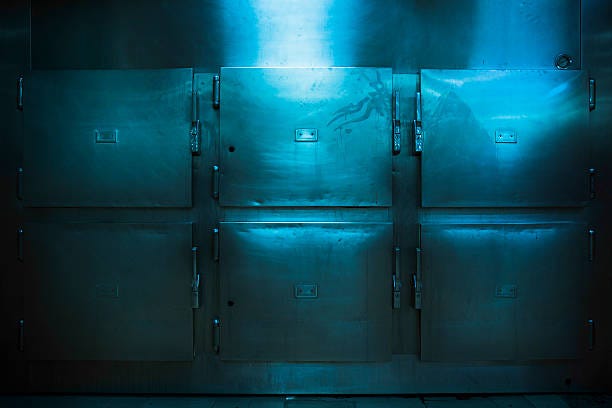
At the pathology lab, I had the opportunity to see up close bodies in various stages of decomposition. I wasn’t allowed to work on those bodies because I didn’t have the proper training and it was crucial that an exact time and cause of death were determined. I was allowed to watch the whole process though. The smell was terrible but I was grateful to be there.
The people who were moving the bodies around in all the labs were very tall (at least, very tall compared to me) men. One of them, Mr. Lukáš, would joke about his appearance a lot and said that he had accidentally scared several students over the years. He was at least 1.90 m (6'3"), rather large, and bald.
If you saw him in one of the dark hallways of the morgue, wheeling around an autopsy table (with or without a body on it), it could seem like you were in a horror movie. But Mr. Lukáš was one of the kindest and most gentle people I have ever met and he wouldn’t hurt a fly.
Pursuing other paths
After switching to Psychology, I continued working there for a while but eventually I had to stop because of my training schedule. I was sad that I had to stop, and I had spent sometime considering doing some vocational training to become a licensed autopsy assistant.
I was thrilled by the idea of being able to work in complete silence, and getting to use very cool tools that required precision. Eventually I decided that I would be more useful if I got to work with the living.
The combination of my experiences from this job and the one semester we had at a hospice for training (2nd semester of pre-med) helped me figure out that I would love to work as a psychotherapist with the terminally ill (I’ll be writing more about my experiences at the hospice another time).
During an autopsy preparation, back in 2009, I got an idea about a research project that could change the way psychotherapy works for the terminally ill. I am now on a path to make this a reality, and I’m hoping that things will go as planned.
Life lessons
1. Seeing the human body in all possible states is humbling. Additionally, spending time with the deceased helped me appreciate death as a normal part of life, and eventually demystify all aspects of it.
2. Unknowingly, I was also working through unresolved grief by doing this type of work. I realized that a few years later, while in psychotherapy.
3. I also understood that the body is just a vehicle. We have to treat it well though, so we can have a pleasant ride through life.
4. Now, there’s nothing that I find weird about the human body whether its healthy or sick. I can see the beauty and appreciate life even more. Nothing grosses me out anymore. Also, bodies do all sorts of noises even after death. There’s nothing wrong with that!
5. People working in autopsy labs and morgues might look creepy or distant, but it’s mostly because it’s the job itself that leads you to become humble and quiet. Not to say that there aren’t creepy people working in that field.
6. Don’t pass on the opportunities that come your way, no matter how much you doubt yourself!
7. Inspiration about your life can come from the most unlikely sources you could ever imagine!
Thank you for reading!