
Working as a Caregiver for the Elderly With Alzheimer’s
4 years at an Alzheimer’s and Dementia facility was rewarding, yet draining
A little backstory
In 2015, I finished all the prerequisites needed to apply to nursing school. This may seem silly but I decided that I wanted to become a nurse after watching all the seasons of Grey’s Anatomy.
I always enjoyed helping people and I thought that would be the perfect career move for me. So I went back to school in my late 30s in hopes of gaining my so-called “dream career”.
What I didn’t realize is that it is really tough to get into local, affordable nursing schools near me. Sure, you can pay 100 grand to get into a private school, but who wants to do that when you can go to a community college?
After spending over a year taking all the prerequisites, I applied with what I thought was a shoo-in application but was denied. There is a point system to get in and I wasn’t bilingual nor did I have any work experience in the health field which were things that would give me an extra point.
I applied again the following term and was denied again. So, I set out to volunteer at a local hospital for volunteer points on my next application because I didn’t want to give up after all those classes that I completed.
Once again, I was denied which was such a letdown and so disheartening. I felt as if my heart was breaking a little bit each time I was denied. I forgot to mention that I got A’s in all of my classes. But, again, I wasn’t bilingual, ex-military, or had previous work experience in the field.
Just as I was about to officially give up, a friend of mine that worked at an Alzheimer’s facility told me that they were hiring. This would be perfect to put on my application so I told her that I would love to apply.
I got the job on the spot and started a week after my interview. My feelings were mixed because I knew how difficult it was to care for someone with Alzheimer’s because I watched my grandfather go through it.
My first day on the job
As most people are on their first day, I was apprehensive and nervous.
Would I be cut out for this kind of work? Was I strong enough? Did I have enough patience?
Turns out that as a mother, you gain patience, compassion, and understanding. At least, that has been my experience.
During my interview, I met my supervisor who would be working with me daily but on my first day, I met two other caregivers and was instantly at ease because they were all so kind. I think that is another characteristic that you must embody to be a caregiver.
We referred to the seniors as clients at the facility. There were 12 clients present on my first day and the number would fluctuate depending on the day and because of different circumstances. The facility required there be one caregiver present per 3–4 clients.
This was a daily drop-off Alzheimer’s care facility to provide respite for families caring for their loved ones. People with Alzheimer's and dementia often wander and need to be watched for their own safety. I had a lot to learn because there were so many other factors that I wasn’t aware of yet.
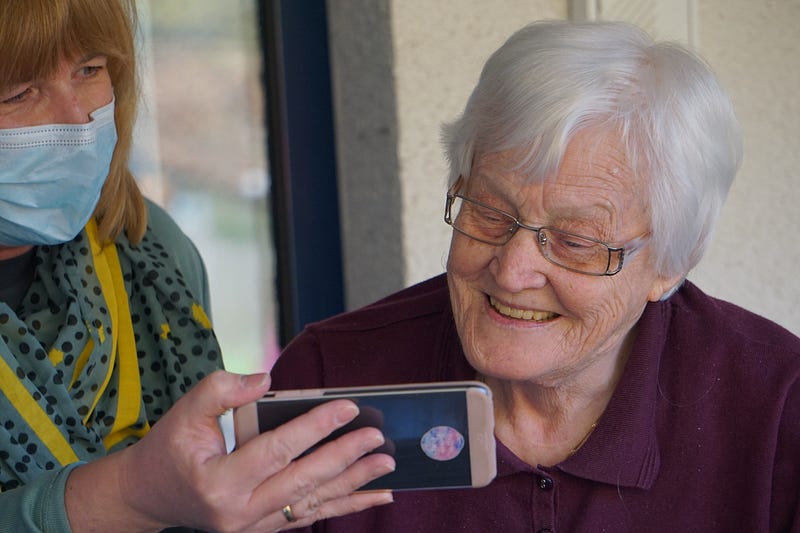
The clients all arrived at 9 am, we provided and served them breakfast, while reading them the newspaper. They enjoyed that and depending on the stage they were at in their awful disease, some would chime in with stories from their youth or observations about what we were reading.
As we were cleaning up the breakfast, Clyde walked in and the two caregivers ran to greet him and escort him through the lobby. I didn’t know what was going on but they held his hand and walked him close to me. Turns out that Clyde was suffering from macular degeneration, which is an eye disorder that caused him to slowly lose his sight.
“This is our volunteer, Clyde. He is 100 years old and has been volunteering here for the past few years after his wife, who was a client, passed away.”
Clyde went in for a hug instead of a handshake and I immediately fell in love with him. Although, I am sad to say that he passed away this year, just shy of his 105th birthday.
We became instant friends and he was so helpful and kind to the clients.
I was informed that we were to follow a schedule with the clients. After working there for a few months, the routine was self-explanatory and definitely made for a well-oiled ship.
After breakfast and news, it was time for crafts, painting, or anything creative. Using the creative part of your brain is said to slow the progression of the disease. This is because art reduces stress and the use of fine motor skills daily improves their quality of life. When a person begins to decline rapidly, they can lose their fine motor skills which result in family members having to feed their loved ones.
Side note: What I loved about this facility in regards to a traditional placement facility (one that a family member would move their loved one to permanently) was the level of care and kindness towards the clients. Many times in those permanent facilities, they are left to sit and watch tv. I visited many when my job included picking up clients for the day to come to our facility. It was really sad and I understood why the families wanted them to come for the day.
But, some families just couldn’t care for their loved ones at night, either. Many would wake up and leave the house, wandering the streets in the middle of the night. That can be hard on the family members, especially when they have many other things on their plates like work and children.
After crafts or painting and lunch, the clients would need some downtime. Some would take a nap in one of the recliners that we had and some would watch a short video.
I was inspired to write this and reminisce after I read Pam Winter’s article about these realistic baby dolls.
I recalled a few clients that would rock their baby dolls, especially when they started getting frustrated. We learned that a baby doll would instantly change their mood.
One of these clients remembered everything from her youth until about 40 years old. After that, her memory was blank and her short-term memory was non-existent.
It’s crazy how the mind works. When she would rock the baby, she would tell us the stories of her kids. That followed the stories of her growing up in Sweden, speaking every other sentence in Swedish. I loved her so much and still communicate with her daughter asking how she is doing.
After relaxing, their favorite time rolled around. We would sing all the old war songs from the 30s and 40s, patriotic songs, oldies from the 50s and 60s, and even some silly nursery rhymes. What took me by surprise when I first started working there was the fact that almost everyone remembered all the words to every song.

Even the clients that didn’t speak and couldn’t remember something that happened two minutes prior, knew every word of the lyrics.
I marveled at that and soon came to find out that key brain areas that remember songs are undamaged by the disease. Fascinating, right?
Simple stretching and a game or two followed our musical party leaning us towards the end of the day when their family members would come to pick them up.
This just scratches the surface of what happened at the facility.
The downside to caregiving
So much of the job was rewarding although dealing with this disease on a daily basis can be tiring and depressing. I came to fall in love with so many of the clients that ended up passing away. Others declined so rapidly and couldn’t feed themselves or had a hard time going to the bathroom… or both.
I had many unwanted bodily fluids on me and some of the larger men fall down, which was challenging to get them back up. I’m only 5’3 so picking up a 6 foot 200-pound man was tough.
Many of the clients turned ornery when they got agitated, wanting to slap me, spit, and run out of the door and I had to remind myself that it is the disease. It wasn’t me.
That is where the extreme patience would step in, leaving me mentally and physically exhausted at the end of the day. So, when Covid hit, I was already dreaming of a break and gladly accepted what we thought would be two weeks off. The facility didn’t open again for another year but for 6 months in 2021, I did home care for one of the clients. That was a struggle in itself, too.
He was eventually placed in a full-time home and I decided to not go back to caregiving and thankfully found writing, turning down the offer to come back to the facility.
My time there was valuable, I feel like I made a difference in some of their lives and definitely the family's lives. I will forever treasure my relationships with my awesome co-workers and my special friends, the clients.
Many have passed away since and I am grateful that I am remembered enough to be informed.
But you might be asking, what about nursing school?
I decided not to apply again because, in my mind, I found my dream career as a caregiver. That remained true for 4 years but as life changes, so do we.
Another inspiration for this article came from Iva Ursano. Check out her article here:
If you liked my story, become a member and subscribe to Medium to read all you want each month, including my articles. If you use my subscription link, I will receive a small commission at no extra cost to you.
Thanks for reading!
Much love, Michele