Workaholism — An Antidepressant Or A Temporary Bandage
Love to work or work to love.

My parents are one of the most organized people in this world. Their house is like a 5-star hotel. All the places are meticulously designed and have a purpose. On the other hand, I am a complete nightmare. My house is a constant mess. Every morning, I have to go on a treasure hunt for keys, wallets, etc., before I can leave for the day.
My father always jokes about my house management skills. My excuse is that I don’t have much time. Even though it’s true, the harsh reality is that it’s not a priority. My professional and intellectual world overpowers these supposedly mundane things like managing or organizing my house. Why is that?
How did it start? Am I, Workaholic?
I grew up in a middle-class Indian family, witnessing my parents working their backsides off to create a life of substance. They earnt respect and acceptance from society, and my little brain registered all of this. Indians take pride in romanticizing hard work, and I don’t blame them. After all, we come from a country where anxiety is an ordinary person’s GOD gift.
I followed in my parent’s footsteps and worked very hard on my education and career. Although it paid dividends, this approach did a lot of psychological damage.
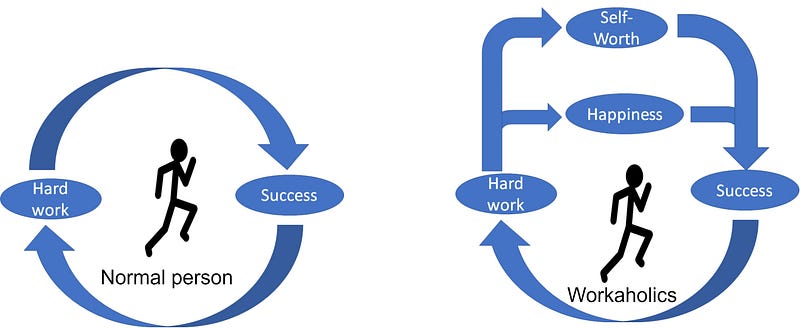
There was an apparent association between hard work and success. The damage started when I began associating hard work with happiness and self-worth. The number of hours at work drove my happiness quotient. Any professional victory on the way will work as a confirmation that I am on the right track.
It becomes an addiction whenever we depend on something to drive pleasure in our lives. I started this section with a question — “Am I a workaholic?”. I think you know the answer.
Problems With Workaholism — Diagnosis
Primarily, there are two kinds of addictions — physical & psychological.
If your body is dependent on any particular substance, it’s a physical addiction — for example — Alcohol, Cigarettes, or prescription painkillers. Symptoms of physical addictions are on the surface and easy to diagnose. For example, one can diagnose alcoholism based on the number of daily drinks.
On the other hand, psychological addictions are mental, such as gaming, shopping, sex, or overeating. Addiction is to an emotion rather than a substance. They are harder to diagnose but are never encouraged by society.
Workaholism comes under the umbrella of psychological addiction. Since our society has a history of romanticizing hard work, addicts get praise and acknowledgment, making it one of the most challenging addictions to diagnose.
Burnout Syndrome

Workaholism brings short-term benefits. They get shit done and are corporate favorites. It does bring financial stability, and people put you on a pedestal. After achieving any goal, workaholics will always look for something bigger, something brighter.
As the expectations increase, workaholics can’t extract the same amount of happiness with every project. It increases frustration, and since the only answer to every problem is hard work, they increase the number of hours, hoping that happiness will follow.
It’s a never-ending cycle, and there comes a stage where the results do not meet expectations. Stress at work increases at a non-manageable level, leading to Burnout syndrome. It’s a stage where your productivity decreases exponentially. Occupational depression is the symptom of burnout syndrome.
If you see yourself constantly complaining about work-life balance or work satisfaction, ask yourself? Are you suffering from burnout syndrome?
The role of Oxytocin
Being an engineer, I wanted to find a logical reason for Burnout syndrome. My research led me to a TED talk by Mina Intanate, who referred to the love hormone Oxytocin.
Oxytocin plays a role in social bonding, reproduction, childbirth, and the period after delivery. It is released into the bloodstream as a hormone in response to sexual activity and during labor. Interestingly, stress triggers the release of Oxytocin. During stress, our body looks out for support and care from loved ones due to the release of Oxytocin.
Workaholics live in isolation. Their social circle is primarily workmates. The body demands love but work hours come in the way. As they dive into the ocean of their work, passion, and ambitions, the craving for love and care increases, and the reason behind this is the hormone Oxytocin.
Conclusion
I started this article with, “Love to work or work to love.” Ask yourself this question when you are slogging through never-ending meetings and emails? Is it worth it? What purpose is it solving?
I was lucky to identify the issue at an early stage. One company unofficially forced me to leave, and I realized that I was deep into Burnout Syndrome. There was nothing wrong with the organization. They tried helping me out in different ways, but I didn’t leave them with a choice. My performance wasn’t excellent, and I was missing deadlines after deadlines.
I became a workaholic to heal from an abusive relationship. Work gives you instant gratification and works perfectly as a temporary bandage. I call myself lucky because I had tremendous family support, and I was willing to work on myself. What about you?
Act before it’s too late.
P.S — Medium is an excellent platform to read, write and learn from fellow authors. If you want to join this journey, Join medium today.


