
🙏🏼 chosen for further distribution
Making Poets Out Of Poverty
Words, Not Walls
DYSPLA Founder, Lennie Varvarides speaks on why poetry is urgently needed in areas of high deprivation
Before you begin reading this post, let me say that I am not an Education Specialist — but I am an expert on how society and schools fail people with Learning Differences through the work I do at DYSPLA. I identify as Working Class and my 7-year-old child attends a school in an area of high deprivation. My Cypriot parents’ childhood, was also one of ‘absolute poverty’, so these themes are extremely important to me.
Charles Dickens’ much-loved novels illustrate a Victorian world where poverty and poor literacy go hand in hand, and for many, not enough has changed in the last 120 years. Victorian England will still look familiar in 2022, with child poverty predicted to rise to 5.2 million hungry children in the United Kingdom. These figures were reported by the UK Government’s Social Mobility Commission.
Being poor is still met with prejudice and disdain; being poor still means you are underperforming or dropping out of school, being poor still means living in areas of high-level deprivation, pollution, and with no access to cultural engagement. More harrowing, being poor means being hungry. The growth of which has been evident in the UK since 2000, when the first Food Bank was established by the Trussell Trust Network. Being poor does not, however, mean, being out of work. Two-thirds of children in poverty have either one or both parents in employment as reported by The Joseph Rowntree Foundation.
Hunger directly determines the ability to learn. Being hungry means you cannot focus, you cannot concentrate and your brain cannot develop properly due to malnutrition. The Pandemic has also made things much worse for families already affected by over 10 years of aggressive British austerity policy. Policies that are intended to destroy the welfare state and devastate funding for the NHS, Education, and the Arts.
Being poor reduces children's opportunities for a good and varied education and since 2010, under a Tory Government, schools have reported an ongoing and ever-increasing absence of arts provisions and art education as reported by The Fabian Society.
Cultural experience and arts education has historically been portrayed as a luxury. But what if that perception is a designed concept? Presenting art and artistic experience as a luxury not fit for the poor is a political act against all society. It is also an obvious classist attack, intended to starve not only spending on education, libraries, arts, and culture but also to reduce a sense of one's self-worth and confidence.
That is the long-term consequence of defunding arts education in state schools and in the community with the closure of libraries, early learning centres, youth clubs…It is all an ongoing social attack by the Tories intended to destroy morale and hinder critical and collective thinking among the proletarians.
In 2019, it was reported that 1,440,788 children needed Free School Meals, and this rise also correlates with the increase of children’s low attainment levels, echoing loudly how the two go together. In 2020, my daughter’s primary school was reported to have 44.7% of students on free school meals which is extremely high, nationally the figures are only 23%. However, I do live in Enfield, a borough in North London England, ranked in 2017 as the top 25% of the most deprived areas to live in. Today, Enfield is listed as the 11th worst borough for child poverty.
Child poverty hit a record high shortly before the Covid-19 crisis, rising by 200,000 kids — or 15 percent — to 4.3 million overall, before more families were pushed into hardship by pandemic-driven redundancies, income cuts and increasing living costs. — Hannah Westwater
Maybe people reading this might not consider Britain a poor country, how can it be when it is the 6th richest country in the world? Well, the 2020 median household income for the UK was reported as only being £29,900 and 60% of the British population make below that national average. That means 15 million people are living in poverty. Our great big rich old country is failing its citizens and as we surge into another devastating financial crisis, many of us will be lost in a sea of more debt, uncertainty, bad health, poor education, and increased pollution.
The Tory Government claims that the only way out of poverty is education while legislating against education and against the Working-Classes. They do not believe in “Levelling Up”, they believe in ring-fencing their own privilege. Let’s not forget that it was their government that historically stopped providing milk for all primary school children, retracted school lunch nutrition requirements, and more recently were willing to cut Free School Meals altogether during the Pandemic, creating an easy ride for their cronies to profit from the inadequate food parcel scandals.
‘As a result of the COVID-19 crisis, the most deprived pupils are not only more likely to be behind in their learning, but their families are also at greater risk of poverty, food insecurity, and job losses. This could further entrench the disadvantage these children face. …it is, therefore, crucial that schools in deprived areas receive adequate and well-directed funding so that they can help to close the disadvantage gap and ensure all children can reach their potential.’ Josh Hillman, Director of Education at the Nuffield Foundation.
But the funding for schools isn't coming — why would the Government fund something they have legislated to cut? History has shown us over and over again that a Conservative Government cares little for state education and even less for disabled and Neurodivergent children.
My daughter's primary school is a microcosm of where we live, our local community, and surrounding areas. It is a snapshot of what London looks like on the edges. The school has a predominant intake of Working-Class children, children whose mother tongue is not English, and they support the highest number of special educational needs and disabilities (SEND) students. This school was also the first choice. All the other schools close by had been turned into Academies which have a reputation of treating disabled and emotionally challenged children terribly. My daughter is very happy here, she loves going to school, she loves playing with her friends, and she feels very loved by her teachers.
Of course, I wish she was getting a better education and by better I mean, a more robust creative education — but school budget cuts and ever-growing pressure of tracking ‘output’, leave no room for my wants. Art, after all, is a luxury that is placed wrongly at the bottom of the priority list. Not ranked as important or relevant enough by this Government to even ‘grade’ in an Ofsted Report. Lobbying the teachers will not help, especially after the disruptions to education caused by the Pandemic. With no budget or incentive to run arts education, it is impossible for primary school children, especially schools like my daughters, to experience the benefits of creative education unless it is ‘donated in’.
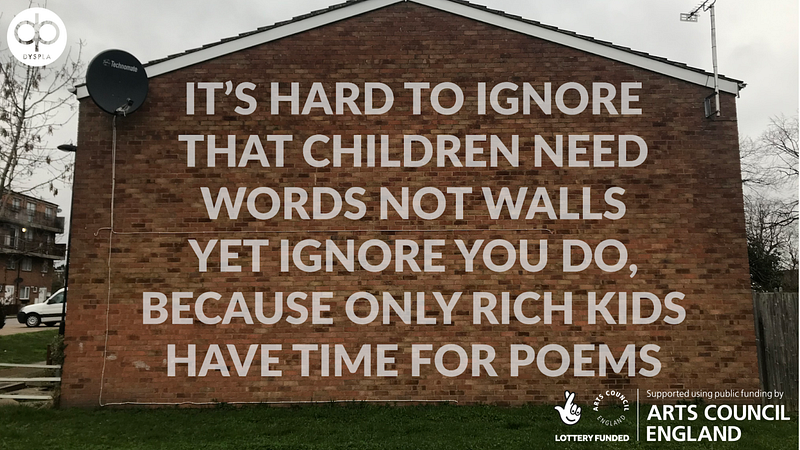
So, that's what we did, we donated an art project to our daughter's school! As artists, we took stock of our own resources and made a successful Art Council England application to run a series of six poetry workshops about the value of art and poetry among working-class children. The most promising poems will be selected for public display on buildings around Enfield. The exhibition is an attempt to highlight England’s cultural apartheid’ and shine a light on the necessity of creativity in schools.
Words Not Wall — Putting working-class children’s creativity into public view.
Words Not Walls is designed to counteract the lack of creative writing opportunities among working-class children and to bring poetry into the classroom as a form of positive self-expression, agency, and activism. The project and exhibition will not only prove to be thought-provoking, but it will also turn the wrong side of Enfield, into a public art destination.
Every time a child or any member of the public passes by the art work, they will be compelled to engage with the work through the act of reading.
Take Away
Read So You Can Become Words. Write and live forever.
Words, Not Walls is designed to explore and develop the children’s own poetic voice and inspire a curiosity for reading poetry. The project will also be an introduction to writing poetry, the first experience of it for many of the children we will be working with.
Art, poetry, theatre, music, may never be seen as equal to the 3R’s because we live in a society that values profit, not people; but when society learns to value personal growth, expression, communication, environment, collectivism, and activism as the pillars of a coherent community, and we have the courage to teach our children those same values, and the confidence to vote for representatives who share these values, we might all have a chance at this thing called life.
Imagine it, working-class children taught not only how to read, but how to value and enjoy the physical act of reading.
We hope, Words, Not Walls will instil a sense of self and pride only achieved when one sees themselves in their environment. Publishing their poems and presenting them publicly, will go a long way to instil confidence. After all, where does confidence truly come from, if not from self-expression, encouragement, and success? Take away stress and hunger and children are able to become successful learners.
Gavin Williamson is wrong! England’s Education Secretary thinks children need more “discipline and order” after Lockdown, but I disagree. Children need poetry, not more policy.
I truly believe poetry has the power to improve literacy and the Words Not Walls project will be our testament to this. We hope it will go some way in turning a poor reader, perhaps the kind who might be labeled as a ‘problem child’, into a confident and creative learner.
Empowering working-class children to write poetry is a form of rebellion, after all, the pen is mightier than the sword and when the working classes use their voice, society radically progresses forward.
© Lennie Varvarides, April 2021
More Information: Words Not Walls, is a series of short-form poetry that will be printed on the facade of buildings, on shopfront windows, on notice boards, school gates, and anywhere else we can get our hands-on as part of a public art display. The work will be facilitated and curated by DYSPLA, who will commission local artist SHAY-PRESS to design the typography and install the artwork written by children. The poems will also be made available online as well as through Augmented Reality Technology. The public exhibition will launch in Enfield during the Summer of 2021 with the support of Arts Council England, Honilands Primary School, Enfield Council, and the local MP, Feryal Clark.
A bit about me: I am an Award-Winning Neurodivergent artist and founder of DYSPLA, an Arts organization predominantly working with British Neurodivergent (ND) Artists, Writers, and Directors, to develop their ideas and confidence. Neurodivergent people’s self-esteem is much damaged due to their traumatic time at school. For most dyslexics, their earliest memory of school is their first experience of being an Outsider. If you identify as Neurodivergent and would like to connect, please leave a comment or follow us on Instagram, Twitter, or Facebook.
Connect with DYSPLA Subscribe to our Newsletters Instagram: @Dyspla_festival Twitter: @DYSPLA_Festival Facebook: @DysplaFestival Linkedin: DYSPLA Medium: @lennievarvarides Substack: @dyspla.substack Podcast: DYSPLA Website: Dyspla.com Email: lennie at dyspla dot com