
WOMEN’S HISTORY MONTH
Words, Food, and Love: How Maya Angelou Conquered The World
The tricks and quirks behind one of the most complex women in history
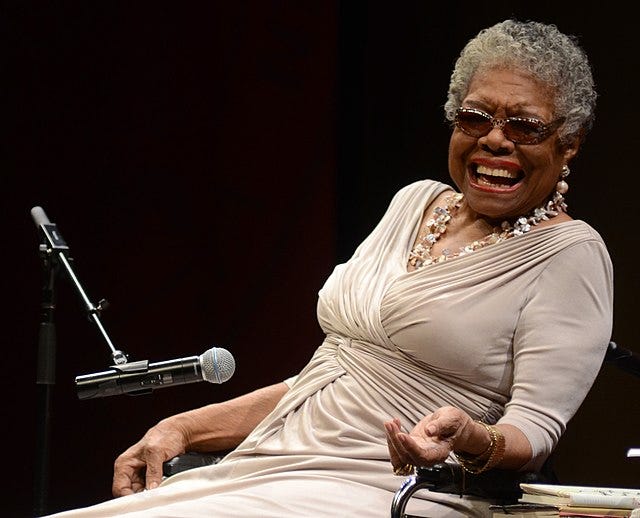

Have you noticed how some people are just different than us mortals? How they are larger than life, and when they walk into a room the world stands still?
Some of these people end up on stage, where they belong, to inspire the world toward a better life. Others toil away in their home kitchen and do their part by feeding their dear ones with love and stews.
Maya Angelou did them both.
Hotels are for writing and eggs are best for dinner
If you’ve ever watched one of the videos of her on stage, you’ll notice her presence is oddly quieting, satisfying by its very existence. She smiles and it seems like the sun came up. It’s suddenly warm and you want to be there, basking in her light.
That was my first thought about Maya: she’s just a woman, but she walks like she can command an army and she sits like a pharaoh.
Of course, Maya did none of that.
What she did was love the world.
She put herself out there and embraced it with every touch of pen on paper.
Or every drop of soup that dripped off her magic spoon.
Yes, Maya was also a cook. A good one, a passionate one. A cook who wrote two recipe books that remain hidden amidst the rest of her work: Hallelujah! The Welcome Table and Great Food, All Day Long.
Just like with the rest of her life, Maya believed the best way to go about food was to ignore the rules. She believed in slow natural cooking, in savoring every moment, just like she believed in slow poetry and concentrated explosions of taste and words.
“You can eat anything at any time,” she says. “Who made the rule that you have to have eggs in the morning, and steak at night?”
I suppose the same people who believe you need to be at a desk to write. Maya didn’t stop at such roadblocks. She marched forward, carving her own path.
She used to write in hotel rooms she rented for months on end in the same city where she lived. She would write lying on her side on a made-up bed that the hotel staff were not allowed to change.
Why would they, Maya thought. She would never get under the covers. She didn’t go there to sleep, or even get into bed. She was there to lock herself away from the world and give herself to her craft.
She wrote for hours on yellow lawyer pads, with the assistance of a dictionary, a Bible, cigarettes, and a bottle of sherry. There could be no distractions, not even the art on the walls. The first thing Maya did when she entered the room was to take the paintings down and proceed to write.
It was a ritual she respected religiously, like a magic abracadabra that put her in a parallel dimension: a zone she needed to extract words and phrases from. Tools to love the world with.
She knew the rules and found them limiting.
She would have her sherry before 11 AM and her creative ideas at about the same time. In the afternoon, she edited the pages she wrote to about half. She distilled them into pure essence and made them sing.
When I first heard Maya Angelou recite a poem, I broke down in tears. I had no idea she had previously won Grammys for such a performance.
“We had him,” she said… “We had him whether we know who he was or did not know, he was ours and we were his. We had him, beautiful, delighting our eyes…”
It was a poem she wrote especially at the passing of one of history’s greatest, most controversial entertainers. Her voice, the deep and low cadence of her words, and the musicality of her poems opened up a whole new world. The world of Maya. And it was vast.
Maya managed to “mumble around in about seven or eight languages,” she said. She also mumbled around in a myriad of fields. She was a singer, storyteller, activist, poet, cook, mother, and at one brief moment in her life, a pimp.
She tried everything that crossed her mind and excelled at most.
Despite everything: the dark and oppressive childhood, the rampant racism, her dysfunctional family, the rape, and early motherhood, Maya still rose.
She was a complex artist and an intricate human who dominated the room. The theatre. Life. The world.
All cable cars go to Europe
More than a writer, Maya was a performer who captivated audiences and hypnotized them into a trance through her words and movements.
She earned a dance and drama scholarship at California Labor School. She was a singer. She was a dancer. She was offered the lead role in a Broadway production of House of Flowers. She turned it down to join a touring company for Porgy and Bess.
She wanted to see Europe. She wanted the chance to see places she wouldn’t ordinarily see and do things she once only dreamed of. Maya said it was one of the best decisions she ever made.
Her decisions to break the rules and make her own path also made her the first black woman to conduct a cable car in San Francisco, although she briefly had to quit her dance studies.
“I saw women on the street cars with their little changer belts,” Maya explained to Oprah Winfrey. “They had caps with bibs on them and form-fitting jackets. I loved their uniforms. I said, ‘that is the job I want.’”
She wanted it and she got it. Maya had no problem going after her dreams even if her dream at the time might have conflicted with another, previous dream.
When a new dream came along, Maya went after it. Right until the very last day.
“What would you like carved onto your tombstone?” a reporter asked her.
Maya laughed.
“I did my best, I hope you do the same.”

For more stories about magnificent women, follow Fourth Wave. Have you got a story or poem that focuses on women or other disempowered groups? Submit to the Wave!