
Wordless in Malta
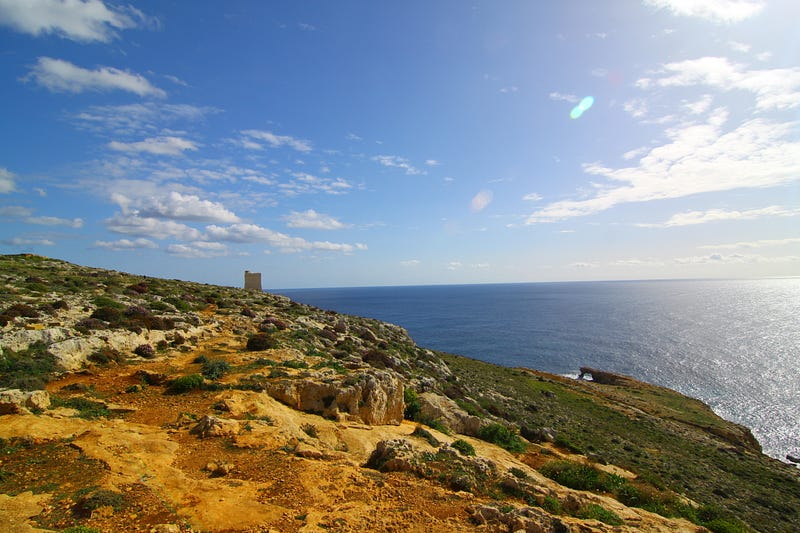
I didn’t write a word in Valletta.
Not as we watched the sun sink like a sentence handed down, perched on top of the thick stone walls that have cradled the tiny city since the 1500s. Not when we wandered among the temples, some of the oldest buildings on earth, perched on cliffs above the dazzling sea. Not even when the fading light made the glass of the colourful closed balconies on every building, the gallariji, shine like smiling eyes.
It was winter in Malta, but winter in Europe’s sunniest city is a fine thing. In a city like Valletta, built on a single hill threaded through with steep stone stairs, a visit in the summer heat could easily become a trial. The swimming is great in Malta, I’m told, but we weren’t swimming in February.
Instead, we went to see the temples. Hagar Qim was founded over 5000 years ago, when the pyramids weren’t even thought of, and mammoths hadn’t yet gone extinct. Under glass in Valletta’s Archaeological Museum, the carved statues and artifacts of these enigmatic sites yield few answers. They are so old that the years no longer touch them.
Malta’s a unique place.
And it’s not just the prehistoric ruins that make it that way. The succession of foreign occupiers of the tiny nation is a poem on the rise and fall of empires. From Carthage to Rome, to Arabs to Normans, to the Spanish, the French, and the British. On the wall near our hotel, where we got upgraded to a suite for no particular reason, a painted sign proclaimed the location of a vanished victory kitchen, a community kitchen designed to help rationed food stretch further during World War II. The Maltese still speak English, but not among themselves. The Maltese language is as unique as everything else about the tiny island nation. It’s the only Semitic language in Europe, descended from extinct Sicilian Arabic. And these days, plenty of Maltese residents speak Italian just as readily. It could be the weather or the scenery or the religion, but Malta feels Italian. Like some alternate universe where Italy was ruled by the British. That might be reason enough to visit by itself.
But I didn’t write a word.
“Are you going to see the Michelangelos?” the dark-eyed hotel receptionist asked us as we checked in. She was talking about the other Michelangelo, Merisi, better known to history as Caravaggio. The painter fled Malta with a bounty on his head, but two of his works still hang in the ornate Co-Cathedral where we duly paid to get in. After the garish gold and Mannerist fluff of the rest of the cathedral, Caravaggio’s gloomy and sparse Beheading Of St. John the Baptist is all the more striking. The massive painting is mostly black, its subjects frozen in the midst of a murder, with blood still gushing from the fallen Saint’s neck and two onlookers watching through a barred window. The audience drawn into the masterpiece, no longer removed but now complicit, a 400-year-old crack in the glass between that world and this.
And still, I didn’t write a word.
Not in the church. Not in the cobbled streets and narrow alleyways, nor at a café table where waiters bustled past with coffees and beers and pastizzi, the delicious pastries filled with spiced peas that I’ve been missing ever since we left the island.
Malta is not like anywhere else. And perhaps it’s a shame that a large portion of its visitors come purely for the warm weather and warm water, and ignore the strange and rich culture of this ancient island. Or maybe not. We all enjoy what we enjoy, and there’s nothing that makes an appreciation of art history inherently superior to a nice swim. Malta’s history, its language, its amazing 30 cent pastries, its city-built shelters for the army of feral cats that patrol the stony streets — it’s all unique, and it’s all beautiful. And I was too busy taking it all in to record any of it.
And now that a full year has come and gone between Malta and me, now that a sea far wider than the Mediterranean has been crossed and the sun no longer shines, what I keep closest from Malta is not all the things I enjoyed there and didn’t write about. It’s this:
Even in Malta, it rains sometimes. Caught out by a sudden shower that made a slick mirror of the pavement, we dashed through the open iron gate of a tiny courtyard between tall buildings. And stood transfixed, heedless of the cool raindrops spilling down on our heads. A single tree in the courtyard was full of sparrows. And every single bird was singing as though its tiny heart might burst with joy.

This story is published in Writers on the Run. If you’re interested in submitting your travel stories please visit our submission guidelines.


