
Wooing the Fates: An Imaginary Conversation
Kary B. Mullis talks to his driving companion about discovering PCR
The following is an imaginary conversation between two real people about the discovery of the polymerase chain reaction or PCR — a technology that has changed the course of biology, medicine, and biotechnology, and given us the means to detect COVID infections.
The conversation…
I got it! I got it!! Jenn, I got it!
The car swerves sinusoidally across the mountain road as Kary excitedly bangs his fists on the steering wheel. The headlights pan across the redwoods around them like torches nervously seeking monsters under the bed or deep within a cave.
His girlfriend, Jennifer Barnett, wakes up and grabs the armrests. What’s wrong, what have you got?
I know how to amplify DNA! I can make buckets of it, it’s a chain reaction!! Wooooo!
Settle down or you’re going to get us killed! Are you high again?
It is 1983 and Kary B. Mullis, Ph.D. is an extraordinary biochemist and research director at one of the first biotechnology companies in the US, a company called Cetus Corporation which makes short synthetic pieces of DNA.
Mullis successfully optimized making these short DNAs. It was now so easy and efficient that his staff of smart, skilled Ph.D. chemists (and Mullis himself) had too much time on their hands. He was worried about the company slashing his staff, so he looked for new ways to use oligonucleotides, as the short DNA molecules were called. He sought new applications to boost demand for his oligos.
I only took one hit of acid, Jenn, so I’m fine and the ideas blazing across the inside of my skull are brilliant and connected and perfectly formed, it’s like watching a laser show inside a planetarium in here. I wish you could join me in my head!
Jennifer looks over at Kary dubiously.
Look, Jenn, biologists all over the world are trying to decipher the language of DNA and the genes within… oh look up in the redwoods, way up high, you can see the genes! They’re like Christmas lights scattered along a string of DNA. Ain’t it beautiful?
They were driving on California’s US 101 heading to Mendocino, to his unfinished cabin among the redwoods. Kary peers up at the phantasms high in the branches, threatening to strew pieces of their car and their bodies among the giant trees. So Jennifer says. Perhaps, Kary thinks, the psychedelic chemicals in his body will be taken up by the trees and they‘ll see the same lights strung between their outstretched limbs and they’ll sway ecstatically to the harmony of DNA.
Can I sing you a song, Jenn? Kary starts without waiting for an answer, off-key but enthusiastic:
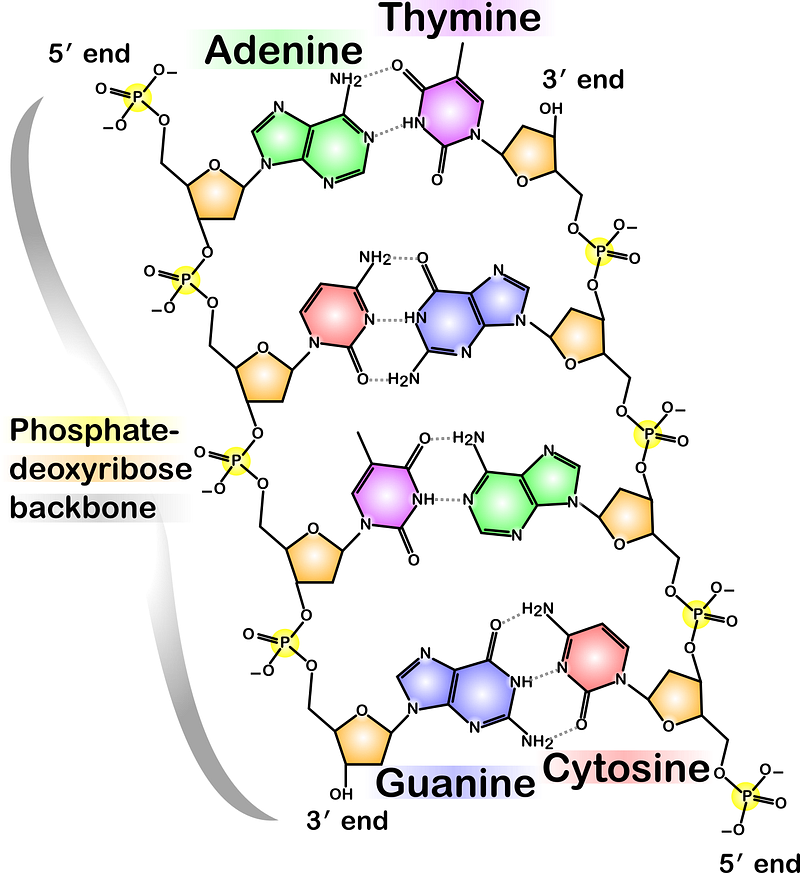
A is for adenine. T is for thymine. C is for cytosine. G is for guanine.
These are the letters of our DNA code! Any three letters spell an amino acid And a chain of amino acids makes a protein And all those together make us human beans!
Wooo! Wooo wooooo!
DNA is a long string of letters, An alphabet made of just As, Ts, Gs, and Cs! Misspell that code and you’ve got a disease!
DNA’s two strands come wrapped up in a helix The code in one strand has a complement Because A binds to T And G binds to C
Wooo! Wooo wooooo!
Kary’s warbling peters out after the last woooo drains his breath like water spiraling down a drain, and he coughs fitfully to end the aria.
Jennifer settles her head down and closes her eyes, bracing for a long evening of Kary’s kaleidoscopic nonsense. Suddenly he straightens up and addresses her. His song was factually correct within the distorted reality spinning about him, and his ability to speak lucidly is like a waking dream.
Look, Jenn, we need to find new uses for our oligos, and we know that our short DNAs can bind specifically to genetic sequences, because of the complementary A-T and G-C binding. We can design our oligos to bind to specific genes and then amplify them!
Jenn sits up because Kary’s work affects her job as a chemist as well. They met in the lab when Jenn had to rescue an experiment that he, the brilliant biochemist, screwed up. Kary had a wildly creative brain, but a rather ineffective pair of hands. Jenn’s practical ingenuity at the lab bench captured Kary’s heart.
I understand specific binding, Kary, but I don’t know where your amplification nonsense comes from. You want to make many copies of a specific gene or segment of DNA, right? But how does your short-DNA binding help amplify the longer DNA?
To Jenn’s dismay, Kary starts yodeling uncontrollably again:
At the heart of all cells from bacteria to man Are coils and coils of DNA That spells out our Fates like the Moirai Who spin and measure and cut our life-thread And who set in our tombstones the day we all dread.
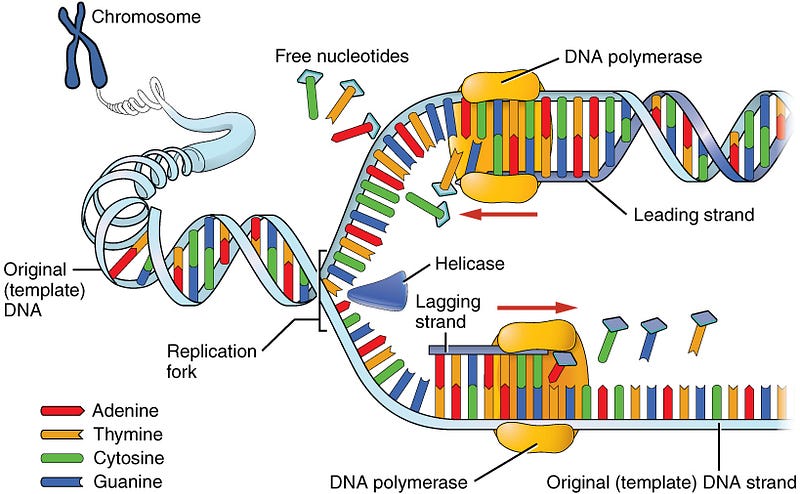
For a cell to divide the DNA must double So both daughter cells each get their own copy The scribe assigned this tremendous task Is a protein machine called a DNA polymerase Copying our genes to the end of their days
Woooo woooo…!
Where the polymerase sees an A it puts in a T Where it sees a C it puts in a G And vice versa vice versa For a strand of DNA as long as the letters are read The new strand has the complementary letter instead
For a polymerase to make a DNA copy It needs a short strand of DNA to start Where the short DNA ends, the polymerase adds The complement to whatever The long strand has as the next letter.
Woooo woooooooooo cough cough
Jennifer sits up… she thinks she understands where Kary is going. The short DNA oligonucleotides that they make at Cetus could be the primer for the polymerase pump. She queries Kary for confirmation:
Let me get this straight… The primer binds only to a specific gene area because of the complementary nature of DNA binding — this we already know. Then the polymerase reads the long strand of DNA to which the primer has bound, and extends the primer to build up a second strand of DNA. Is that right?
Kary just grins like a dog looking out a car window, its face flapping in the wind.
But Kary, you’ve only got one copy now. You haven’t really amplified DNA very much.
Kary seems to have found his preferred means of communicating scientific information, in tuneless tones trilled in a careening car:
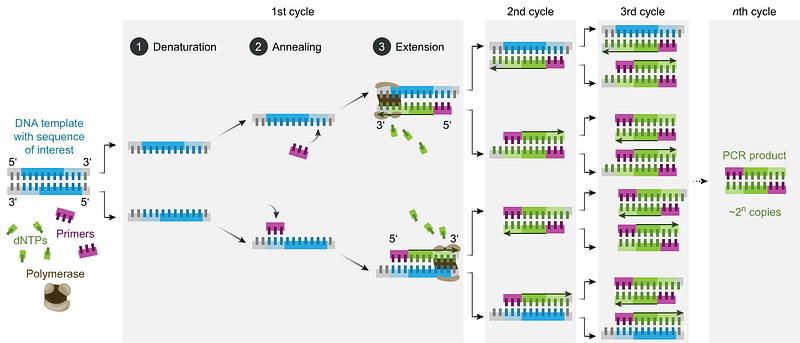
DNA’s two strands are held together Only by weak hydrogen bonds Heat them up and the two helical strings Will melt apart like a snowman in spring.
An electric shock buzzes in the back of Jennifer’s brain, a sense of recognition, perhaps the synchrony and amplification of brain waves.
So, then you repeat the DNA strand melting and the polymerase’s copying reactions, over and over? Jennifer asks.
In answer Kary hollers like a cowboy calling to his cattle on the range:
Each repeat you only double But each double compounds One becomes two, two becomes four, then eight Thirty-one doublings get you 8,388,608
Woooo woooooooooo!! cough cough!
This rapid doubling is the chain reaction that drives the amplification of DNA. Thus, the name, polymerase chain reaction, or PCR.
But wait, something’s missing, Jennifer says. She is musing over some gaps to this psychedelically revolving dialog. You want to amplify a defined DNA segment, so how….
She pauses and Kary just looks at her from the corner of his eye, an anticipatory smile prowling in the undergrowth of his face, waiting for the prey to come to a mortal realization before pouncing.
Oh my gosh, you will use a second primer. A primer for each end of the DNA segment you want to amplify! The polymerase will extend the DNA in one direction from one primer, and then after melting the DNA strands, it will extend the other strand in the opposite direction from the other primer! The polymerase extension points toward the opposing primer, so only the DNA between both primers gets amplified!
Oh yeeaaaaahhhhh oh oh oh yeeeahhhhhhh!!!!!
The energy in the car leaps up a quantum level as the two brains synchronize. Grins overlap like two photographs overlain on acetate transparencies, giggling hands shifting the faces until the teeth merge like a sun briefly peering over dusk-darkened clouds.
Jennifer the chemist with miraculous hands was already thinking through the components that this reaction would need:
A DNA polymerase stitches together As, Ts, Gs, and Cs into a long chain forming the new strand of DNA. So those letters, the raw materials for the polymerase, need to be added to the reaction, lots of them, she thought.
The specific form of those molecules that the polymerase uses has three phosphate groups appended in a chain, like a short but wickedly powerful tail. Each phosphate is like a battery that powers its own reaction and ensures that the letter connects to the growing DNA chain.
The polymerase is a key component of the reaction, as is the DNA which will be copied, and the short DNA oligos which Cetus (and Jennifer) will synthesize. The polymerase needs to operate at a certain pH and salt concentrations that mimic its conditions within the cell. All those must be added.
And, of course, this is all within an aqueous solution — it will be mostly water with tiny amounts of these various components she just enumerated. We are leathery bags of seawater, she thinks. And that is the approximate condition to replicate in a test tube to make the polymerase happy, to coax it into making millions of copies of DNA. But only the DNA between the two primers.
Jennifer falls back asleep, with molecules dancing in spiraling arrays on the screen behind her eyes.
Her dreams run hot and cold driving the reactions accordingly. She sees oceans boil and the impossibly long DNA double helix melt apart, separating like loose strands of cooked spaghetti. Then Poseidon commands the seas to cool to tropical temperatures so the short DNA primers bind to the long strings of DNA. Then, like whales sidling up to strands of fishing line, the polymerase docks to the DNA where the primer has bound. The polymerase gobbles phosphate-powered letters of the genetic code, As and Ts and Gs and Cs, swimming like tadpoles into the whale’s mouth and emerging as part of a long chain, a second DNA chain that spirals do-si-do around the first one.
Then oceans boil again and the dream recurs over and over again until the seas spill over with coiled ropes of new-made DNA.
Postscript to a life…
Jennifer and Kary spent two tumultuous years together, during which time Kary struggled to prove that his PCR process worked, and he struggled in the relationship. He probably wasn’t a nice guy. She probably did well to leave. He was heart-broken. But he got his PCR to work.
Others improved PCR dramatically, especially by discovering heat-resistant polymerase which could withstand the multiple boiling temperatures which destroyed normal proteins including normal DNA polymerase.
The magic ingredient was a bacterium that lived in the hot springs of Yellowstone National Park. Biologists Thomas Brock and Hudson Freeze named this thermophilic (heat-loving) bacterium Thermus aquaticus or Taq for short.
Taq polymerase has become famous in labs around the world for its essential role in making PCR so much easier and quicker (in Kary’s process, each repeated cycle after boiling the DNA solution required a new addition of polymerase — there were usually 30 or more cycles in the PCR process).
Kary ended up winning the 1993 Nobel Prize in Chemistry, which fueled his drug and surfing habits, as well as his globe-trotting speaking engagements with his fourth wife Nancy Cosgrove tagging along.
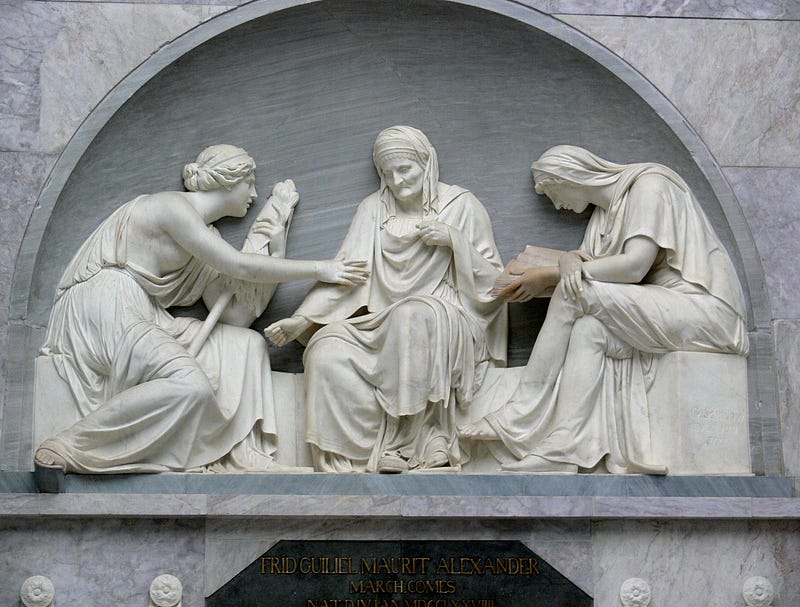
The Moirai, the three Greek goddesses we know as the Fates, defined Kary’s life as they did other mortals. Clotho spun the thread, Lachesis measured the span of thread, and Atropos wielded the dreaded shears and cut the thread of Kary’s life on August 7, 2019.
Postscript…
Since the 1980s, PCR has been used in an incredibly broad range of applications including solving crimes, cloning genes, DNA sequencing (like the human genome project), detecting diseases like COVID-19, and many more.
Thank you…
I would like to thank Christine Sander for challenging me to write about PCR more accessibly. I know there are much better and more direct ways to do this, and that I probably failed, but I enjoyed the effort. I hope you do, too, Christine, and others who have patiently suffered through my various attempts to write about science.


#/media/File:DNA_chemical_structure.svg)

