The webpage discusses the history, construction, and significance of wooden railroad bridges and trestles, including their role in early railroad development and their eventual replacement by more permanent structures.
Abstract
Wooden railroad bridges, particularly trestles, have been an integral part of railroad history, enabling rapid expansion across challenging terrains. These bridges, characterized by short spans supported by closely spaced frames called "bents," were often constructed quickly using local timber. While initially intended as temporary structures, many remained in service due to financial constraints. The page also draws parallels between the construction of wooden trestles and roller coasters, noting the strength and flexibility of wood. Personal anecdotes and historical photographs illustrate the author's fascination with these structures, including a reflection on a specific wooden truss bridge across Tunks Creek that is still in use today. The narrative concludes with a nostalgic look at model railroading and the joy it brings, invoking the author's own experiences with model trains and the memories they evoke.
Opinions
The author expresses a deep appreciation for the aesthetics and functionality of wooden railroad bridges and trestles.
There is a sense of nostalgia for the era when these structures were commonplace and for the author's personal experiences with model railroads.
The author acknowledges the practicality of wooden bridges for bridge approaches and floodways, where they do not obstruct water flow.
Despite their limited lifespan due to deterioration, the author seems to value the historical significance of timber bridges and their replacement materials, iron, steel, and concrete.
The author has a personal connection to timber bridges, having walked along and even clambered over historical bridges like the one at Tunks Creek.
The author views wooden construction, as seen in roller coasters, as providing a unique character to the ride experience, which is cherished by enthusiasts.
The author's passion for steam and timber is evident through the sharing of personal photographs and the recollection of building a logging layout with an HO scale shay locomotive.
Wooden Railroad Bridges
Always loved trestle and wooden railroad bridges.
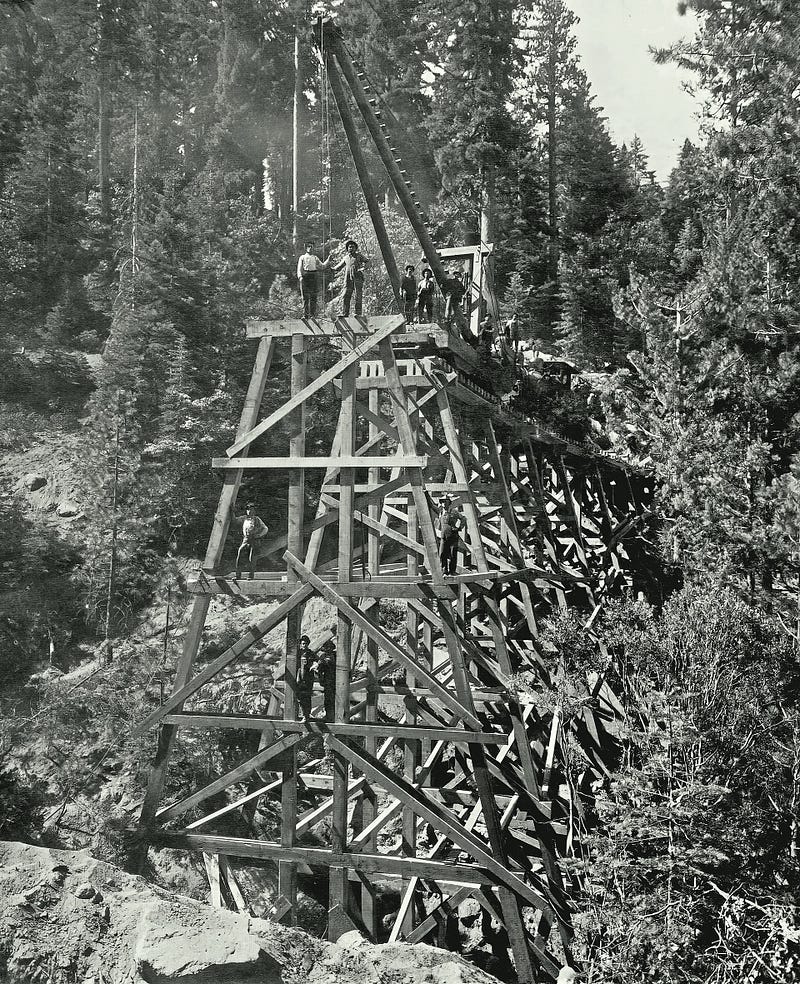
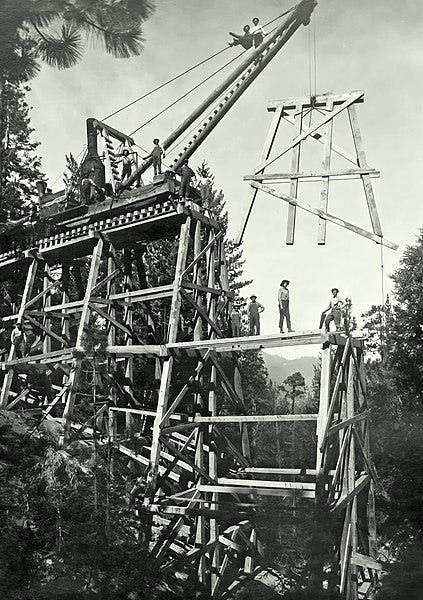
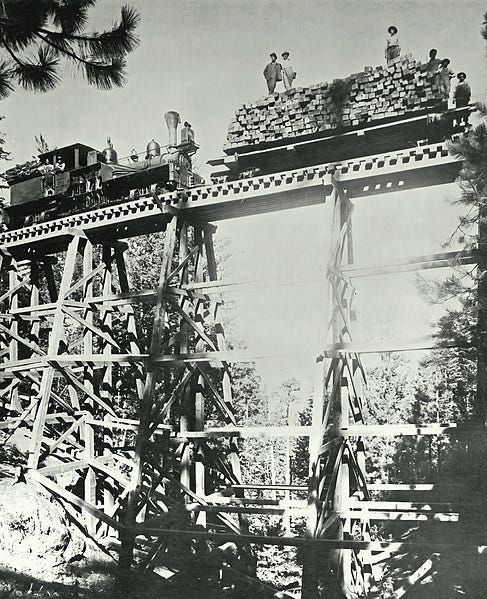
Flatbed scanned from source by Hume-Bennett Lumber Company — Johnston, Hank (1966). They Felled the Redwoods (circa 1915): A Saga of Rails and Flumes in the High Sierra. Fish Camp, California: Stauffer Publishing. ISBN 0–87046–003-X., Public Domain, https://commons.wikimedia.org/w/index.php?curid=125979249Flatbed scanned from source: Johnston, Hank (1966). Construction of a railroad trestle in present day Sequoia National Forest (circa 1915). Note typical bracing of trestle “bents”. This work is in the public domain in the United States because it was published (or registered with the U.S. Copyright Office) before January 1, 1928.
Trestle bridge composed of
short spans supported by
closely spaced frames
spans between 12 and 16 feet,
Supporting frames
called “bents” that
often consist of
4–6 vertical
cross braced posts,
Trestles differ from viaducts,
Viaducts have towers that
support long spans and
higher elevations.
Timber trestles
fast to build
using local wood,
Helped speed railroad to
get running and earning,
Once operating
railroad transported
builders and material to
replace trestles with
permanent bridges,
At least that was intention,
Sometimes replacements
delayed or never happened
because of blown budgets and
poor financial conditions.
Timber trestles great for
bridge approaches crossing
floodways where earth fill
would obstruct floodwaters,
Wooden trestles by their
nature had limited lives
due to deterioration and
often replaced by
iron and steel in
19th century and
now by concrete,
Some railroads made
forward plans for
wooden bridge replacement.
Wooden roller coasters
built similar to
trestle bridges
because they can be
strong and support high
track path while being
flexible and resilient to
imposed stresses,
Wooden construction gives
ride certain character due
to flexing and sound,
Appreciated by fans
but scares me to death,
Much to grandkid’s amusement.
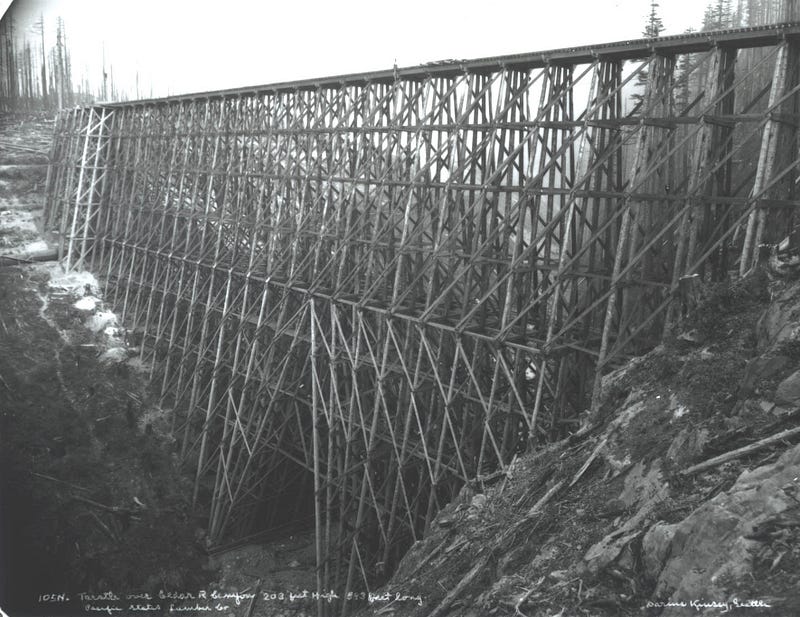
The Cedar River Logging Trestle, 203ft High and 843ft Long, Pacific States Lumber Company, near Selleck, Washington. Circa 1925. Picture by Darius Kinsey (1869–1945), Public domain, via Wikimedia Commons This work was never published prior to January 1, 2003 and, according to the provisions of 17 U.S.C., it is in the public domain in the United States because its author died before 1953.
My Link to Timber Brides
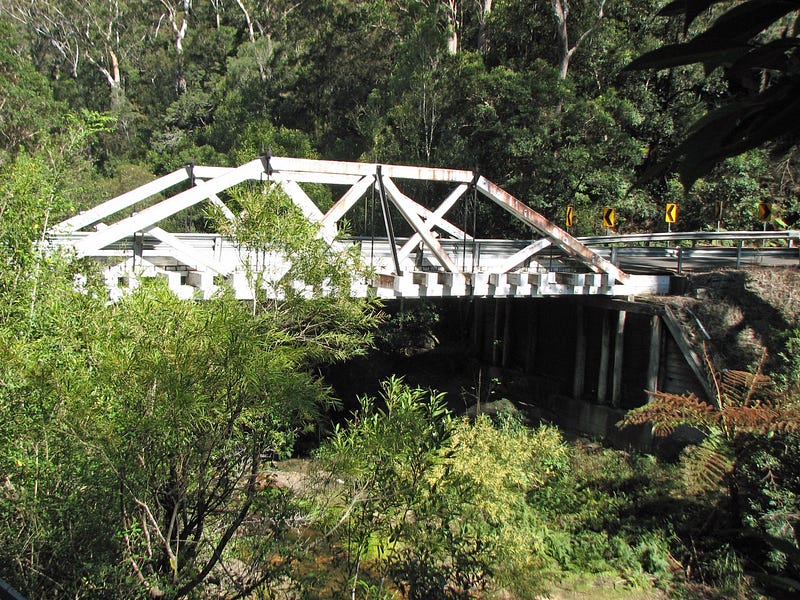
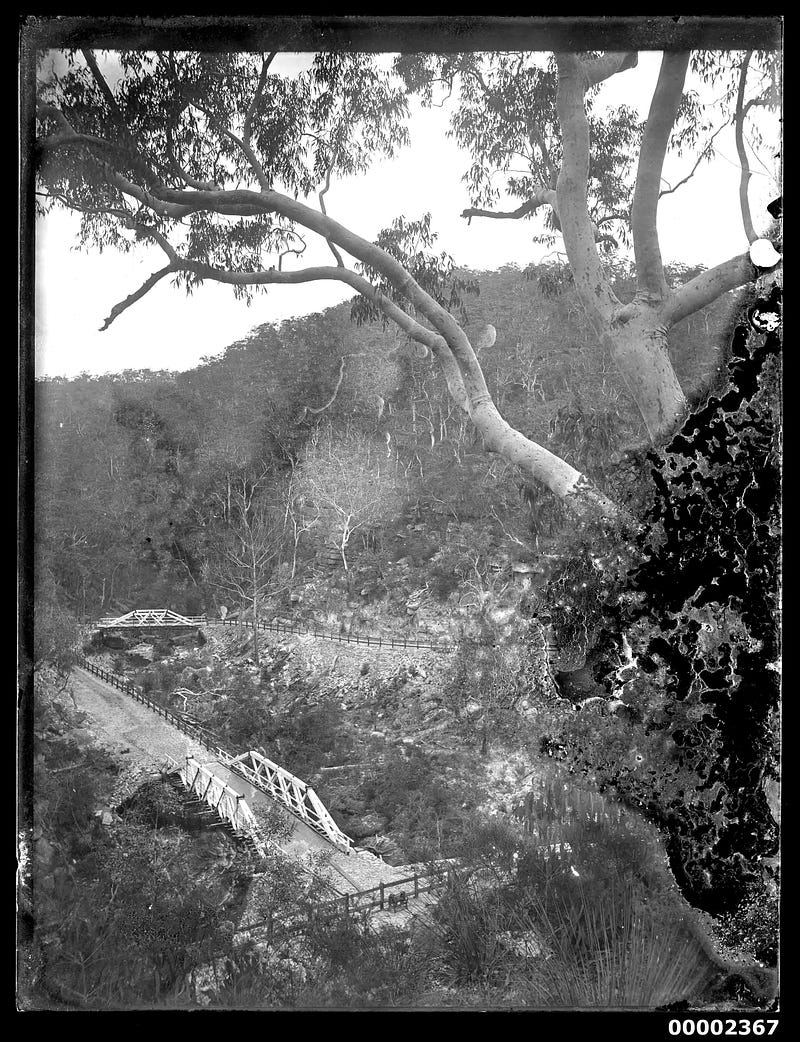
The bridge spans Tunks Creek at the bottom of Galston Gorge. The road through the gorge provides a link between Hornsby Heights and Galston, suburbs of Sydney. By Collywolly — Own work, CC BY-SA 4.0, https://commons.wikimedia.org/w/index.php?curid=72744943. licensed under the Creative CommonsAttribution-Share Alike 4.0 International license.McDonald truss bridges in Galston Gorge NSW, Australia (Near Sydney) 1894–1909. This image belongs to a series of photographs probably taken on the Hawkesbury River by William Frederick Hall between 1880 and 1909. No known copyright restrictions
Foreground timber bridge
replaced in 1930’s,
Background bridge still
carries traffic and
Drove accorss today,
Have walked
along creek and
some years ago
clambered all over it.
This wooden truss bridge
across Tunks Creek
constructed in 1893-94,
Carrying Galston Gorge Road,Bridge is 65 feet long,
Wooden plank surface.
Model Railroad days.
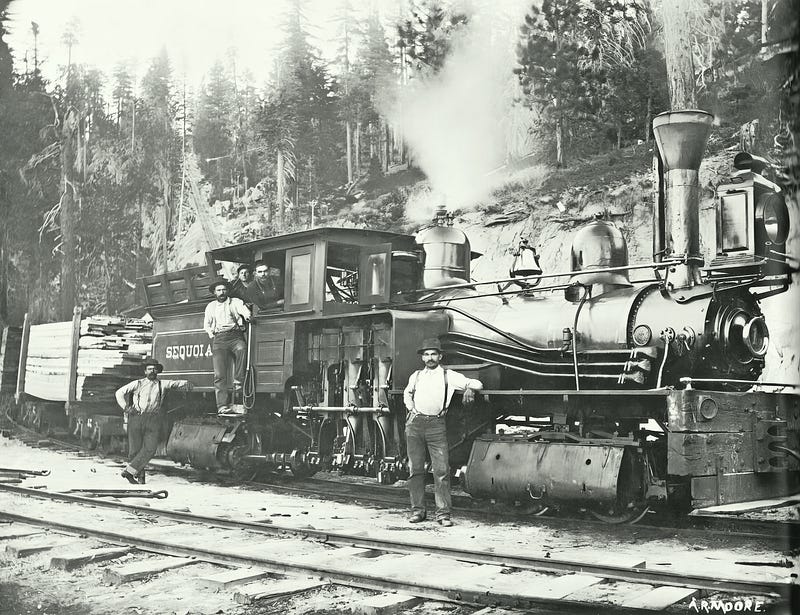
Shay locomotive on the Sequoia Railroad with a load of railroad ties (1915). Flatbed scanned from source: Johnston, Hank (1966). They Felled the Redwoods: A Saga of Rails and Flumes in the High Sierra. Fish Camp, California: Stauffer Publishing. ISBN 0–87046–003-X. This work is in the public domain in the United States because it was published (or registered with the U.S. Copyright Office) before January 1, 1928.
Going through old pictures
came across above,
Sums up love for
all things
steam and timber.
The Sequoia Railroad’s Locomotive Number One at the bottom of Hoist Ridge (1894). Dick Challacombe Collection. Flatbed scanned from source: Johnston, Hank (1966). This work is in the public domain in the United States.
Had my HO shay
fine scale brass loco,
Built logging layout
sharp curves and
steep gradients,
Watched shay hauling
hand carved model logs,
Hours of fascinating fun.
Seeing picture of
Sequoia Railroad’s
shay and trestle bridge
bought back many
happy memories,
Hope you have
enjoyed my sharing
them with you.
Blessed be.
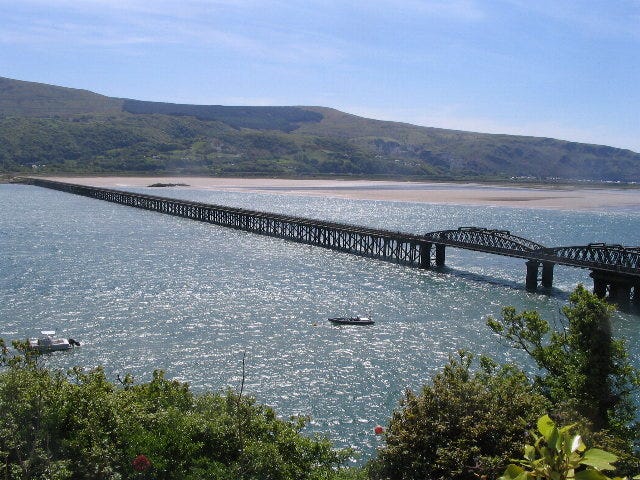
Barmouth bridge Barmouth bridge carries the Cambrian Coast railway across the Mawddach estuary. Opened in 1867, it was rebuilt in 1899 to alter the opening spans from sliding ones to the swinging span seen here at the near end of the bridge. Apart from the opening spans the bridge is a timber trestle. Plans to withdraw the Coast Line in 1971 met with organised opposition in the shape of the Cambrian Coast Line Action Group who successfully lobbied against closure. Another threat to the bridge came in 1980 when it was discovered that the teredo worm had infested the footings of the timber section and made it unsafe. The action group were again involved and ultimately extensive repairs were made and rail traffic continues to run from Machynlleth to Pwllheli along the coast. The rocks on the sands beyond the bridge are Cerrig-y-gorllwyn. By E Gammie, CC BY-SA 2.0, https://commons.wikimedia.org/w/index.php?curid=14038541. Licensed under the Creative CommonsAttribution-Share Alike 2.0 Generic license.