
Wonders of Childhood Rediscovered on a Mountain Hike
Day 5: Travels with Wally and Company: The Westward Excursion
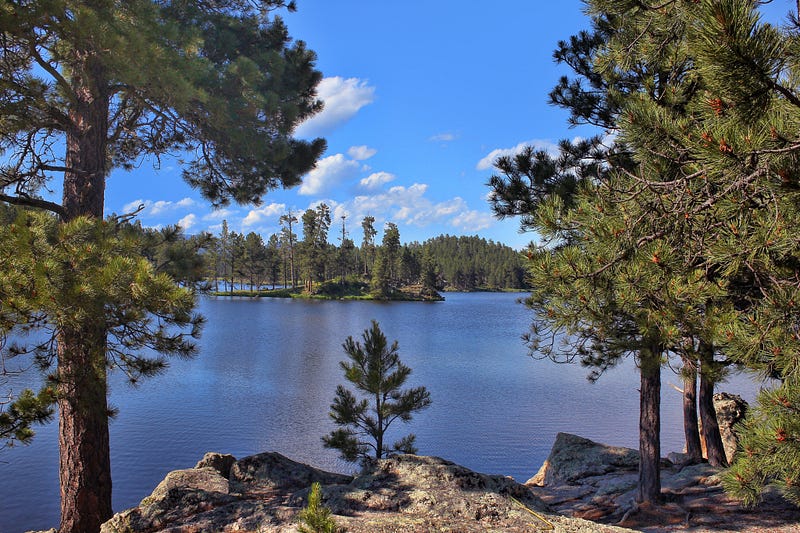
Tuesday, June 27th, 1988 The Black Hills of South Dakota
My brother Dave and I were finally alone.
We were alone to commune with nature and marvel at its wonders. We were alone to talk about male stuff, women, jock itch, college, where I was an English major, high school, where Dave was an in-coming senior, the philosophies of Dudeism, and other such intellectual topics on our hike to Harney’s Peak in South Dakota in 1988.*
Although we love our sister Noelle and our mom, after so much camping, it was natural to get on each other’s nerves. Every now and then, you need time away, even from those we love.
Alone time is so needed.
The journey into the mystic
Dave strapped his canteen of water around his neck. I had my camera case. We were careful not to take huge swallows. We needed enough for the trip back.
The first mile was easy. However, as the mile dragged, we noticed the unusual color of the sand along the trail. The color gave the impression of being wet; the ground splattered with sparkling silver. After close scrutiny, the silver was really slate chips, thin and shiny flecks.
The trail led to a small clearing that overlooked the forest and the summit of Harney’s Peak. An old stone building stood against the blue sky.
We hiked upward and onward. Midway through the second mile, the trail grew steeper and more treacherous, with unstable rocks. The trail curved around the side of the mountain.
Late in the afternoon, the sun was not too hot. Huge spruces and evergreens enclosed the trail, providing near-constant shade. Streaks of holy sunlight pierced holes in the canopy, breaking through, illuminating particles floating insensibly in the air.
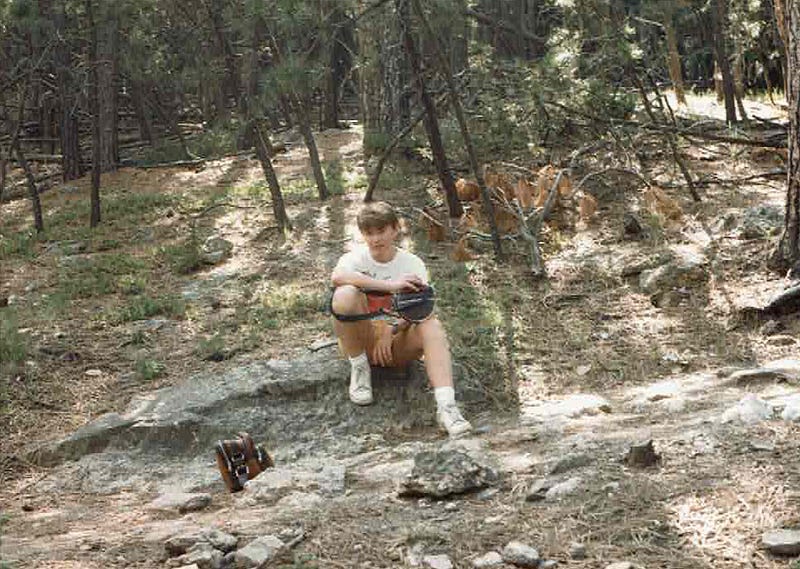
Brothers on a mission
The hike reminded me of Stairway to Heaven by Led Zeppelin. In my imagination, I saw “rings of smoke through the trees” and heard “voices of those who stand looking.”
I even heard the whispering of the wind echo my name. Was it a subliminal message of the Piper calling me to join him? Join him for what? Why?
I hoped to find Merry Gentlemen prancing about, wearing the outfits of Jesters, or playing Nine Pins like in “Rip Van Winkle,” or playing a flute or drinking from a flagon of rich ale.
The Jester was summoning us to the King’s Court on top of Harney’s Peak. How could we be of service?
Such outings inflame my imagination! Before the hike, Dave and I pretended to be Frodo Baggins and Sam Gangee from Tolkien’s The Lord of the Rings. Through the Elven Woods of Murkwood and the Haunted Forest to the Forbidden Land of Mordor where the Ringwraiths lie in waiting, ready to reclaim the Lost Ring before we cast the Evil Thing into the Cracks of Doom.
It was fun to be young again. Even at twenty and in college, I loved pretending. What was my mission on this trip?
We often forget what childhood is like — a child blessed with ideas and a wild imagination. Why does such creativity leave us? Perhaps the responsibilities of adulthood smother such creativity. Is that why fiction is so popular? Authors transport the reader to other realms, much like Tolkien.
My real escape had started.
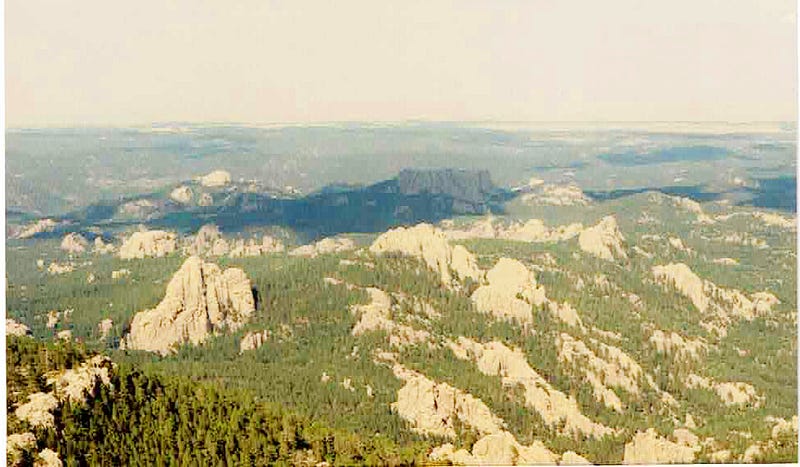
I can see miles and miles and miles
Huge columns of granite lined the trail with several small alcoves, caves, and havens for animals. We looked for elk, moose, mountain lions, and birds. Many rocks and tree stumps, from a distance, transformed into fantastical creatures.
The trail marker ahead read two miles. The journey was two-thirds over. The trail led straight up. Rocks embedded in the soil acted as steps. We rested often, taking water breaks. The air was thin. At this altitude, the oxygen is low.
The density of the trees grew smaller. The rocks and huge, granite boulders became larger — like guardians. Would we reach the summit after we turned just one more corner?
No, the trail wandered around towards our left. The number nine was imprinted upon a tree. We were heading in the right direction.
The summit was approaching. With every step, that Piper’s song grew louder. The trail became steeper and more difficult. As we rounded the last curve, several crude stairs led to the final leg. Such stairs seemed out of place; civilization in the wilderness. The steps were narrow and steep but placed with care. We took the staircase, or The Stairway, and followed its serpentine route. There, the ground was level.
Had we just entered the King’s Court? The mysterious stone building had drifted like a dusty cloud. We had entered the first chamber; one wall rose to our left and another one, to our right. There was no roof, but a path led underneath a small opening in the rock, forming a tunnel. The walls blocked the wind and silenced the song.
We entered another room, much larger than the previous one. On the right, an opening appeared as a natural window, overlooking the Black Hills of South Dakota.
A long narrow staircase led up to the taller, left wall and we followed it with care. The place was eerie. Our footsteps and the tripling of stones were the only sounds. We exited the room and found ourselves on a plateau, guarded by large boulders on each side. As we walked forward, the wind picked up and swirled around us.
Through cracks in the boulders, a panoramic view of Custer State Park stretched for miles and miles and miles. The Who’s “I Can See For Miles” floated in my brain. The Tower loomed several hundred feet above us. Where was the entrance? Would goblins be guarding the gate? To the right, I quickly found one. A gate, not a goblin!
We climbed, keeping our balance, staying away from the strong wind gusts.
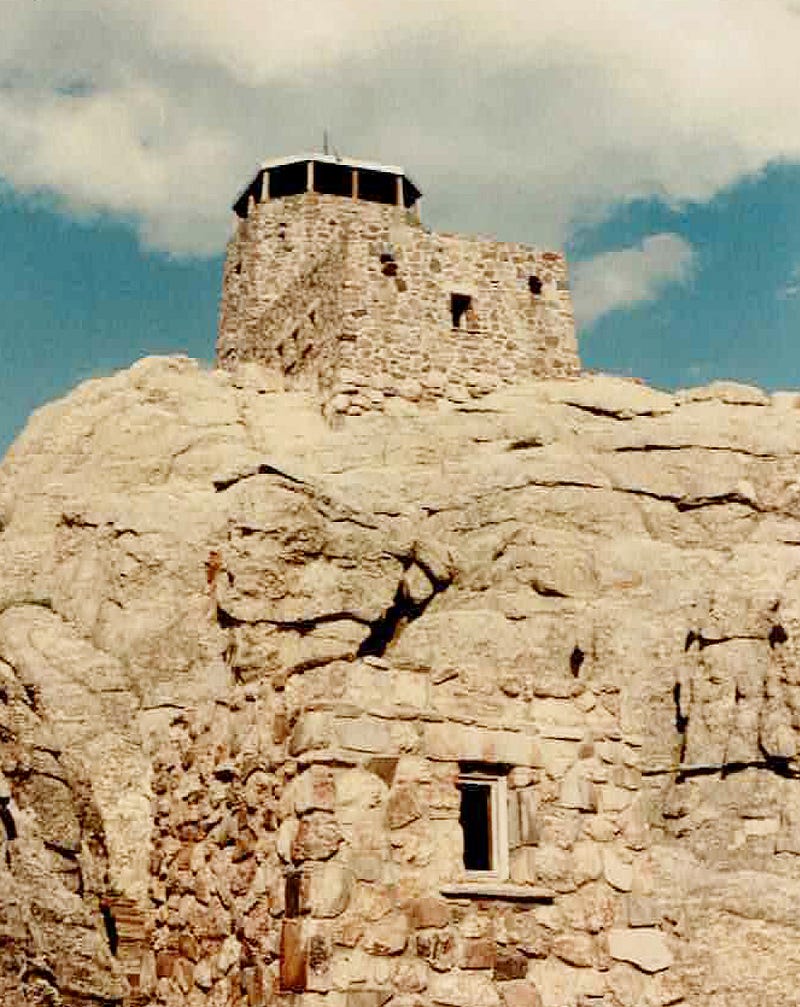
The spirit of Valentine J. McGillicutty
We finally reached the entrance of the Stone Tower. At the gate, a silver-plated plaque with strange letters in an ancient script spelled: Valentine J. McGillicutty: 1849 to 1939.
Who was this? Was he a hermit who lived in the tower? Was his spirit luring us? Was this the Piper calling us?
I did not have my Ouija board, which was probably a good thing.
We walked under the threshold and into an empty chamber. Why was this Tower built? How did someone build such a structure on top of such a mountain? What was its purpose? Would we want facts, or would our own fiction serve us better?
A window appeared to our right. A metal staircase, directly in front of us, led to a dilapidated patio overlooking the Black Hills towards the West. With care, we walked upon the blacktop patio and stared into eternity.
The Cathedral Spirals, to the left; The Needles soared directly next to them. Once again, we entered the main chamber.
Dave and I placed the canteen and camera on the floor and then began our climb. The Upper Level was open to the elements. Twelve metal poles supported a wooden roof. Was this a lookout tower? An eagle’s nest? With the wind, it was difficult to remain stable.
We were now at the highest point east of the Rockies. The view, needless to say, was impressive: to the east clouds hovered off the horizon, casting long, dark shadows upon rolling fields and mountain slopes, giving a “black” tint to the region. Was it any wonder these were called the Black Hills? Much like “the Blue Ridge” in Virginia?
We felt so alone in the tower. Over the vastness of every angle, no one could be seen. No signs of civilization. I felt small, insignificant, amidst such grandeur of Nature. Was I one of its wonders, too?
We retreated downstairs. I took several pictures. We stayed about ten minutes in the Tower. I shouted. My voice echoed for what seemed miles. I shouted a Whitman “barbaric yawp,” and my voice echoed and echoed.
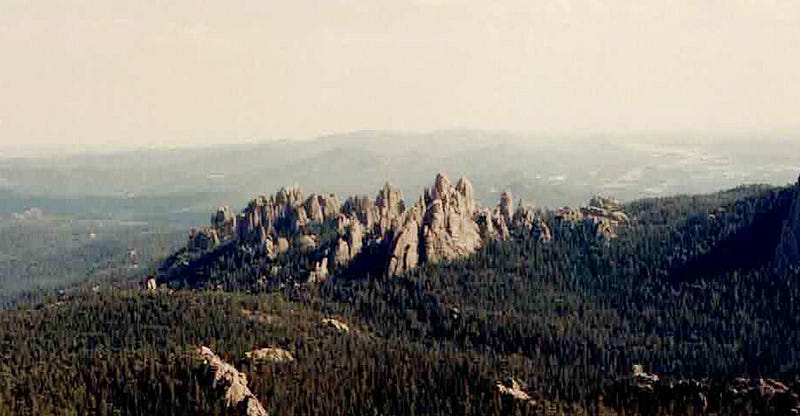
Standing naked on the Tower
David was now downstairs. I was alone. An urge hit me. Taking off my clothes, I stood naked against Nature’s brilliant backdrop. The wind wrapped around my body with its cool, embracing fingers. It was there that I returned to the womb of the world and perhaps back to God.
After several minutes, unashamed, unlike Adam and Eve, because I never left Eden, I placed my clothes on and met up with Dave. He was on the patio. We peered over the ledge. A small pool was nestled between massive boulders.
A cool dip would be lovely since we were hot and tired. We searched for a way to the pool.
Huge boulders stood as proud sentinels. The castle disappeared. A small cave had the remains of a campfire. Inside was nothing but darkness. Was I half hoping to stumble over a sleeping bear or a mountain lion? What a shock and a story and an obituary that that would have been!
Of course, being Wally Chapstick, I could have easily handled the situation.
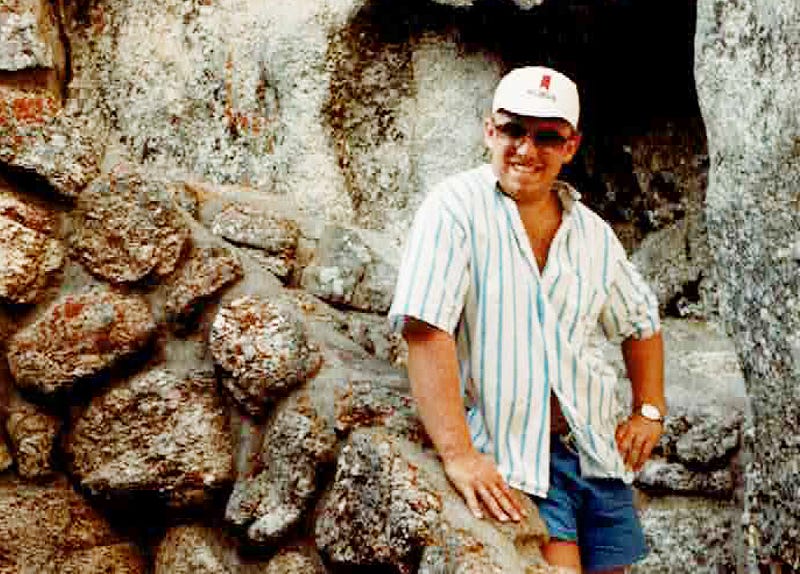
A mysterious pool, like Dozmary Pool?
Dave stated there must be an opening higher up, near the castle. We just had to find a passage to this forbidden pool! Like the legendary pool from King Arthur? We made our way up the path.
Dave stopped and glanced around, his eyes like an eagle, hoping to find a path. I walked on, continuing the climb. I leaned over. There was a door below me. I called out, “Dave!”
We jumped over the ledge and scrambled over the boulders. An easier passage appeared, and Dave helped me through the crevice. The covered path was now evident. We found the lower story of the castle. I approached, ducking my head from the low threshold.
The place was eerie. More so than the second floor. Debris was tossed about, but there wasn’t any garbage or signs of fellow travelers. It was debris from ruined furniture and broken pipes. All human-made ruins. Two small windows emitted fragments of light; cobwebs hung in every corner and dust storms encircled my sneakers.
I lingered in one room while Dave went ahead to a small alcove, the light more like the dawn. A broken toilet basin with rusted pipes tore through the floor and broke apart at the ends.
A flight of wooden stairs curved around the bathroom wall. David went first. What was behind that stairway? Just other bricks in a wall.
We retraced our steps and wandered through the rest of the abandoned building. A fuse box with wires hung out of one wall and a boarded window on another. I was chilled as if haunted.
With each step, the floor squeaked and moaned. The hallowed whispering of the wind sounded like restless spirits we had released. Were we welcome guests? Or disturbers to peace and solitude?
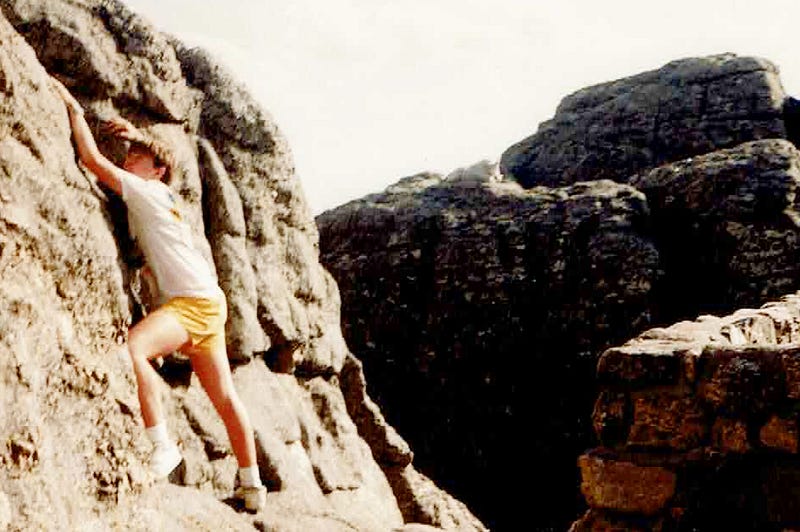
We left the house and wandered down the narrow pebble path to another Stone House. Where was that elusive watering pool? What secrets did it contain? With so much difficulty, it must hold some sword or restorative powers.
The outhouse was nothing exciting, but through a window, I spotted a shallow pool of water glimmering just below the house.
“Hey, Dave!” I yelled. “I found it!”
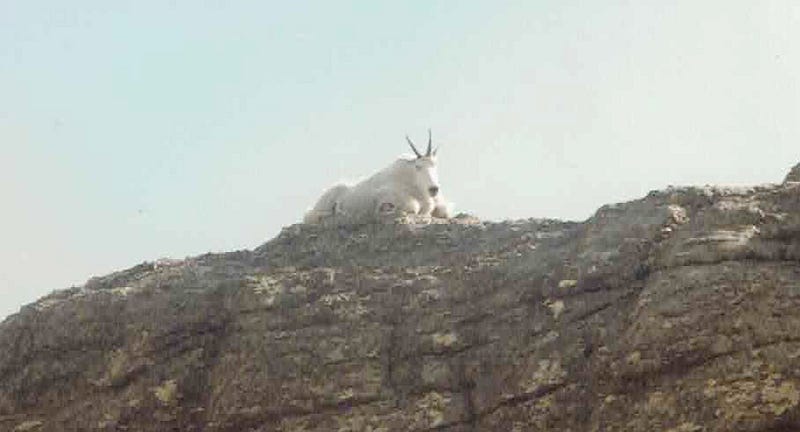
A billy goat gruff and his mysterious stare
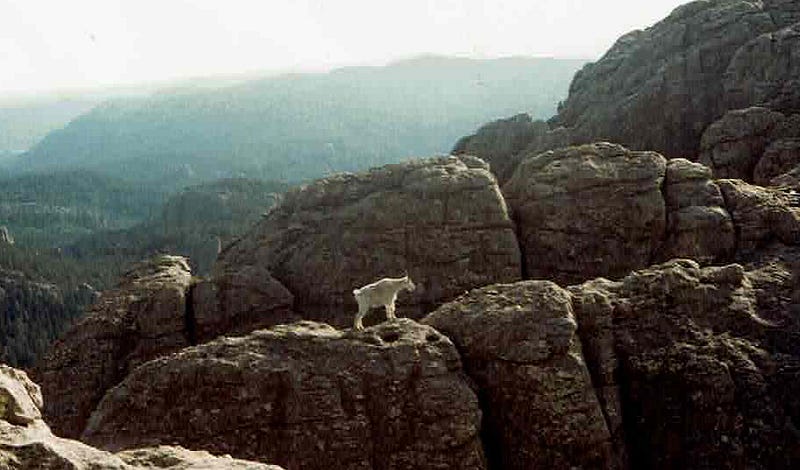
Between the stone shack and large boulders, we fit through the small crevice. I found a foothold. Dave tapped me on the shoulder and pointed to an object on top of the boulders. It was a Rocky Mountain goat. She was white and staring straight at me from twenty yards away.
Her stare was unshakable. Her dark eyes marked my every move. For a better view, I moved higher. Although amazed and excited, we were both a little scared by this impressive animal.
After all, we were in her land. We were the visitors in her territory. Although mountain goats are not prone to be dangerous, they are unpredictable, especially at close range.
We had nowhere to run. Fear soon passed and gave way to wonder. How much wildness was still contained within us? She seemed unmoved by our presence but kept a watchful Eye.
The three of us stood staring at each other. For ten minutes this continued, without a sound. Was this the communion between beast and man?
The goat was resting, high upon the sun-baked warmth of the boulders. Was life easy for her? Such words are not necessary for higher animals. Was she secure in the knowledge of her safety? How different life must be for such a creature. Could humans mirror such a life?
Miles to go before we could rest
It was getting late. Unlike the goat, we had miles to go before we could sleep. After all, hiking along a mountain trail at night without flashlights is not safe, not even for Wally Chapstick!
The air was cooler. The wind: a soft breeze that brushed the fur — like waves on the goat. Like Adam, who bequeathed names for everything, could we name our new friend?
Dave suggested “Valentine, The Keeper of the Castle.” So I dubbed the white goat “Sir Valentine, the goat, of Custer, and Keeper of the Castle.”
This was a historic occasion. For the first time, I had initiated a non-human into my Realm of Dudeism, a philosophy I created in 1986 while a junior for my school newspaper.
Heading back, we found a path and traveled down the staircase which led to the main entrance.
We peered at the granite boulders, protecting the pool. Valentine, poised like a Calacatta marble statue, gave us our final look. I will always remember that goodbye.
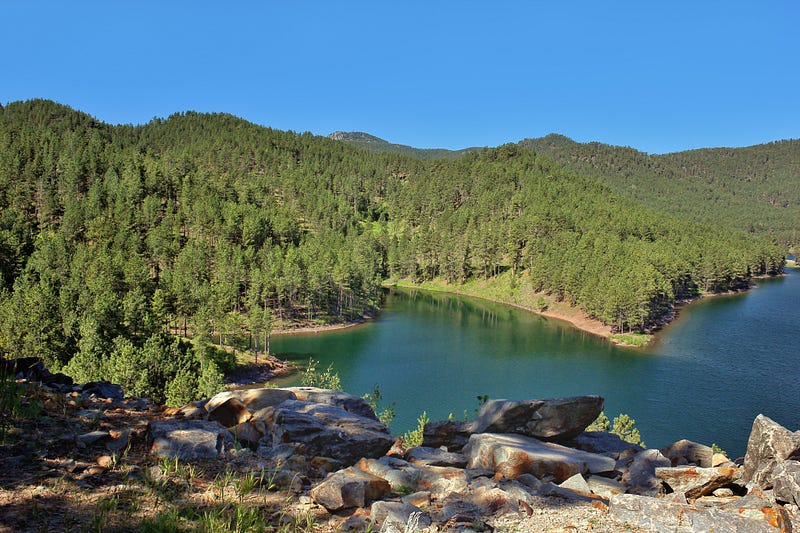
We picked up the path and headed back to Sylvan Lake.
Six stairs led to an altar-shaped object. How weird was this? If only I had brought my Ouija board! Some nasty spirits could be summoned from the depths of Hell at a place like this, like in Fantasia’s “Night on Bald Mountain.”
It seemed strange, and so out of place. Was this a door to another portal? As we walked on, the cast of shadows from towering evergreens kept in step and danced in front of us.
The journey back was easier. The temperatures were cooler. The sun was no longer a factor, just more of a danger. After two miles, we stopped for water. We talked of a great many things; Valentine, the Castle, the views from the Summit, and how great it was being away from Civilization.
From the time it took us to complete the last mile, we concluded it was much longer than stated on the trail markers, but we finally made it back to Sylvan Lake.
Memories of the mind and of the page
Alas, dear reader, the journey was over. We met up with Mom and Noelle who were sitting on a bridge, waiting for us. They had a good time horseback riding. I was glad.
All that was left were memories; memories that will be stored on the pages of this journal. Then a typewriter. I will bring these memories out again, every now and then, to be cherished and savored.
We all need times like these: on top of the mountain, for instance, especially being naked in the wilds of the wind. Amen. And good night and happy travels.
In the morning, we head to Cody, Wyoming.
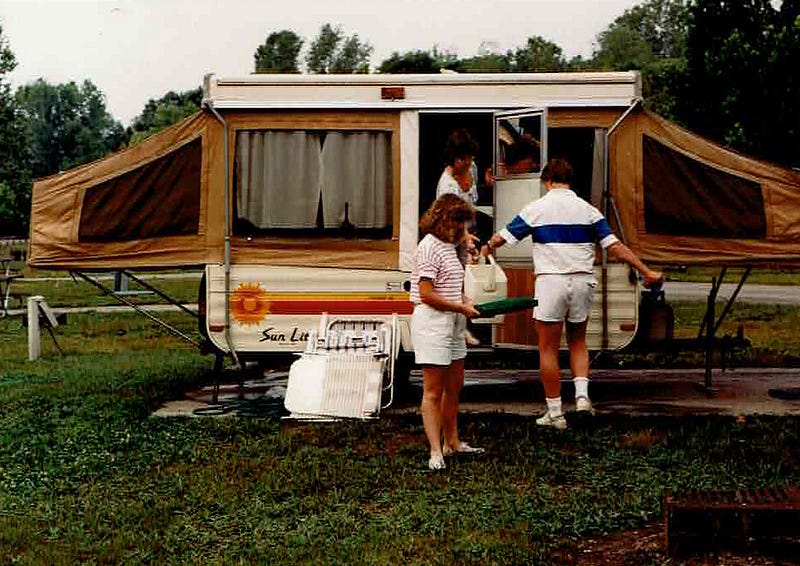
More adventures coming! Look for these stories on The Masterpiece:

*Harney’s Peak is now called Black Elk Peak. It was renamed in 2016. General Harney’s men massacred Native American women and children, according to historic records. The site is holy to Native Americans.
Thank you for reading! Thanks to Lanis Rossi for the photo.


