avatarChristopher P Jones

Free AI web copilot to create summaries, insights and extended knowledge, download it at here

4024

Abstract

canvas. 232 × 290 cm. Florence Cathedral, Florence, Italy. Image source <a href="https://commons.wikimedia.org/wiki/File:Dante_Domenico_di_Michelino.jpg">Wikimedia Commons</a></figcaption></figure><p id="456b">Take this fantastic painting by the 15th-century Italian artist Domenico di Michelino. It shows the poet Dante in a pink robe, displaying a page of his poetry. On his head he wears a laurel wreath, the ancient sign of poets and musicians.</p><p id="a0cc">The poem is the <i>Divine Comedy</i>. Surrounding Dante are scenes from the epic verse: on his left is the entrance to Hell, whilst in the background are the seven terraces of Mount Purgatory. On his right stands the city of Florence. The banded sky is an image of Paradise.</p><p id="9966">Scale and proportion are far less important than comprehensibility.</p><p id="0b15">Dante appears as large as Florence’s Duomo cathedral, and is maybe even tall enough to step over the city walls. Meanwhile, the unclothed figures that populate the realm of Hell have the diminutive quality of toy dolls — compared to the magnificent poet.</p><p id="94a9">What is clear is that the artist felt at liberty to present a tableau whose qualities were descriptive and evocative, much more so than realistic.</p><figure id="488d"><img src="https://cdn-images-1.readmedium.com/v2/resize:fit:800/1*SZm1024doTVOJiezpAMiPw.jpeg"><figcaption>Divine Comedy, Paradiso: Dante and Beatrice meet Folco of Marseille (1444–50) by Giovanni di Paolo. British Library, UK. Image source <a href="https://commons.wikimedia.org/wiki/File:1K002578_Divine_Comedy_Giovanni_di_paolo.jpg">Wikimedia Commons</a></figcaption></figure><p id="99e2">Here is another brilliantly lucid painting, again made by Giovanni di Paolo. It is another scene from Dante’s <i>Divine Comedy</i>, in which Dante and Beatrice meet Folco of Marseille.</p><p id="3390">Not only are buildings awkwardly set in the landscape with the tower and turrets with a Cubist-like multiplicity of angles, but the relative proportions of the figures utterly contravene our normal assumptions of scale.</p><p id="2493">Still, as an object of visual narrative, the painting achieves a level of descriptive clarity that a more life-like image would perhaps fail at.</p><h1 id="6059">Hierarchical Perspective</h1><figure id="a337"><img src="https://cdn-images-1.readmedium.com/v2/resize:fit:800/1*kjPhqznBjtGGyZ1X8CHGhg.jpeg"><figcaption>Portinari Altarpiece (1475–1476) by Hugo van der Goes. Oil on wood. 253 × 304 cm. Uffizi Gallery, Florence, Italy. Image source <a href="https://commons.wikimedia.org/wiki/File:Hugo_van_der_Goes_004.jpg">Wikimedia Commons</a></figcaption></figure><p id="b590">A central tradition in the art of this period was of “hierarchical perspective”, where the size of the figures were shown relative to their importance in the scene rather than to laws of perspective.</p><p id="cda0">This three-part altarpiece painting by the Flemish artist Hugo van der Goes illustrates the idea well. The central image shows the Nativity with the baby Christ in the centre. Above him, Mary — as an image of divine motherhood — looms enormously.</p><p id="70ee">Meanwhile, notice the three shepherds crouched in worship at the entrance to the stable: their presence is verging on the monumental, telling us that they are one of the main subjects of the painting. In other words, the painting’s central theme is devotion.</p><p id="f82e">On the outer panels, the scale and proportion of figures are equally telling. Notice how the saints stand like giants over the kneeling patrons, conforming to the tradition of the most significant figures in the painting being larger regardless of their location in the pictorial space.</p><h1 id="6c69">The Emergence of Perspective</h1><figure id="f18e"><img src="https://cdn-images-1.readmedium.com/v2/resize:fit:800/1*cBqT_lh7oIt2Mheac1FLBA.jpeg"><figcaption>Presentation of the Virgin (c.1330) by Taddeo Gaddi. Fresco. Cappella Baroncelli, Santa Croce, Florence, Italy. Image source

Options

<a href="https://www.wga.hu/html_m/g/gaddi/taddeo/croce/07baronc.html">WGA</a></figcaption></figure><p id="fba3">Throughout this era, painters worked towards an evocation of dimensional depth with a variety of techniques, creating a wonderful if sometimes discordant array of effects.</p><p id="7b50">There is perhaps no better example than this image, <i>Presentation of the Virgin</i> (c.1330) by the Italian Taddeo Gaddi.</p><p id="86e9">Once again, figures are shown in a variety of sizes according to their importance — yet at the same time attempts at architectural perspective give the painting a different feel. The building arrangement presented artists with a more intricate set of challenges, giving the setting an unwieldy and oddly labyrinthine look. Even so, the whole composition still has a certain gothic beauty.</p><figure id="a514"><img src="https://cdn-images-1.readmedium.com/v2/resize:fit:800/1*iBCNIsJV2h7188iJLN295Q.jpeg"><figcaption>Annunciation (c.1445) by Domenico Veneziano. Tempera on panel. 27.3 × 54 cm. The Fitzwilliam Museum, Cambridge, UK. Image source <a href="https://en.m.wikipedia.org/wiki/File:Annunciation_(predella_3),_fitzwilliam_museum,_Cambridge.jpg">Wikimedia Commons</a></figcaption></figure><p id="11b3">A crucial year in the development of perspective was 1420, when the Italian architect Filippo Brunelleschi explored the concept of a single vanishing point. By conceiving how parallel lines on the same plane converge toward a central point, he more accurately articulated the relationship between distance and the apparent diminution of objects as they recede in space.</p><p id="d627">Perhaps it is not too surprising to find, then, that once linear perspective was well understood, artists began to emphasise it more and more in their paintings — as in Domenico Veneziano’s <i>Annunciation</i> (c.1445).</p><h1 id="fd9b">Breaking the rules</h1><p id="2f0a">Of course, once rules are formulated they are apt to be broken.</p><figure id="1144"><img src="https://cdn-images-1.readmedium.com/v2/resize:fit:800/1*iEtYmpf47XofgDihvbUIIw.png"><figcaption>“The importance of knowing perspective” (Absurd perspectives) (1754) by William Hogarth. Engraving on paper. Image source <a href="https://commons.wikimedia.org/wiki/File:William_Hogarth_-_Absurd_perspectives.png">Wikimedia Commons</a></figcaption></figure><p id="3214">I’ll end this study of unusual perspective with this engraving by the British satirist William Hogarth, who in 1754 produced this image, <i>The importance of knowing perspective.</i></p><p id="8697">Everything is deliberately erroneous: Trees and sheep get larger as they move away from us, the curves of the wooden barrels slope the wrong way, the main fisherman’s rod stretches an unfeasible distance, whilst the hiker on the distant hill lights his pipe from a candle held by a woman leaning out of an impossible window.</p><p id="5db3">Beneath the image comes the warning: “Whoever makes a Design without Knowledge of Perspective will be liable to such Absurdities as are shewn in this Frontispiece.”</p><p id="9952">Yet recalling the wonderful images from the 15th century, I wonder how true this really is?</p><figure id="cb0d"><img src="https://cdn-images-1.readmedium.com/v2/resize:fit:800/1*igQbKCOI4qGLg6JzYP7H9w.png"><figcaption></figcaption></figure><p id="8989">If you liked this, you may also be interested in my book <a href="https://www.chrisjoneswrites.co.uk/what-great-artworks-say/"><i>What Great Artworks Say</i></a><i>, </i>a close examination of some of art’s most enthralling images:</p><h1 id="5739">Would you like to get…</h1><p id="fa7f">A free guide to the <i>Essential Styles in Western Art History</i>, plus updates and exclusive news about me and my writing? <a href="https://www.chrisjoneswrites.co.uk/sign-up-art/">Download here for free</a>.</p><h1 id="279c">Join me…</h1><p id="2193">On <a href="https://www.instagram.com/greatpaintingsexplained/">Instagram</a> for more great paintings on the go!</p></article></body>

Wonderfully Weird Proportions of Scale in Early Paintings

When old paintings challenge our modern day expectations
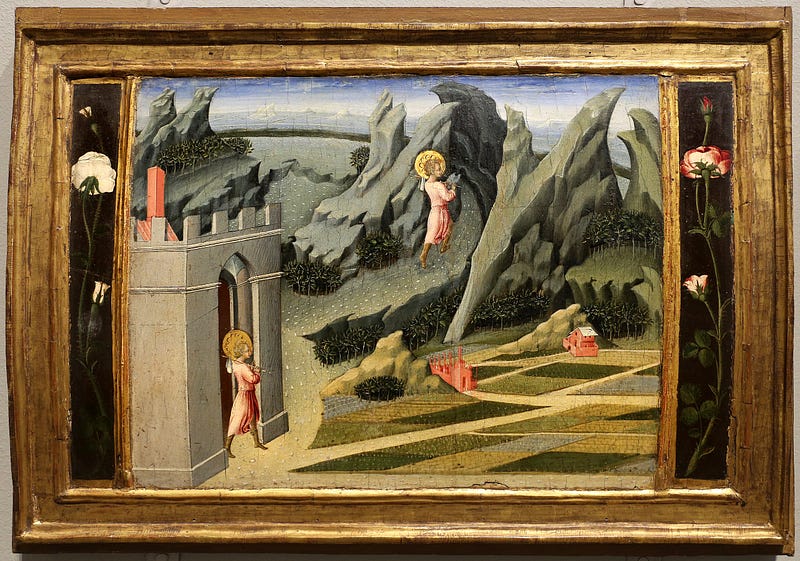
Saint John the Baptist Retiring to the desert, Giovanni di Paolo, c.1453. Oil on panel. 31 × 39 cm. National Gallery, London, UK. Image source Wikimedia Commons

Take a moment to enjoy the intriguing painting shown above.

It was made by the Italian artist Giovanni di Paolo in about 1453. It shows a scene from the life of Saint John the Baptist, who leaves the city to take up a simple and austere life in the desert of Judea.

Notice how John can be seen twice: at first he walks from the city through the crenellated stone gate; next we see him moving up into the mountains to lead a life of material detachment.

To our modern eyes there is clearly something puzzling about this painting, most obviously in the disproportionate size between the figures and the setting, and between the different features of the landscape.

Part of the logic we take for granted about scale and proportion is how, for instance, things that are farther away appear smaller than things close up. Yet few of these expectations are met in this painting.

So you might well wonder: why did the artist choose to paint the scene in this way?

Different Purposes

To get a better idea of the artist’s purpose, take another look at the painting and notice how the colours play a part: St John wears a pink tunic, which clearly stands out against the grey tones of the city walls and mountains. The same pink is used in the details of buildings.

Saint John the Baptist Retiring to the desert, Giovanni di Paolo, c.1453. Oil on panel. 31 × 39 cm. National Gallery, London, UK. Image source Wikimedia Commons

A primary concern of the painting is clarity. It is through this pared-down colour scheme that we can see more clearly John’s journey into the wilderness.

All of which points to the primary objective of the painting, which was to impart a story, in this case of a holy man traversing the landscape from a town into the desert.

Another way of thinking about this, is to say that the painting is designed to show a religious role model rather than a realistic portrait. When considered in this way, it is actually hard to see how the painting could be made more vivid.

Emerging Techniques

Perspective in Western art has been around for several millennia, understood by the ancient Greeks and Romans but never — as far as evidence goes — theoretically articulated. It took until the middle period of the Renaissance before its precise formulation took shape, whilst during the centuries in between it fell out of practice almost entirely.

Its reemergence during the 14th and 15th centuries was gradual, with artists exploring the illusion of spatial depth with a variety of techniques, often balanced against a wish for visual clarity and narrative expediency.

Less concerned with the restraints of realistic portrayal, a different quality of imaginative liberty was exercised.
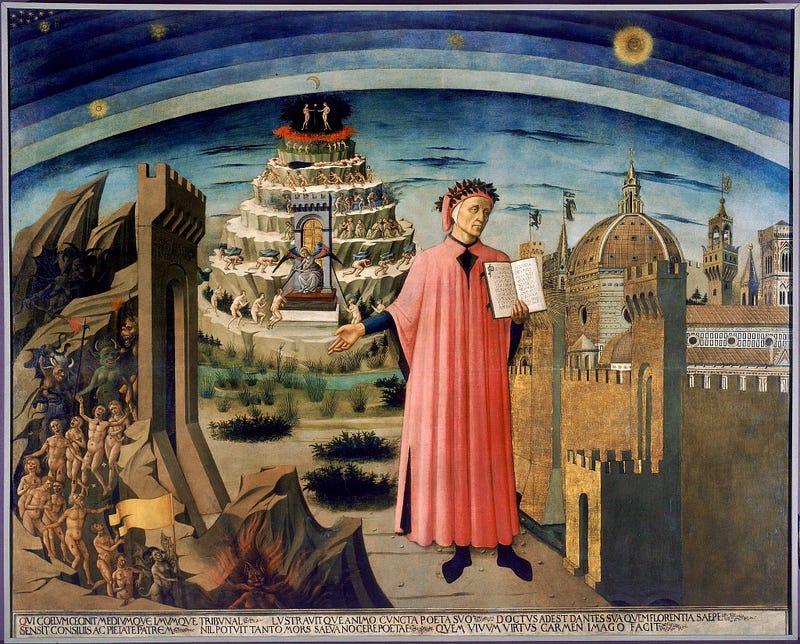
Dante and His Poem (1465) by Domenico di Michelino. Oil on canvas. 232 × 290 cm. Florence Cathedral, Florence, Italy. Image source Wikimedia Commons

Take this fantastic painting by the 15th-century Italian artist Domenico di Michelino. It shows the poet Dante in a pink robe, displaying a page of his poetry. On his head he wears a laurel wreath, the ancient sign of poets and musicians.

The poem is the Divine Comedy. Surrounding Dante are scenes from the epic verse: on his left is the entrance to Hell, whilst in the background are the seven terraces of Mount Purgatory. On his right stands the city of Florence. The banded sky is an image of Paradise.

Scale and proportion are far less important than comprehensibility.

Dante appears as large as Florence’s Duomo cathedral, and is maybe even tall enough to step over the city walls. Meanwhile, the unclothed figures that populate the realm of Hell have the diminutive quality of toy dolls — compared to the magnificent poet.

What is clear is that the artist felt at liberty to present a tableau whose qualities were descriptive and evocative, much more so than realistic.
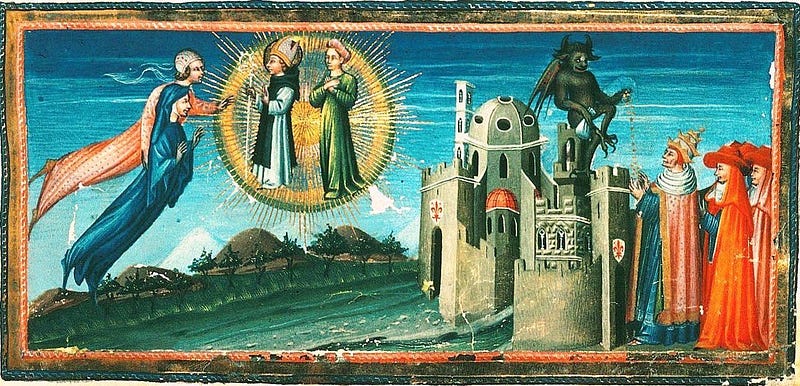
Divine Comedy, Paradiso: Dante and Beatrice meet Folco of Marseille (1444–50) by Giovanni di Paolo. British Library, UK. Image source Wikimedia Commons

Here is another brilliantly lucid painting, again made by Giovanni di Paolo. It is another scene from Dante’s Divine Comedy, in which Dante and Beatrice meet Folco of Marseille.

Not only are buildings awkwardly set in the landscape with the tower and turrets with a Cubist-like multiplicity of angles, but the relative proportions of the figures utterly contravene our normal assumptions of scale.

Still, as an object of visual narrative, the painting achieves a level of descriptive clarity that a more life-like image would perhaps fail at.

Hierarchical Perspective
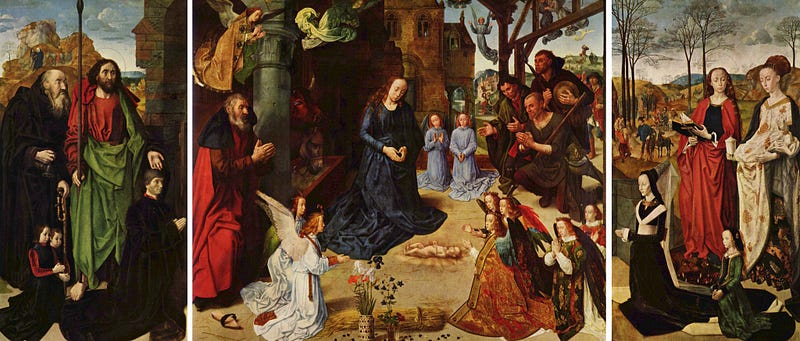
Portinari Altarpiece (1475–1476) by Hugo van der Goes. Oil on wood. 253 × 304 cm. Uffizi Gallery, Florence, Italy. Image source Wikimedia Commons

A central tradition in the art of this period was of “hierarchical perspective”, where the size of the figures were shown relative to their importance in the scene rather than to laws of perspective.

This three-part altarpiece painting by the Flemish artist Hugo van der Goes illustrates the idea well. The central image shows the Nativity with the baby Christ in the centre. Above him, Mary — as an image of divine motherhood — looms enormously.

Meanwhile, notice the three shepherds crouched in worship at the entrance to the stable: their presence is verging on the monumental, telling us that they are one of the main subjects of the painting. In other words, the painting’s central theme is devotion.

On the outer panels, the scale and proportion of figures are equally telling. Notice how the saints stand like giants over the kneeling patrons, conforming to the tradition of the most significant figures in the painting being larger regardless of their location in the pictorial space.

The Emergence of Perspective
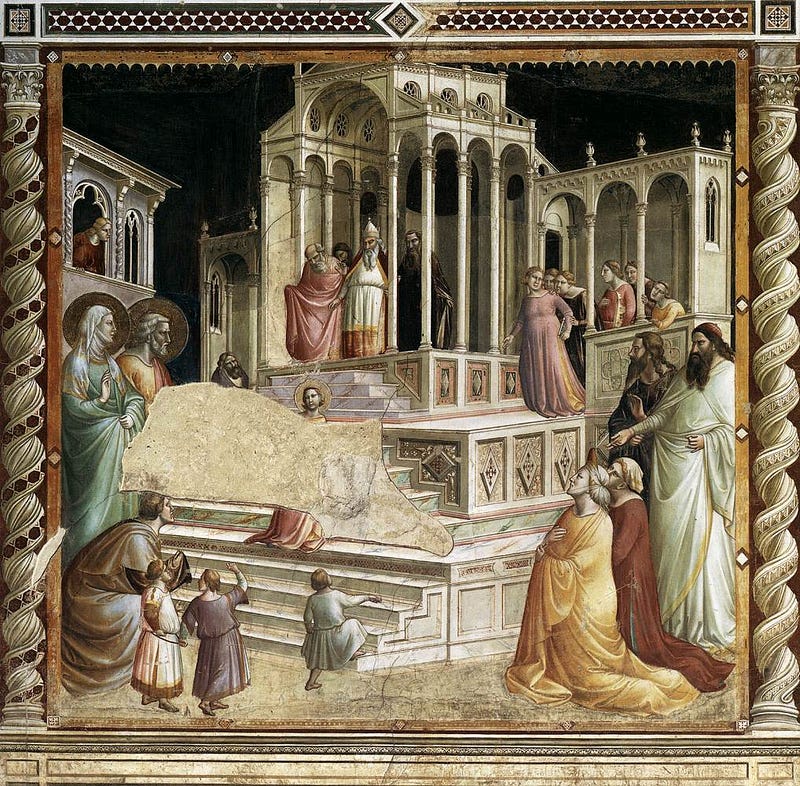
Presentation of the Virgin (c.1330) by Taddeo Gaddi. Fresco. Cappella Baroncelli, Santa Croce, Florence, Italy. Image source WGA

Throughout this era, painters worked towards an evocation of dimensional depth with a variety of techniques, creating a wonderful if sometimes discordant array of effects.

There is perhaps no better example than this image, Presentation of the Virgin (c.1330) by the Italian Taddeo Gaddi.

Once again, figures are shown in a variety of sizes according to their importance — yet at the same time attempts at architectural perspective give the painting a different feel. The building arrangement presented artists with a more intricate set of challenges, giving the setting an unwieldy and oddly labyrinthine look. Even so, the whole composition still has a certain gothic beauty.
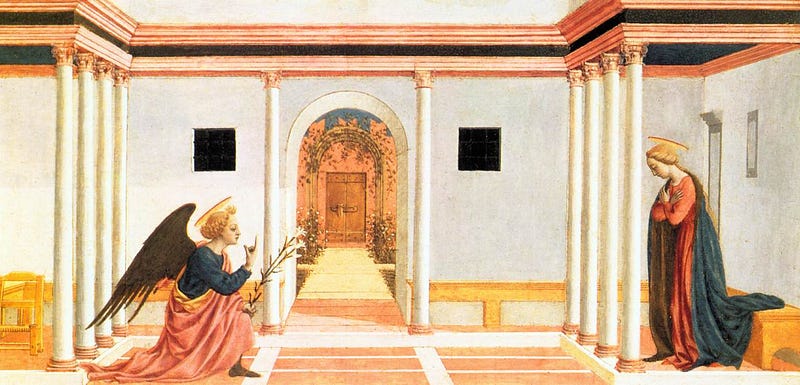
Annunciation (c.1445) by Domenico Veneziano. Tempera on panel. 27.3 × 54 cm. The Fitzwilliam Museum, Cambridge, UK. Image source Wikimedia Commons

A crucial year in the development of perspective was 1420, when the Italian architect Filippo Brunelleschi explored the concept of a single vanishing point. By conceiving how parallel lines on the same plane converge toward a central point, he more accurately articulated the relationship between distance and the apparent diminution of objects as they recede in space.

Perhaps it is not too surprising to find, then, that once linear perspective was well understood, artists began to emphasise it more and more in their paintings — as in Domenico Veneziano’s Annunciation (c.1445).

Breaking the rules

Of course, once rules are formulated they are apt to be broken.
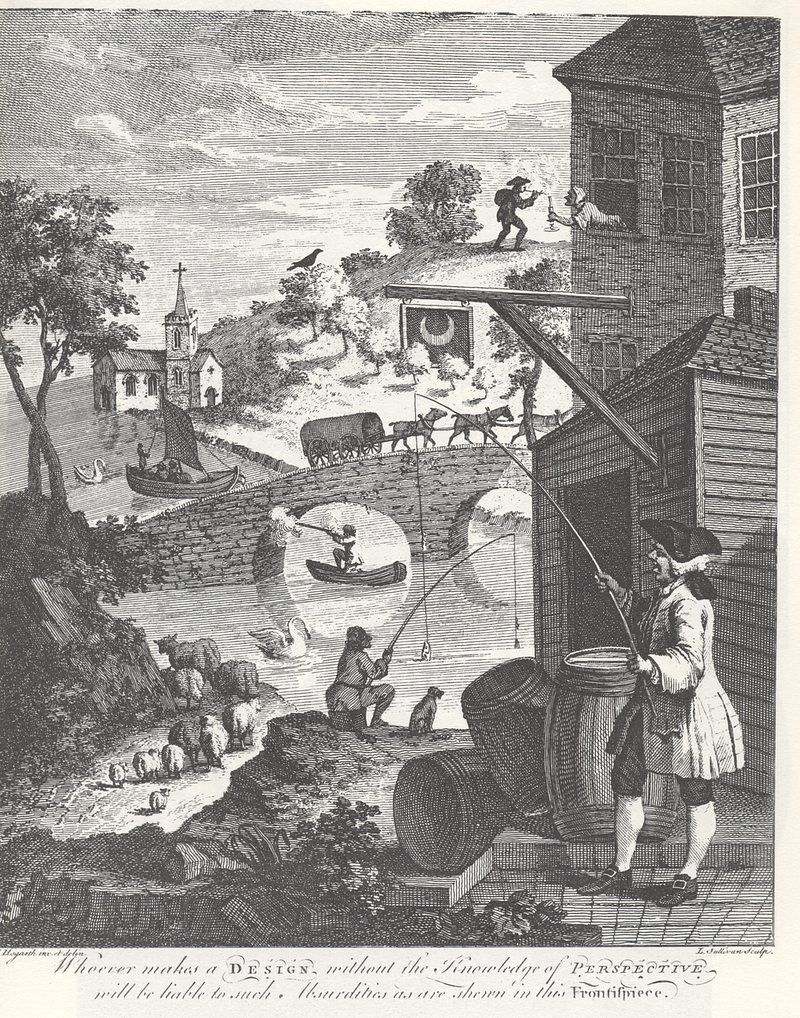
“The importance of knowing perspective” (Absurd perspectives) (1754) by William Hogarth. Engraving on paper. Image source Wikimedia Commons

I’ll end this study of unusual perspective with this engraving by the British satirist William Hogarth, who in 1754 produced this image, The importance of knowing perspective.

Everything is deliberately erroneous: Trees and sheep get larger as they move away from us, the curves of the wooden barrels slope the wrong way, the main fisherman’s rod stretches an unfeasible distance, whilst the hiker on the distant hill lights his pipe from a candle held by a woman leaning out of an impossible window.

Beneath the image comes the warning: “Whoever makes a Design without Knowledge of Perspective will be liable to such Absurdities as are shewn in this Frontispiece.”

Yet recalling the wonderful images from the 15th century, I wonder how true this really is?

If you liked this, you may also be interested in my book What Great Artworks Say, a close examination of some of art’s most enthralling images:

Would you like to get…

A free guide to the Essential Styles in Western Art History, plus updates and exclusive news about me and my writing? Download here for free.

Join me…

On Instagram for more great paintings on the go!

Art
History
Painting
Art History
Culture
Recommended from ReadMedium