
Pets
Wonder Dog
A superhero of health
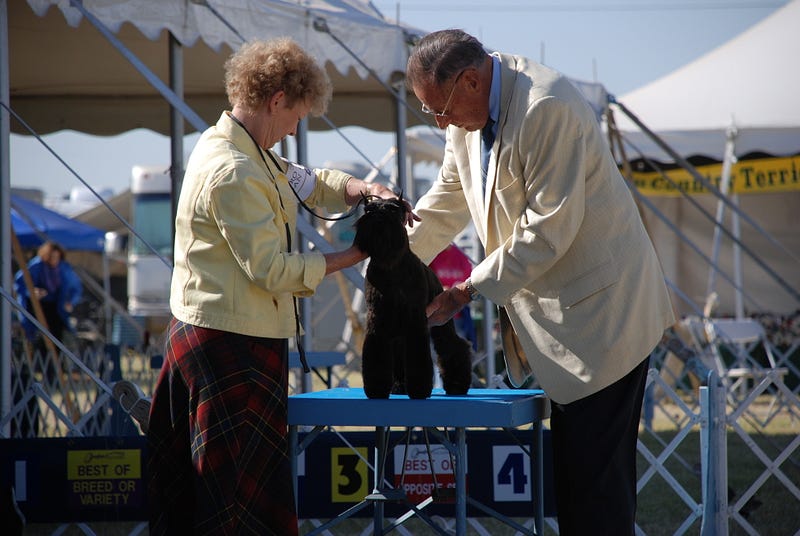
My champion Miniature Schnauzer, Mork, was always a wonderful dog from the day he was born at my home in Arizona. He was from a litter of six — five boys and one girl. Four of the males were black, and the girl and one boy were salt and pepper.
Mork became my favorite because I intended to keep only two of the pups — the female and Mork, the smallest of the blacks— as possible show prospects.
But Mork was never a runt. He was a playful, gregarious black with just a little white hair on a front paw. I used to call him “my little gorilla boy.”
He was shown by a professional handler in Arizona and California and finished his championship (15 points with two majors) by the time he was nine months old. Coal black, he stood almost 14” tall and was a stately stud in the ring. Everyone who saw him remarked on his imposing posture and lovely disposition.
After winning his title, he came home to my loving arms and remained there with his sister and mother. I always intended to breed Mork, but few opportunities came my way, and I did not want to send him out of state.
A few years ago I decided to breed him to a lovely little local female named Maddie, a salt and pepper who carried the black gene. I was only supposed to “borrow” Maddie for this breeding, but as things turned out, I ended up keeping her throughout her pregnancy, delivery, and nursing periods.
Smart as she was, she also was a great mother and a good companion to Mork. She was always low-keyed and diplomatic. When Mork’s sister, Min-Min, wanted to play with Maddie’s puppies, Maddie was cautious at first, but then allowed her to run with them, oversee them, and “babysit.” Gradually they shared duties.
Years passed and happy things and not-so-happy things happened in my world of dogs and cats. The Rainbow Bridge became an unwelcome constant in my life.
In 2018 after a particularly hard period of loss, I took Mork, then age 12, to the veterinarian because he ran a fever and seemed lethargic. The veterinarian, whom I knew for many years and had operated successfully on several of my dogs, did a lot of testing: blood work, x-rays, a valley fever test, tick fever, etc. When the verdict came in, I was devastated as well as extremely surprised.
The vet told me that Mork’s blood work indicated autoimmune hemolytic anemia (AIHA), which his mother succumbed to years earlier. Not only did the veterinarian diagnose AIHA, but he said that the four vets in his clinic plus a veterinarian radiologist from an outside practice examined the images of his lungs and definitively diagnosed lung cancer, which at the time was becoming more common in dogs.
The vet basically handed my dog a death sentence. In fact, he told me Mork could succumb at any time. He could not give me an exact window, but he thought he would die first of the AIHA. The lung cancer would not be the killer. That was small comfort. Both my husband and I were traumatized by what we had heard. I was still grieving from a previous loss of a beloved animal, so my husband actually suggested considering the possibility of euthanizing Mork now so I would not have to go through a period of mourning before he passed away.
No, I said. I could not allow this to happen. The subject then was forever closed.
As a freelance writer, I usually worked in a third bedroom on one side of the house, and allowed Mork and Maddie to wander. Sometimes they came into my office, but often as not, they found a soft place to sleep in the kitchen or den.
Because I wanted to observe Mork as much as possible in the time he had left, I said goodbye to my office and my desktop computer and moved my files into the kitchen and onto the table there. With my laptop, I was able to do the writing that helped me cope with a situation that was untenable: My champion Mork was dying and I could do nothing about it.
I kept Mork and Maddie in the kitchen with me every day, carefully noticing his movements. Was he stumbling? Was he breathing erratically? Was he more fatigued than usual? I checked his gums for color and plied him with food.
I looked at him through a cloudy, nerve-wracking lens because the veterinarians had primed me to do so. I took photos of him to try to preserve this period for eternity. I cried, I felt sorry for myself, I wanted to die in place of Mork.
One day I spoke with my friend Pat, who had suffered through a life-threatening case of Valley Fever. She said the only thing that gave her a decent quality of life was a product called Protandin. She swore to its efficacy. I was skeptical and had been for a while — since the first time she told me of her use of this supplement.
But now I clung to any particle of hope. “I need a miracle,” I said to Pat. “You say the company produces a pet product called Petandin?” She suggested I try it and see if it helped Mork.
Mork had been diagnosed in July and it was now close to October. He still seemed stable, and I was a little less nervous every day. I remained in the kitchen with him and Maddie, watching them eat, drink and interact. I didn’t call my vet for anything — -he had already given his opinion, and more tests wouldn’t change things. They just would upset me and stress Mork.
It’s now two years after Mork’s diagnosis, and he acts like a 14-year-old dog, not any worse. He runs in the yard, comes to the table for food, and keeps me company when I write. As I recount this tale, he is now beside me, his muzzle pressed on the carpet.
I know for a fact that he never had lung cancer because a vet friend of mine described the course of this disease. She said the dog would remain fairly well for some months and then decline rapidly. Mork has remained stable and has never coughed.
Although I’m a pragmatic person who likes to make decisions based on objective data (for a while I always had the vet send me copies of my dogs’ bloodwork), I have never taken Mork back to the vet. Any vet. Call me superstitious or just plain scared, I don’t want to know the numbers on Mork and try my hand at interpreting them.
I lost a lot of trust in veterinary medicine and all doctors due to this crisis. I only take my dogs to the vet if it’s an emergency or I need to run a valley fever test and know the titre. Although I still visit the same vet who diagnosed Mork, I’ve been tempted to berate him. If I had my druthers, I’d kick and scream at him that he put me through hell for an extended period of time.
My husband says the vet probably forgot what a trauma he invoked on us because he never asks about Mork. Still, when I visit him, I always say, “You know, I still have Mork, and he’s doing fine.” Once he asked me what his quality of life was. I said it was fine. He acted the way you might expect a dog of his age to behave. He said nothing more. No apologies, no that’s great! no nothing!
Despite still continuing to see this vet (I would seek another opinion if something serious arose), on some level, I hate him as much as I love Mork. His diagnosis cut a wound in my heart, and it festered for months until I realized Mork was not going to die on the “vet schedule.”
I know that I should forgive him for his mistaken diagnosis but it’s hard to forgive when that person doesn’t acknowledge his mistake. And it has to be a mistake when a so-called terminal dog lives two years with two horrible diagnoses and fares well.
Of course the mistake was bad enough, but the pain it caused was excruciating. I still feel like screaming at him every time I see him, but ironically, he’s such a nice guy I’d be crazy to punish him verbally.
And why would I chastise him anyway? Am I mad that Mork is not living up to his dire diagnosis? Of course not. I thank God every day that I still have Mork and can spoil him with boiled chicken and the godsend Petandin.
I don’t know why or how Mork got healthy, although I have my suspicions that it was all due to Valley Fever. But I don’t care anymore about a specific diagnosis. I’m at the age where I don’t have to dot every i and cross every t. If I had to guess, Mork’s recovery was a combination of an incorrect diagnosis and natural healing. A miracle. The only one I can state without equivocation that has happened in my dog family.
Mork will be 15 in February 2021, and I know he may not make it to 16, but I’ll have to handle his passing when it comes. Somehow.
He’ll always be my “Miracle Mork.”