
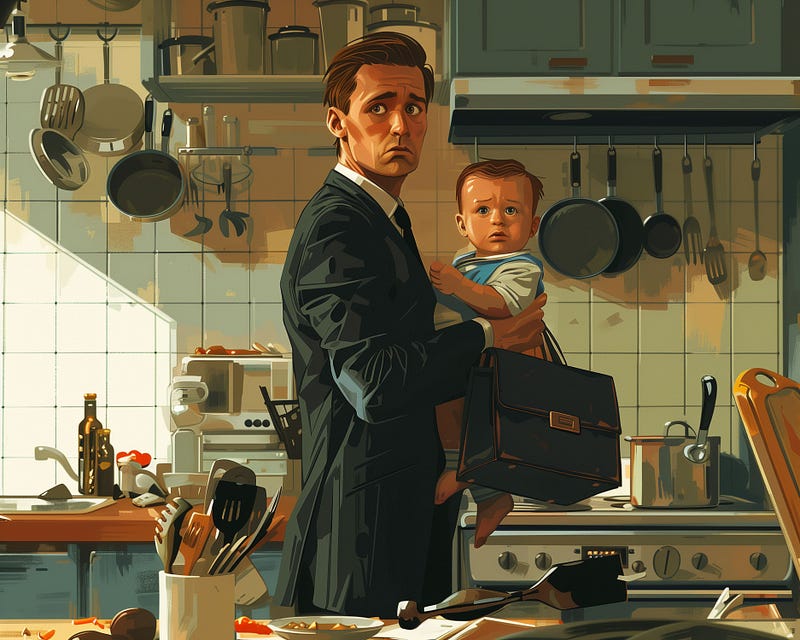
Role Reversal: Men in Women’s Shoes
Exploring a World Where Men Face Women’s Challenges
One of my biggest cheerleaders in life is my aunt. She’s been like a supportive older sister who never judges. There’s always been a great distance between us geographically, but that’s never stopped our relationship.
Her generosity goes back to the ’90s when I was in high school. The only computer I had was a hand-me-down one that was donated to me. It had a whole 1 GB hard drive, but when you have nothing, something feels like you won the lottery.
My aunt, being the lovely person she is, paid for my brother’s and my AOL. This one kind gesture opened up my world at a time when I felt isolated. If you don’t know about AOL, it helped us 90’s kids connect to the internet via phone lines in your home. It was the birth of the phrase, ‘You’ve got mail!’.
That being said, she didn’t have to do this for us, but she’s just that kind of person.
Not once has she ever asked me for anything in return, until recently. After she read one of my most recent blogs, she gave me her positive feedback as usual, but it was followed by a request. She asked me to write a blog about women’s rights.
My first thought was, “I’m not a woman; what do I know about their POV?” She expressed to me her concerns about the trajectory of America in its current form. I agreed with her that things are getting much worse for women, but still, what can I say, as a man in his 40s, that would have any impact? After all, I’m a man.
Then it dawned on me, I am…a man. Within seconds, I went through a series of ‘what ifs’ while wondering what a society would look like had the roles been flipped and men were treated like women are today.
This at first was to help me gain empathy for a female’s plight in America. I quickly realized I was onto something. Men should see what a society would look like if their basic human rights were trampled on.

Below are examples of how men would operate in a female-dominated world of bigotry.
- Men can’t use Viagra: Because it’s believed that God didn’t intend for that erection. Men’s sexual health and desires are not legitimate concerns and should be governed by religious or moral beliefs.
- Men must dress modestly: To avoid tempting women and causing them to sin. Men’s bodies are seen as inherently provocative, and it’s their responsibility to cover up to protect women’s virtue.
- Men’s reproductive rights are heavily regulated: Laws dictate when they can have vasectomies or access fertility treatments. Additionally, these laws determine that the wife has the final say, stripping men of autonomy over their own bodies and reproductive choices.
- Men are paid less: than women for the same work. This leads to a devaluation of men’s work and perpetuates a cycle of inequality in the workplace.
- Men are expected to prioritize family over career: Often being passed over for promotions in favor of women who are considered more dedicated to their jobs.
- Men are frequently objectified in media: The focus on their physical appearance rather than their skills or intelligence perpetuates a culture where men are valued more for their looks than their abilities. Men’s worth is often reduced to superficial standards, overshadowing their professional and personal achievements.
- Men are discouraged from pursuing careers in fields dominated by women: Societal stereotypes label professions such as nursing or teaching as “feminine,” deterring men from entering these fields and reinforcing gender-based occupational segregation. The discouragement limits men’s career choices and perpetuates the undervaluation of work traditionally associated with women.
- Men are expected to take on the majority of household chores and childcare responsibilities: This expectation comes without recognition or support, reinforcing the notion that domestic work is less important and primarily a man’s responsibility. Men who excel in these roles often go unnoticed, further entrenching gender stereotypes in family dynamics.
- Men who show ambition or assertiveness are labeled as aggressive or threatening: In contrast, women displaying the same traits are praised, creating a double standard that penalizes men for exhibiting qualities deemed positive in women. The discouragement stifles men’s professional growth and discourages them from taking leadership roles.
- Men are often not taken seriously when they report being victims of domestic violence or sexual assault: The prevailing assumption that they should be able to defend themselves contributes to a culture of silence and stigma, preventing many men from seeking help or justice for their experiences. This lack of seriousness further marginalizes male victims and perpetuates harmful stereotypes about masculinity and strength.
- Men’s health issues, particularly those related to reproductive health, are stigmatized: And receive less research funding. A man suffering from E.D. might feel more embarrassed to discuss his condition with a doctor. Society often looks down on individuals with E.D., as if they are failing to perform their expected role in life.
- Men are expected to conform to narrow standards of masculinity: Such as being physically strong, emotionally stoic, and dominant. A man who cries in public or enjoys activities considered feminine might face ridicule.
- Men are less likely to be given leadership roles: And when they are, their leadership style is scrutinized more harshly than women’s.
- Men are expected to be emotionally stoic: With any display of vulnerability seen as unmanly. A man who seeks therapy for mental health issues might be stigmatized as weak.
- Men are expected to defer to women in social settings: Being seen as less capable of making decisions or leading conversations. In a group setting, a man’s opinions might be overlooked in favor of a woman’s.
- Men’s success is often attributed to luck or affirmative action: Rather than their own hard work and abilities. If a man achieves a promotion at work, colleagues might speculate that it was due to diversity quotas.
- Men face pressure to maintain a youthful appearance: The societal expectation for men to look young and fit leads to a booming industry of anti-aging products and cosmetic procedures specifically targeted at men.
- Men are underrepresented in political leadership: Fewer men hold positions of power in government, and their representation is seen as a token gesture rather than a reflection of their capabilities.
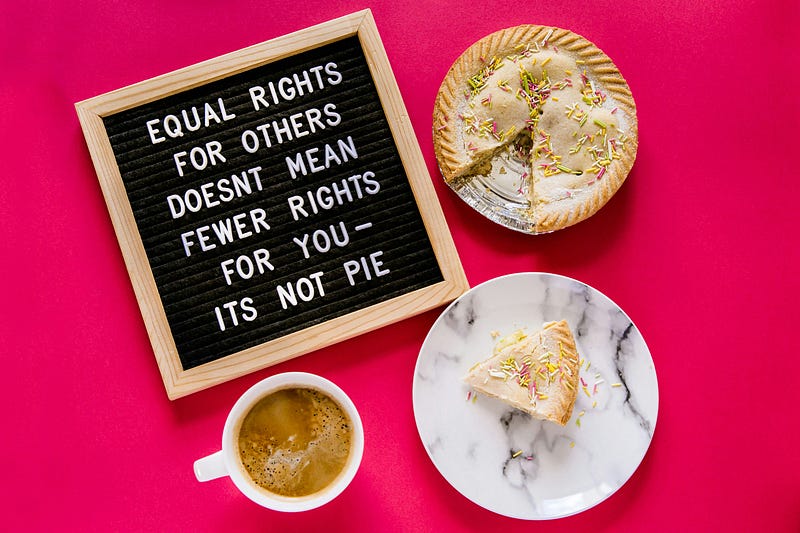
These examples are just a few of the things men would have to endure had the roles been changed. I’m sure every female reading this has many more examples that would ring true. By all means, comment on this piece with better examples. Us men need to hear it.
It’s clear today women’s rights have regressed due to the Christian Nationalist in America. They have spent decades removing the barrier between church and state. Their focus is centered around their version of their religion.
This means women are not equal to men.
The majority of the important people to me are women. My wife, mother, mother-in-law, sister, and aunt. I can’t fully grasp what it is to be a woman, but I can empathize with them.

Reflecting on these reversed roles sheds light on the deep-seated inequalities and biases that women face. It’s a wake-up call that the fight for women’s rights is ongoing and that men have a critical role to play in this battle.
We need to stand with the women in our lives, listen to their experiences, and work together toward a world where gender does not dictate one’s opportunities or treatment. Only through empathy, understanding, and action can we hope to build a more equitable society for all.