
Women’s Month May Be Over, But Our Reading Does Not Have To Be
Reading about Indian Women from various moments in history with Rupa Publications
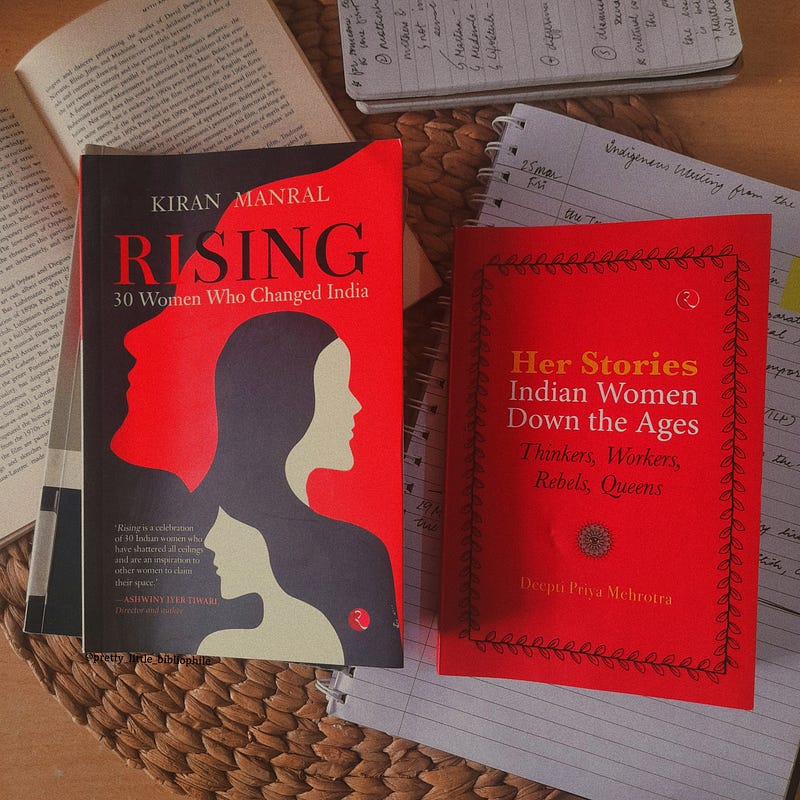
Disclaimer: I received the review copies of these two books from Rupa Publications. However, all opinions expressed are my own and in no way influenced.
Although we in the book community dedicate our TBR (To Be Read) list to books by and on women in March, the month that celebrates International Women’s Day; it does not, therefore, imply that any such reading has to be limited to only that month.
And so, in the first week of April, I decided to dedicate my time to these two books that talk about women from all walks and stages of life — these are Indian women down the ages who changed India — were thinkers, workers, rebels and even queens. What is perhaps the underlying implication is that these women belong to perhaps any such backgrounds, whether social, economic, cultural and despite their varying limitations or challenges, made their mark on the Indian subcontinent. And as an Indian woman in my own right, isn't that something to take inspiration from? As an elder sister to many more sisters, isn't that something I can encourage them by?
I am very glad I got to read these two books. I personally savoured them and read about a couple of the women every day. There was no particular order to my reading and I am glad to say, I was surprised quite often, but made proud and inspired, always. I hope you all give these books a chance and then pass them along to young women in your life!
Her Stories, by Deepti Priya Mehrotra
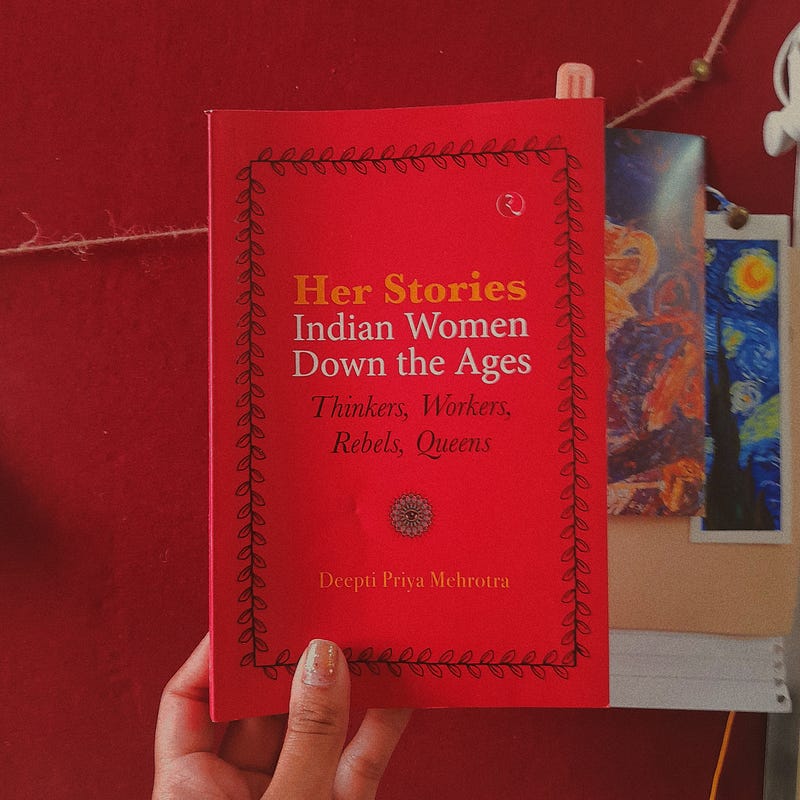
I eenie-minie-minied my way and picked up this particular work first. Of course, I kept on reading both simultaneously but the introduction of this book was the launchpad for me. The “victims of collective amnesia” were very specific women from our history who “were celebrated… vilified, or simply casually neglected”. Mehrotra has very precisely worked on this list which although not exhaustive (and considering our vast and diverse history, it can never be such), is a wonderful account of more than 50 women wonders.
Here is a short synopsis from Goodreads, so that one may get a more precise idea of what this book is about.
Her Stories is a discussion of women from Indian history whose contributions have been all but forgotten. These were poets, performers, warriors, saints, philosophers, activists and more, yet we hardly remember their courage and contributions. The time has come to bring their history to the fore.
Their stories describe desperate situations, ingenious strategies and brilliant sparks of feminist consciousness. Rather than accounts of isolated ‘great women’, these stories place at the centre the ordinary woman, in all her splendid diversity, multifaceted struggle and achievement. The women profiled were encouraged and supported by others — their achievements represent the aspirations of many in the past, and provide inspiration for us in the present.
Cutting across several regions of India and presented in chronological order from second millennium BCE, to the mid-nineteenth century India, these are the stories of women who have been thinkers, doers, movers and shakers who have subverted hierarchies, brought peace out of chaos and survived despite routine devaluation.
As this synopsis emphasizes, this collection really stands out and there is a ‘method to this madness’, this vast list of women wonders (for that is what I shall collectively refer to them in this case) in accordance to years. When it is history one sifts through, it is always better if one does it chronologically and the author has done specifically that. We have poets, ‘hidden’ poets, princesses, Dalit women, washerwomen, queens, devadasis, servants, activists, nuns, teachers, tawaifs, writers, freedom fighters, and many more.
Reading about these women was a journey, or rather, multiple journeys for me. As a woman, I (and many of my counterparts) have always been in strife against the patriarchy, whether societal or internalized. We have been fighting against the mainstream or rather, the ‘malestream’ as Mehrotra so rightly put it. These women, with their [extra]ordinary lives, are essentially no different from us, although our struggles are not always the same. (But isn’t it still?)
I could wrap it all up easily by just saying that it was a compendium of inspiration. But it was so much more than that, as I am sure all women will understand. It is about the collective women experience, the woman question. It is an ongoing fight against the “collective amnesia” of society’s (read patriarchy’s) collective conscience.
And so I shall instead wrap it up by saying read it. Savour it. Go back to it. Flip a few pages and read randomly. I personally read the stories of Auvaiyar, Andal, Akkamahadevi, Razia, Lalla, Meera, Abbakka, and Muddupalani, first because I have either read their works or read about them, in course of my academics. And then I also explored the others whose names I had heard before but didn’t know much about. However, it was a pity that there were so many women whose names or works I had not known of. But of course, all thanks to my experience of it, I now do. So I hope you too pick up and give this collection a read.
Rising, by Kiran Manral
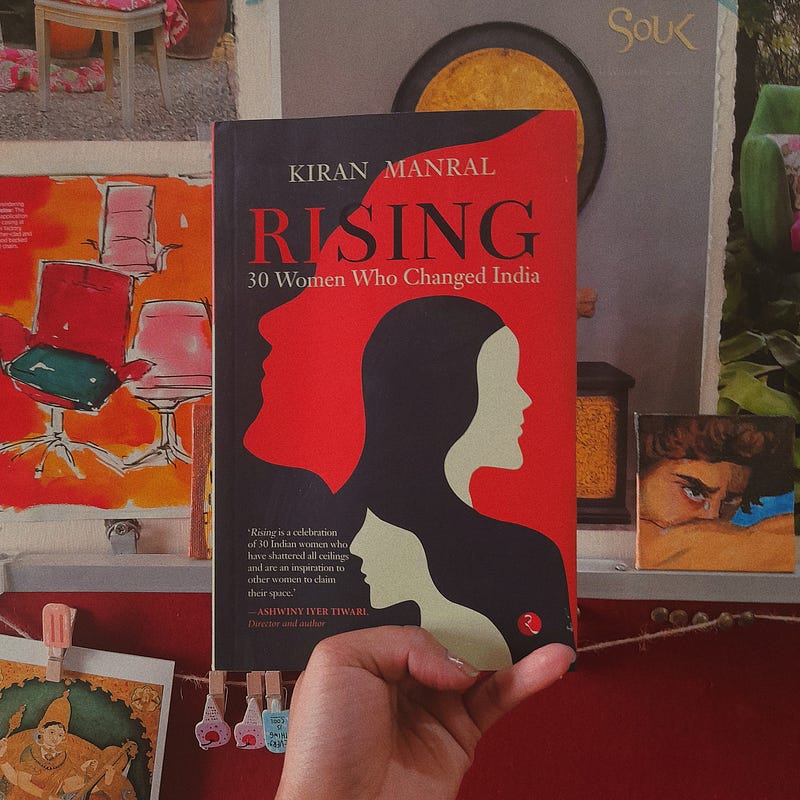
Maybe I shouldn’t have wrapped up the previous review. Nonetheless, Rising is the most obvious book to read next. This book talks about the women who changed India, and is set in a comparatively modern era.
Here is a brief synopsis from Goodreads:
With stories of 30 amazing contemporary Indian women, this book looks at what shaped them, the challenges they faced, the influences they had, the choices they made and how they negotiated around or broke the boundaries that sought to confine them, either through society or circumstance. From diverse backgrounds, different generations, they have risen through sheer grit, determination, bolstered with passion, and are, today, names to look up to, to hold out as examples to the next generation of young women and girls, giving them courage to reach out to their dreams. From politics to sport, from the creative and performing arts to cinema and television, from business leaders to scientists, legal luminaries and more, this book features the stories of much celebrated, fabulous women.
The women in this collection too, come from various fields of work, and action as well as varying socio-cultural, and economic backgrounds. They are pathbreakers, shatterers of glass ceilings and are all warriors in their own rights. Manral’s curation has been on point, inclusive of politicians, writers, singers, painters, actors, sportswomen, mathematicians, producers etc.
Once again, the obvious lesson is the same — it is to inspire me and many more women like me, across all ages and professions. There is no age limit to pursuing your dreams, and the only thing that stands in one’s way is the fear of what the society (read patriarchy) would day. Moreover, for women aspiring to follow a certain profession, I am sure reading about their icons will be an enlightening experience.
A reason why I think this book perhaps be a bit more accessible is that it is more recent in temporal history. As such, the struggles faced by these women are in some ways, more relatable to us, than the stories of women who were of a time when even education was not easily accessible to all. It is an unfortunate reality that due to various reasons a vast number of female children still cannot be educated in India, but the statistical disparity has lessened compared to the previous times. Hopefully, in the next few years, this gap will lessen and will one day, altogether vanish.
From the academic point of view as well, this book was very well researched and as a person who is currently working on their dissertation, I really was impressed by the meticulous list of sources by Manral. What made the reading interesting was that Manral’s biographies of these women were related in what was essentially a story-telling manner. It was not dry and matter of fact, of which I am very grateful, considering I do not particularly enjoy such types of info-dumpy works. In conclusion, I have to say that this book was a really inspiring read and one I enjoyed because I had already heard so much about the women here but hadn’t believed it was enough. This book gave me the chance to delve deeper into finding out their life stories and therefore get to see the story behind the woman I have always known, so to say. I definitely recommend you pick it up!
Both of these books were really very interesting and also very informative. I gained a lot of knowledge about these women and their struggles and their creative outputs. Two weeks after picking them up and reading them, I am not a much more inspired and encouraged woman myself and I now intend to employ this inspiration into breaking my own glass ceiling.
I hope you do give these books a chance as well and find out the stories of our women. Perhaps, when you yourself finish them, you might want to gift them to the other (maybe younger) impressionable young ladies (or any lady for that matter) in your lives!
Nayanika Saikia graduated summa cum laude with a Bachelor’s degree in English Literature and was also a Dean’s List student. She is currently pursuing her Master’s degree and is also a Booktuber and Bookstagrammer. She can often be found on her Instagram account Pretty Little Bibliophile.
You can support her by Buying Her a Coffee or by using her Referral Link while getting a Medium membership!