
WOMEN/SOCIETY/LANGUAGE
Women Of The World Beware Of Being Erased 👩
A campaign is going on to eradicate the word “woman” from public discourse
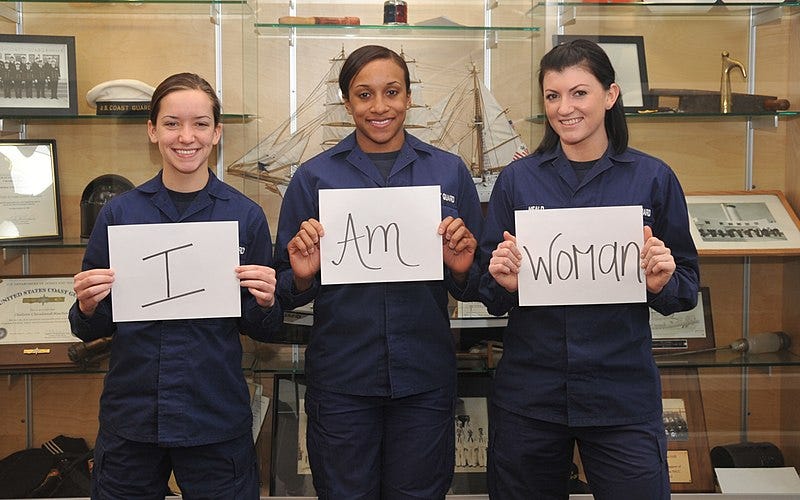

Advocates of gender theory have contributed to the current confusion about gender and sexuality by undermining one of the most foundational realities of what it means to be human: the fact that we are created male and female.
Today there is a rapidly growing global recognition that gender is no longer simply binary; there are more than just two genders, more than just male and female. Non-binary persons also exist, along with gender-fluid individuals and people who identify as bi-gender or agender.
That’s fine and dandy. But many see it as a campaign to erase references to women, feeling that it has reached new levels of absurdity, replacing the word “woman” with gender-neutral terms, such as “womb-carrier,” “birthing person,” or “uterus-bearer,” to be more inclusive.
This shift originates in the activism of transgender advocates and has been taken up by progressive and mainstream organizations and the health sector. At the same time, there is a growing concern among women — born biologically female — that these language changes are causing the erasure of women.
New guidelines in the language you use as a measure of discrimination confuse, and if women are to be punished for using “men” and “women” in their traditional sense, are we saying they must refer to themselves as “people who menstruate” or “people who can get pregnant”? Neither of those even works for women past menopause. So far, no one has even proposed a replacement term.
So the woke position currently amounts to this: women should not talk about themselves as an identity group. That group is now politically incorrect and undeserving of a name, especially undeserving of its old and well-respected name.
I don’t think “gender-neutral” language is neutral at all, and it’s divisive. Feminists are right to call out the replacement of ‘women’ with the deeply creepy and dehumanizing ‘bodies with vaginas.’ Women have fought to be called “women,” not “babes” or “dolls.” We’ve pointed out how women are objectified and asked for respect for our whole selves. This “gender-neutral” language strips away our biological makeup and makes our identity more complex. I think it suggests that women are irrelevant and tramples on women’s rights and equality that we have fought so hard for.
We’re supposed to be “pregnant people,” “birthing people,” or “people with uteruses.” This is objectification on a massive scale, as women are reduced to sexless people with certain body parts or specific functions. It’s appalling.
But it gets worse. How does the LGBTQ+ glossary define gay men? It says,” A man who is emotionally, romantically, sexually, affectionately, or relationally attracted to other men.”
Fueling an online uproar Johns Hopkins University removed an online glossary of LGBTQ terms after its definition of “lesbian” used the term “non-men” to refer to women and some nonbinary people.
According to Johns Hopkins, if you’re a lesbian, you’re a non-man. If you’re a gay man, you’re a man. So let’s see if I got this straight. This misogynistic garbage is coming from one of the most innovative medical brains?
They are describing everyone who identifies as a woman as “non-men.” It implies that men are the norm and women are not. Defining women as “non-men” suggests our only characteristic is “not being men.” It is so regressively sexist that it sounds like it must have been something said about women in the far past. Women are half of humanity; we should be defined by what we are like men. Not by what we are not.
How long until we’re all celebrating “National Non-Man Day?” How long until women become an offensive, unsayable word in polite society? Undeniably, you can have all the gender identities you like, however absurd as many of them are, but what you can’t do is deny the reality of biological sex.
But gender theorists (and institutions like the UN and WHO) often go much further, contradicting natural reality. I’m talking about mammalian biology. They will deny any connection between gender and biological sex or prioritize one’s self-asserted “gender identity” over biological sex.
In defining who we are and how we are to live, gender theorists tell our bodies and our biology to take a back seat. Women have very different life experiences than trans-women. This is not based on a phobia. And it’s not a put-down. It’s just an undeniable fact that everyone knows. Women go through puberty very differently than men do — including trans-women. Women know they will go through menopause. Not so for trans-women. In between, they have periods — unlike trans-women — and may have children and breastfeed them. The list goes on.
I respect that transgender people are at odds with their biological sex and prefer not to refer to it. But most of us have gender identities aligned with our biological sex. We’re OK with that. We shouldn’t be denied our particular identity and its expression.
But if you dare to defend women’s rights to be called women, or state simple biological facts about sex, then prepare to be viciously shamed, vilified, and abused by the intolerant cancel culture mob. They will also try to destroy your career and life, all while masquerading under the laughably inappropriate #BeKind hashtag moniker.
What looks like a liberatory drive to free us from coercive cultural norms speciously rooted in an idea of the ‘natural’ becomes, at scale, a systematic stripping away of our defense against techno-medical tyranny. That this comes disguised as ‘inclusion’ should fool no one.
While gender theory asserts to liberate society, it ultimately can neither objectively describe what a man or woman is nor explain why certain sexual boundaries should exist.
Transgender, nonbinary, and gender-nonconforming people are part of the long history of humanity that stretches across continents and through time. But if using inclusive language to help reduce gender stereotyping, promote social change, and achieve gender-gender equality, what does it say about the visibility of women? 👩🦰
While genuine questions are raised about gender roles or stereotypes, we cannot deny the reality of biological sex without creating victims: protections and opportunities for women are rolled back; increasing numbers of children are being confused about their identity, and the bodies of both children and adults are mutilated based on false promises of relief from their gender confusion.