
Women. Men. Roles. Argh
It’s been decades since I worked in a man’s world, and women are still struggling to be accepted into ‘non-traditional’ roles
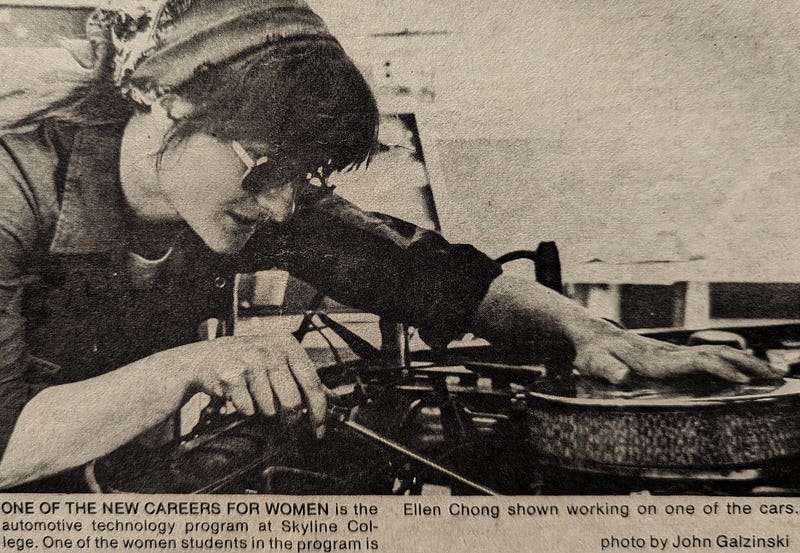
Last week, I realized that for decades, I’ve repressed a deeply seated angst stemming from my short stint as a licensed auto mechanic.
As a child, I was fortunate nobody thought to discourage my interest in tinkering with things.
So it was no surprise when I took up auto mechanics and went on to work with the United States Postal Service (USPS).
It was 1981.
Then I quit that job to have a baby. Go figure. I heard more than one ‘I told you so’.
I had two more babies and never worked as a mechanic again. I did love being a mother.
I could’ve stayed on the job to fight the good fight for women in non-traditional roles. But I didn’t.
I buried my guilt for leaving the job to become a stay-at-home mom. This decision, to forget about it, festered in my brain and came back to haunt me now.
In 1981, I was the first woman hired by the USPS as an automotive mechanic.
I know this because my supervisor, who was responsible for hiring me, told me this on my first day of work.
He also indicated that they didn’t quite know what to do with me. I felt his worry and did appreciate his honesty.
They were trying to include me and follow all the rules that applied to hiring women in this sort of role at the time.
Hurtful mocking from some co-workers aside, my time spent in this role was not all bad. Most of the crew did try and appeared to accept me.
Yet the smiling faces of the other mechanics often masked scorn, ridicule, and distrust.
This was confirmed to me by one of them when he told me, in a rather smug tone, “These guys you think are your friends, they’re not”.
I let him know that I was aware, but my options were limited. It was ‘go along to get along’.
My skills and knowledge were no different than that of any male mechanic at the same level, yet I doubt a male in my position would have been treated as I was.
That’s just how it was.
Recently, I recalled one particular incident that stands out from the rest.
It was my 23rd birthday, and I encountered difficulty retrieving a Jeep with a tow truck.
In short, the other mechanics (one in particular) openly mocked me for a minor thing. A thing that if any other mechanic had experienced while retrieving a Jeep, no one would have cared.
Their comments cut deeply; they were cruel. My co-workers usually tried to be civil, but the boss wasn’t there that day, and they took advantage. I’ve remembered that day many times in the last 42 years and squelched the memory. I didn’t want to think about it.
But not this time. This time when I recalled the feeling of being mocked, I had a full-on meltdown.
Tears spilled from my eyes, and a hiccupping cry rose from my chest. I asked myself: Why after all these years, am I falling apart over this?
I am a gray-haired grown-ass woman. No one died — there is no tragedy in this story. I didn’t understand why the depth of emotion was overwhelming.
WTF is going on?
Women today are still struggling to be accepted in male-dominated professions.
I began writing this piece to help me figure out why I denied these emotions and why they’ve surfaced recently.
This resulted in a spate of surprisingly powerful crying jags that had me getting up, walking away from my laptop, and falling into a convulsive fit of sobbing from the gut.
I’m not isolated in this, unfortunately.
Women are still struggling to simply be ‘people’ as they work in any role they choose without stigma or judgment or scorn for not staying in the girls’ lane.
Even today, people are subjected to similar treatment as I was over 40 years ago, across all fields of employment. It’s not surprising that “Women in majority-male workplaces report higher rates of gender discrimination” today.
The senselessness of this is infuriating. It’s unjust.
We’re still f#*k%g fighting for respect. And I unlaced my gloves decades ago and never laced them back up.
Finally acknowledging this knocked me on my butt.
Since my time spent working in a fog of testosterone at the USPS, the idea of gender has evolved and become complicated.
How we identify within gender roles is a subset of the much larger gender discussion the world is currently having.
I’ve not found the 1981 stats for female employment in the automotive maintenance industry, but it stands to reason that our numbers in this field have grown.
According to the U.S. Bureau of Labor Statistics, recent stats for women working in the field of Automotive Service Technicians and Mechanics in the U.S. stands at 2.9 percent, and at 9.5 percent (table 14) in the broader field of Automotive Repair and Maintenance.
Reading the numbers led me to another thought.
Are we focusing too much on the numbers?
It’s the treatment of everyone, regardless of gender within a profession that is critical.
So why treat one woman in any profession differently than we would a thousand?
Perhaps, more women would be attracted to certain professions if they didn’t feel intimidated by the culture on the job.
It’s not unreasonable to expect that some jobs will never be highly attractive to people whose gender, male or female, doesn’t ‘match’ the expectation.
One of my difficulties in working with the other mechanics was that while I was strong ‘for a woman’ I was not as physically strong as the men I worked with.
While there are exceptions, women are the physically weaker sex. This is a fact.
Droves of women are not going to be attracted to a career in a field where physical strength helps get the job done. Again, there are exceptions.
Implementing the rights, respect, and acceptance of any one of us of the ‘wrong gender’ is so simple, yet ridiculously difficult to achieve.
Lately, we are all becoming well-versed in the subject of gender.
Who should, shouldn’t, can, can’t, and why or why not be doing something relative to gender has been discussed ad nauseam at this point.
So why am I blathering on about it here?
I suppose because l can, and with some authority.
I was there, in the trenches. A lone female working in a traditionally male role. Dirty fingernails, gasoline, grease, and asbestos in the brake dust.
And men, lots of men, all around me.
Manly men, old and young, with eyes that dart, eyebrows that wiggle, and expressions of awe mixed with doubt on their faces.
I remember the smell of testosterone in the air.
I do miss my twenty-three-year-old mechanic muscles. I could deadlift engine cylinder heads. That’s pretty strong for a girl.
It was not easy working in that vehicle repair facility.
Harder still after word of my pregnancy spread.
Boy, girl, does it matter?
Times have changed and people are questioning the relevance of pointing out someone’s gender when it doesn’t ‘fit’ a role.
It’s no different from pointing out someone’s race, color, religion, or my pet peeve, age, as something ‘special’.
Unless it’s about identifying someone in a lineup, police chase, cakewalk, or perhaps a donor match, is it OK?
I dunno. Let’s say that it’s right or wrong depending on the context.
I can state that there is a common denominator between all of us: We’re all human.
We are still working things out.
Oh, I’ve done it now, gone off on a tangent. Did I make you think?
It wasn’t all bad.
My time spent working at the USPS vehicle maintenance facility, and as an installer (tires and batteries) at Sears before that, had its good times.
For the most part, I enjoy observing the males of our species carry on. I seemed to have learned to identify with most of their alien behaviors and get a kick out of it.
I like most men I meet and am usually comfortable around them. Occasionally, I run into a jerk, but is that because he’s a man?
Jerks come in all genders, sizes, shapes, and colors. So, there ya go.
I can attribute my ease around the opposite sex to my time working with them as the token woman.
I had to survive, and I got to know men to do so.
When I began my Auto Tech classes at a local community college, my mother gifted me with a work shirt with “ERA” stamped large and loud across its back.
I wore it with pride as I worked alongside the other students in the program.
I was barely an adult when I worked to gain the skills to be hired for a job in a male-dominated field.
I was proud of my accomplishments, still am.
Yet, when I took maternity leave from the USPS, I did not return when that maternity leave was up.
I still feel a gut punch every time someone points out that I was a mechanic in the way-back times.
I failed, why would I want to admit that? Please, don’t bring it up, I’ll have to explain that I quit.
People were disappointed.
My husband had ‘bought me books, sent me to school’, for nothing.
I worked hard to land a good-paying government job fixing postal service vehicles, and I left it.
Didn’t go back into the field at all. Took a different path.
I buried a sense of failure, buried the fact that I quit.
I am embarrassed and frustrated that when I left that male-dominated industry, I let down women all over the planet.
I let down everyone who cheered me on. I let down my auto school teachers and my peers.
The worst part? Women all over Earth are still struggling to ‘fit in’ with the boys.
And I quit.Meanwhile, “The Equal Rights Amendment is (still) dead”.
One day, through perseverance and some action, maybe we’ll get our act together and just be humans.
Warts and all.
Like this? Read more by Ellen Anne Chong:


