
Women — Carpentry is Not Rocket Science and You Don’t Need a Y-Chromosome to Learn It!
Conquering Power Tools and Building Cool Stuff in Women’s Carpentry Class
I was trying to use a power drill without success. First, the screw spun round and round, not going in at all. I thought maybe I had the drill turning the wrong direction, so I flipped the switch to change direction. This seemed to make no difference. Perhaps I needed to press harder? Argh!! The screw just shot off into the air. So frustrating! The idea that I lived in a house with a basement full of tools (my husband’s) and was incapable of using those tools for basic household tasks made me want to scream.
Tired of being a zero in all home improvement tasks, I signed up for a 2-day course in women’s carpentry ‘basic skills’. A few friends were surprised I was going. Couldn’t my husband John teach me? Of course, he could and would have, but I wanted to learn where my zero skill level was the norm. I wanted to know there would be no mansplaining because the course was all women, including the instructors.
So off I went to the Hammerstone School of Women’s Carpentry, in the beautiful Finger Lakes region of New York.
Is Anyone Afraid of Power Tools?
We started the first day with introductions, including our skill level, fears, and goals. A few women had built things and wanted to improve their skill level, but most of us were total beginners. More than one woman confessed she was afraid or intimidated by power tools, particularly saws.
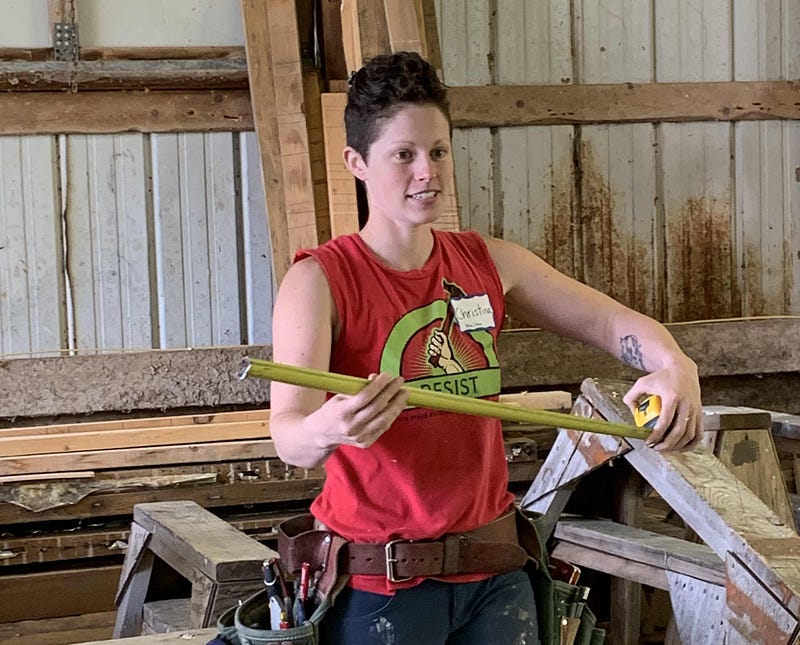
Our instructor, Christina, and her assistant Emily are both skilled, working carpenters. They quickly put us at ease and told us they were in their twenties before learning carpentry. Christina said failing is part of learning and that you never get so good that you don’t make mistakes. However, she assured us that everyone in the class was going to succeed ultimately. We joked about the class being one part carpentry and one part group therapy.
Let’s Start at the Very Beginning — Tools
And then we jumped into the learning and the doing. The course material was a great mix of explanations interspersed with doing, starting with what’s a boxcutter and how to use one to sharpen your carpenter’s pencil. We were partnered up to share tools, temporarily brace pieces of wood and learn from each other’s mistakes and successes. My partner, Rosie, was slightly older than me — nice to not be the oldest. Rosie commented that her husband, a carpenter, was excited she was taking the course.
Before you can cut, you must measure. I figured a tape measure was one tool I was very familiar with, but hey… no, I didn’t realize the end of the tape measure has some play, or give, in it for a reason. And no, I never noticed marks at the 16, 32, and 48-inch measurements. Interesting.
By mid-day, we were ready to use the saws. One woman grew flush as she talked about how anxious she felt. I saw her taking some deep breaths before I focused on my own work. I knew that Christina or Em would stop by if she needed help or reassurance.
What Were We Building?
A pair of saw-horses, like this one:
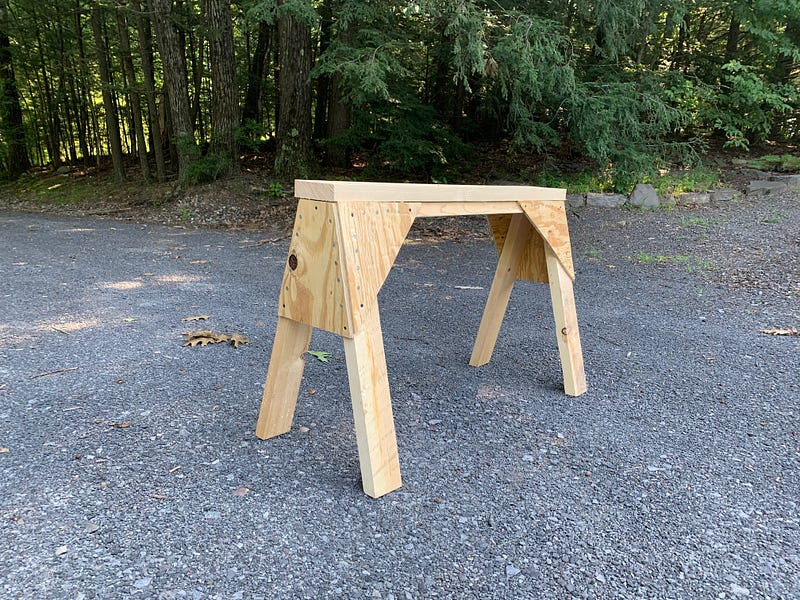
While our instructors had provided the wood, fasteners, and tools, we were doing the rest.
At least as cool as mastering the tools was learning more about how things are built. Christina started at the beginning, with a tree growing and water being carried up through the tree. The ‘straws’ that the tree uses to pull water up from the ground affect the grain of the wood. The water has to dry out of the wood before it is used. It was eye-opening, and several concepts clicked for me.
Self-reliance is highly valued by the instructors at Hammerstone. Christina demonstrated how to carry sheets of 1/8 inch plywood by ourselves. She explained that if you kept the board balanced, with the weight positioned properly against your body, then you won’t hurt yourself. She broke the task down and made it look easy.
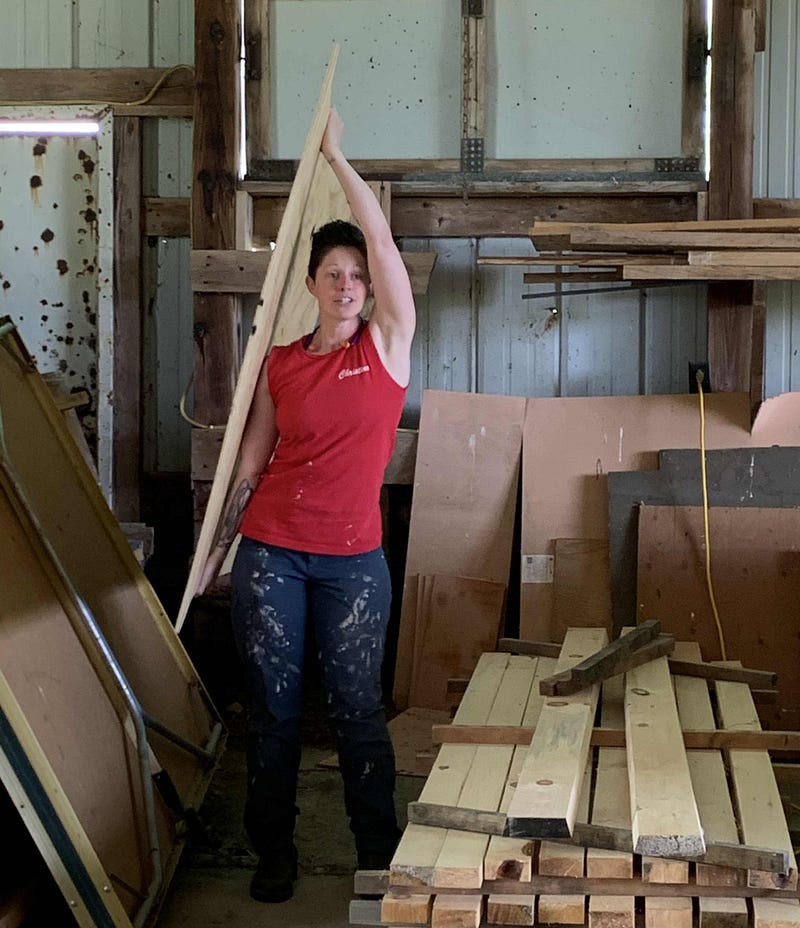
“Would anyone like to give it a try?” she asked. One by one we each decided to give it a try and succeeded. Very cool.
My Nemesis
On the second-day of class, fairly late in the day, I met my nemesis, an electric power drill. While I had been successful in everything covered in class so far, suddenly, I was struggling. I failed to even fathom getting the drill bit in and out. “Hold the chuck? Huh?”
My classmates were doing what had been demonstrated, and I was not. Self-doubt began to buzz in my brain. My class-partner Rosie had taken her drill bit in and out. What was wrong with me?
I tried positive self-talk, “Come on, Anne, you can do this. You are among friends now. Let them show you.” I made a joke of needing ‘remedial instruction’ and asked Christina for a second run-through on the basics of drill operation — putting in the bit, running it forwards and backward. This time, I managed the basics. Now armed with the drill, I headed over to the workstation that Rosie and I shared, and faced wood and screw. Things did not go well.
After the third or fourth time of the screw sliding off, Rosie calmly said, “Take your time.” Her voice steadied me. I held the screw and again checked that my hand, arm, and drill were lined up to apply pressure evenly and in the right direction. At last, the screw went in! The score became Power Drills of the World — 6, Anne — 1. About 10 minutes later I had put in the other 5 screws and evened the score: Power Drills — 6, Anne — 6. I can do this.
I also learned that I didn’t have to have complete mastery of a power drill. I fell in love with the impact driver. Apparently, I’m not the only person in the world to struggle with screws sliding off. Good to know.
The Most Important Lessons I Learned
1) Women can be excellent carpenters and master teachers of the craft of turning wood into useful objects.
2) Part of learning anything is a willingness to fail, look silly, and try again.
3) It’s more fun and effective to learn with others who are at your level.
4) If I can do this — measure, saw, assemble, screw, hammer — anyone can.
5) You don’t have to stay at the level of skill/understanding you were raised at.
6) Basic carpentry skills and understanding are not rocket science, and you don’t need a Y chromosome to learn them.
Two Reasons for Women to Build Carpentry Skills
According to Statista, a ridiculously low percent of professional carpenters are women — 3.2 percent to be exact. The carpentry trade is looking for people. People with modest skill levels, but strong work ethics and a good attitude, will get hired. Entry-level positions have fairly low pay but can lead to better positions and pay more than unemployment.
At least as important as the job potential is everyday life. Women don’t generally tackle construction or repair tasks around their homes. Many of us wait on the guy in our lives for home improvement instead of controlling our own destiny. If you have a chance to take a women’s carpentry class, do it.
If you can’t get to an in-person class, some online alternatives are: Erin Devine of Top Shelf DIY or Emilee of Mama Needs a Project. Or see this list of online ‘female makers’ with handy video tutorials.
I came across this quote while browsing Mama Needs a Project:
“I believe down to my core that working with your hands to physically create something will change your life! DIY helps build confidence, forces you to problem solve, teaches you practical life skills and gives you a sense of accomplishment that is unmatched.”
~Emilee
I agree.
If you liked this article, here is more about me and more of what I’ve written. Or follow me to see the awesome stuff I write in the future!
For more of the good stuff, follow Fourth Wave, where we’re changing the world for the better, one story at a time. Got one of your own? Submit to the Wave!