
Without Living Through Darkness, How Could We Appreciate the Light?
The flowers and the wildlife agree it’s impossible
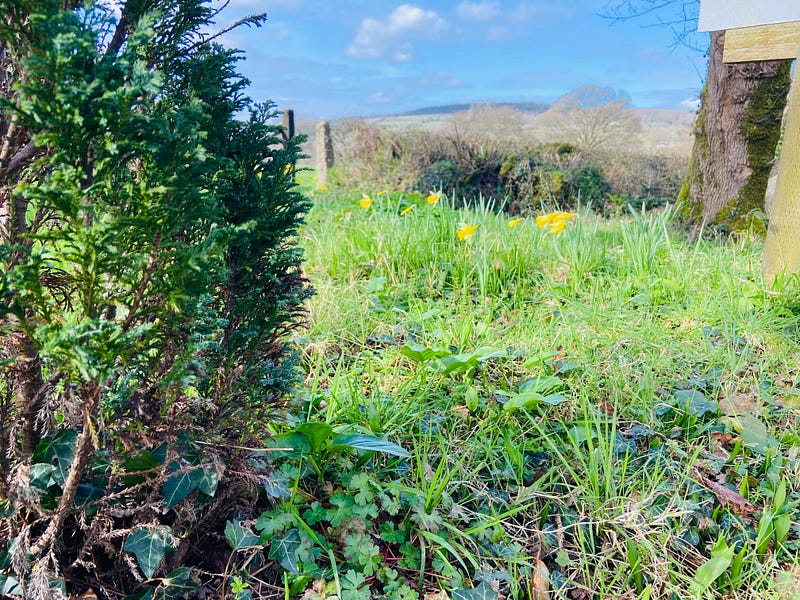
Something magical happens in March. I often see it first in my kitchen.
As soon as we enter the first days of March, my kitchen sees the first glimpse of something it hasn’t seen since October — sun.
It may seem small and insignificant, but to me it’s huge. The darkness of the winter is like a blanket that smothers everything. My kitchen, like many traditional Devon kitchens, is a cold space — perfect for storing food but horrible to spend time in during the winter season. My morning coffee-making ritual during winter is an act of survival before I can slip away with my cup of hot liquid-heaven, and cosy up back in my bed or beside a glowing heater.
With no sun ever touching it, there the kitchen remains — cold and bereft of any direct natural light or warmth.
But when March arrives and I enter the kitchen in the early morning to put the kettle on and start my day, the kitchen is a whole new place. A tiny slither of morning sun has made its way through the French windows and has fallen across the corner where the kettle sits.
That tiny slither of sun welcomes me to a whole new world, and gives me a taste of everything that is to come. It changes my entire day by dowsing it with a sense of elation and belief. It makes a smile break out in every part of my body and soul.
This month, everything is waking up.
Even the moment I open my eyes each morning feels more woken-up than last month.
The light that is trying to flood my room by 6.30 am is like a kick to my senses, making me feel alive despite the early hour.
It’s as if the time to live has returned. And it makes me realise that every day that passes through the darker, colder times are simply being counted down until it’s time to live again. It’s not that those days are spent in some depressed winter state, but simply a dulled state of being.
Years back, when an ex-partner and I used to travel every winter, I didn’t know this feeling of bursting out from a dulled place. And I will say again and again and again, back then, I missed out.
Travelling abroad to hot places in the winter may make my life look idealistic, as if I am living in a perpetual summer, but in truth I missed out on some of the best parts of living by constantly chasing the sun. Life was never meant to be all light and sunbeams because the light and sunbeams can’t be appreciated without some darkness.
Just ask the daffodils and the crocuses. They know. They understand what it means to quietly bide your time until the sun’s angle is such that the earth is ready the receive you.
The birds too. They chirp their agreement with the daffodils and the crocuses.
And yes, I do talk to the flowers and the birds a lot. Every day. And also the bunnies and the bees and the foxgloves and the honeysuckle and the sunflowers as they all appear, one by one, through the strengthening of the light and the inevitable warming of the air surrounding us. They all live by the principle that they are stronger for the dark times.
There’s a saying that the darkest times come just before the dawn.
Sometimes that can mean literal darkness. Other times it may mean that everything feels the hardest just before relief comes.
I’ve watched my sister endure her first winter in the UK in around 27 years. She successfully avoided winters by pursuing a career that took her across the world, to the Far East, where she spent the majority of those years.
While her career in environmental resilience and development was, of course, a major part of her motivation, avoiding the dark, cold and grey of British winters was also a big driving force, for her mental health suffered during those months. So this first winter back here, while dealing with a myriad of problems with her new house and some battles in her job, proved to be a huge challenge for her.
There’s little you can say to help someone who is battling winter depression, other than to try to remind them that it’s only for now, not forever. We may have grim winters here in the UK but we are fortunate that there is light at the end of the dark winter tunnel, even if we can’t yet see it.
Not everyone is so lucky. Their darkness may, for whatever reason, not have that guaranteed light to look forward to. So for those of us who do, we need to remember what a true blessing that is.
In early March of 2015, I was probably at the lowest I had ever been in my life following a legally-enforced no-contact order between my abusive ex-partner and me.
Like many victims of abuse, I had been as addicted to my abusive lover as much as I had hated him and wanted him out of my life. When he wasn’t there, I felt deflated and utterly lost.
It was around then I came across a gratitude practice that required me to take a photograph each day of something I was grateful for. Although it was challenging to find something each and every day, the act of keeping my eyes constantly open for something that evoked a sense of gratitude meant that, before long, I was finding a million things. That practice subtly worked its magic on me to shift my mindset from being devoid of any happiness to experiencing multiple moments of great joy and elation each day.
That same month, on 20th March, the eve of the Spring Equinox, there was a solar eclipse taking place that would be visible from the British Isles. The headteacher of my daughters’ school decided we could start the school day with a picnic on the steep moorland hillside above the school, to watch the eclipse together.
It was a cold, misty day, but with blankets and flasks of hot tea, we watched the silhouette of the sun through the mist as it disappeared into the shadow of the earth, and re-emerged before burning away the thin clouds surrounding us.
That experience, of sitting on the earth, feeling it slipping into darkness as the sun was obscured, only for it to return, gentle-paced but with great force, was profound. Coupled with my deeply impressionable state of being and my virgin experiences with the power of gratitude, I found myself thrown into this state of great elation like I had never known before.
I would go as far as to say that it felt as close as I have come to a mystical experience.
On that occasion, the darkest time really did come just before the dawn, before the sun’s emergence from the shadows, and before the darkest half of the year transcended into the lightest half.
As we approach another Spring Equinox, I find myself reflecting on these profound moments when I have patiently given space to the darkness, and then witnessed its gradual replacement by light.
When I don’t go chasing the light, I live in the moment and act in the moment.
Since giving up chasing a perpetual summer, I have learnt to love the dark times for what they can offer.
I have used those darker, colder, duller times to my advantage. Those are often the times I become most creative and productive. They are also the times I spend learning, soaking up information from books, videos and courses I have treated myself to.
Those winter months are perfect to go inward, to retreat from other people, and give myself permission to enjoy all the good things that being still indoors offers. Come the warmer, brighter weather I’ll want to be outside more, moving my body, and enjoying interacting with others.
To me, the seasons are important. Without the dark seasons, I can’t appreciate the light ones. Without the slow, restorative seasons, I can’t appreciate the high-energy ones.
Without my introspective season in which I think, create, learn music or a new skill, write, and put energy into my immediate surroundings, I can’t appreciate the opposite. Without saving my physical energy and building my strength, I can’t immerse myself in the joy of swimming, kayaking, hiking the coast, and long evenings sitting out with friends.
It’s the yin and yang of life.
For each of us, that will look a little different.
But for me, it’s as simple as the dull and the bright, the cold and the warm, the darkness and the light.
And now it’s March, that little slither of light has arrived, and I’m ready to shift gears.