
With a High-Pressure Full-Time 9–5 Job, I Wrote 18 Articles Last Month (You Can Too)
How to access the content that’s already inside you is the real game.

I manage a team of six people in my full-time job, and it’s a tough job, at least to say. After I log off in the evening, I want to unwind, and writing is the last thing on my mind at 6 PM.
Still, I managed to pump out articles fortnightly last month. How?
I built a system around writing content that helped me write a couple of hours a day and post enough to grow on the side.
I’m sharing some of the tools that have worked for me in the past few months (especially in the last month), and I hope they’ll be helpful to you, too.
1/ Unique personal experiences
How do we make sense of life?
By telling stories.
How do you make sense of your experiences?
By sharing them in the form of stories.
Many people think that they don’t have any unique experiences to share or there’s nothing of value in their experiences.
Do you know what the problem is with the above sentence?
It’s just one word, and that’s the core of the problem — “think.”
If you want real data, write about it and let the world decide whether your experience has value or not.
If you don’t share your stories and suffocate them inside of you, the only possible result is your belief that “you don’t have anything to share that’s worthwhile.”
But by sharing your unique experiences, you give it a chance to breathe in the real world, and then those stories can get a life of their own, and you can’t control how people respond to it.
“Give your stories a chance to breathe. That’s the only way you’ll understand their power.”
Build a library of your unique experiences. Don’t think. Write a list of 5 things daily about your experiences — the more you write, the more unique angles you’ll find within them. Don’t judge them. Just put them down.
2/ Unique cultural background
Back in 2013, I worked as a software engineer. And then, I quit my job and got into a film school to learn film direction and screenwriting.
I can speak and write volumes about films, screenwriting, and writing in general. But, writing on Medium has allowed me to speak about where I come from and understand my life in a way I never imagined possible.
What writing on Medium has taught me is that a simple story about my upbringing and my life in school, which I presented as is (here), created an impact on people because it might be generic to me because I’m aware that such things happen to so many people in India; but it was a unique perspective for the readers (and writers) from other cultural backgrounds.
To write about the place where you grew up is an unfair advantage you were looking for.
And this is not just limited to your stories; it’s about the stories of people you grew up with, the friends you grew up with, the school you went to, the kind of teachers you met there, the kind of communities you were a part of, about your extended families, and so much more.
Write about your background without mincing your words.
You’ll be surprised to see how so many people will connect with you, talking to you about their background and similarities and differences in your culture.
Create a library of unique stories from the place you grew up in.
Don’t worry about the uniqueness; list down the things you remember because you remember them for a reason — believe in your subconscious, it won’t let you down.
3/ Unique pain you’ve experienced
Think about this.
A kid lost his favourite pencil in school. Now, he’s crying all day about it, and he/ she can’t stop thinking about it.
Think about this from the perspective of an adult. Will I cry about this lost pencil? No.
Is it insignificant to me? Yes.
Will I cry about my girlfriend dumping me? Yes.
Here’s the thing about perspective.
The pain that the kid experiences after losing his pencil when he’s a small kid with very limited life experience is very similar to the pain I’d experience after losing my romantic partner.
We make a huge error by trivializing our pains because that’s one of the ways for us to escape ruminating about it.
But whether you write about the pain of losing your favourite pencil or your beloved partner, it’s not the story that’s important here, but the writer of that story (YOU) who’s bringing the unique perspective to it.
I’m not asking you to complain about stuff; write about it exactly how it happened to you, exactly how you experienced it, with an attempt to make the reader experience the same.
Don’t judge your pain. Just share it. It’s valuable and makes the people with the same kind of pain feel less lonely.
Last
The idea is not to write perfect pieces of content every day.
It’s to create a library of content that you reiterate as you continue to evolve as a writer.
Here I’m sharing my brain dump of everything I came up with today in the morning.
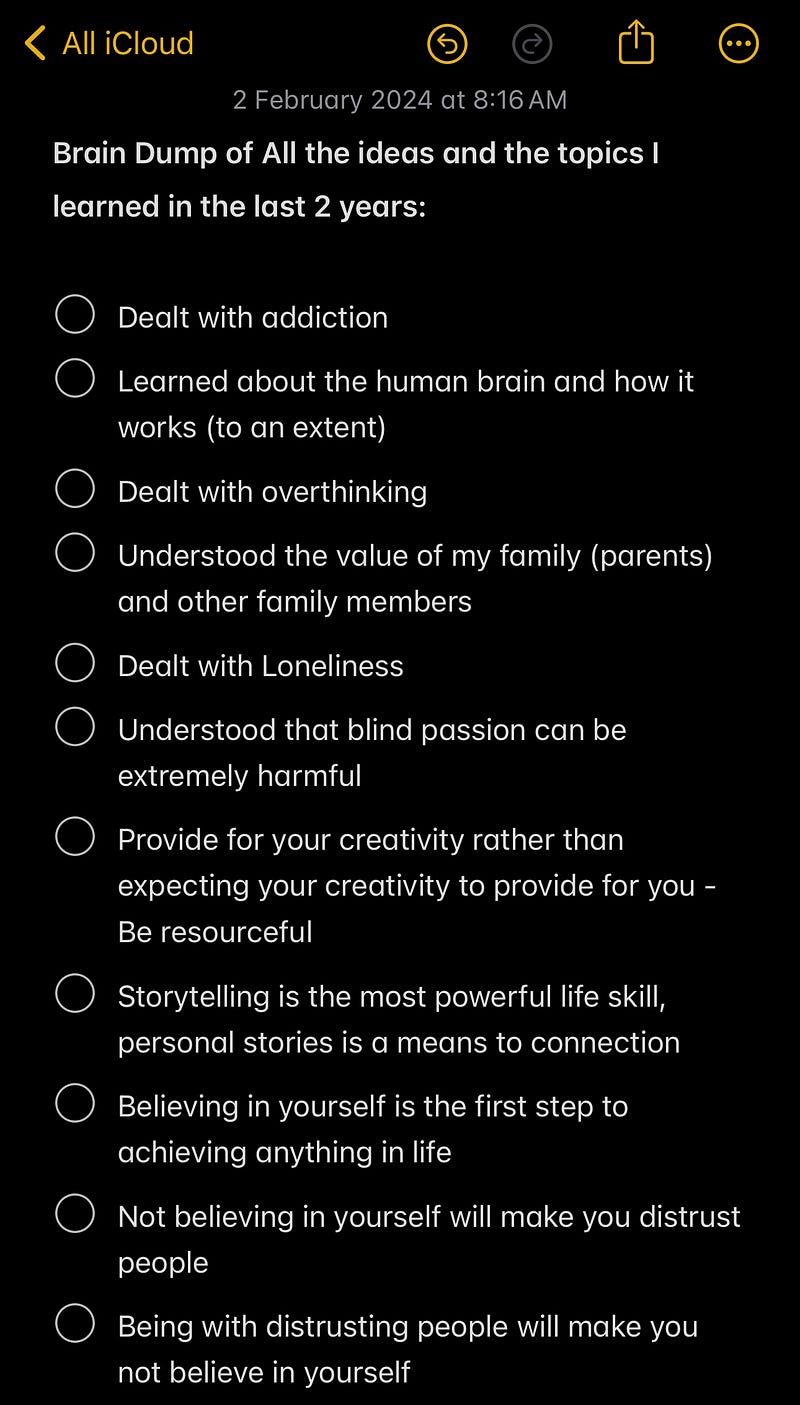
I do this exercise every week, and although you don’t have to write about everything, your brain dumps in your notes.
Feel free to write about it for yourself — not everything you write is supposed to be put out there in the world.
Some stories you write are exclusively for you.
And that’s the magic of writing — you’ll either learn something about the world outside you or, other times, about the world inside you.
Until next time,
Ciao!
Join 100+ creators, storytellers, and filmmakers in a newsletter that makes you a smarter storyteller — The Storytelling Wizard