
Witch Trials with Fangs: The Werewolf Trials of Medieval Europe
During the height of witch trials in Europe throughout the fifteenth through seventeenth centuries, one subset of witchcraft that men and women were accused of was Lycanthropy or being a werewolf.
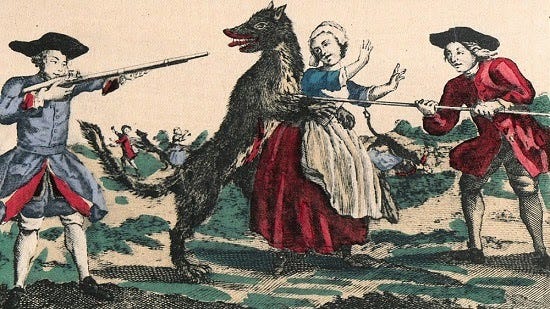
The Fairy Tale Little Red Riding Hood tells the story of a wolf who lays a trap to catch and eat a young girl. Some versions end with a woodsman saving her at the last minute while darker, earlier versions do not. Either way, the story is a cautionary tale for young children to be careful who they befriend, especially in the woods. The wolf in question is generally seen as a metaphor for the real danger of humans who mean no good. In the sixteenth century, however, when the tale first began circulating, many rural areas believed in real werewolves. In fact, hundreds of men and women were accused of, put on trial for, and some even confessed to, being werewolves.
Werewolf trials were a specific type of witch trials. Those accused of being werewolves were accused of practicing witchcraft to perform their transformation. They were less common than the standard witch trials prominent in the same period, but the main crime -practicing dark magic — was the same. Most accusations and confessions involved a pact with the devil and hunting and eating humans. Many also involved a magical ointment or, occasionally, a magical object such as a belt that gave werewolves their abilities. The trials were generally public and often led to public executions. Some of the accused were brutally killed and then burned while others were sent to an asylum or monastery, or simply banished. Most of the heavily recorded cases involved men on trial, but women were accused of werewolf witchcraft as well. In some cases, family members of the accused were put to death along with them.
The most uncanny thing about the trials is how many confessions are recorded. These confessions were most likely made to avoid torture, but some may have been due to mental illness. Lacking adequate medical treatment, they may have only been able to make sense of their experiences by believing to have made a literal transformation into another creature. Another theory is that the ointment mentioned in several of the trials may have been a hallucinogen. Symptoms of Lycanthropy also correlate with symptoms of rabies or epileptic episodes.
It is difficult to say how many of the accused werewolves were real criminals who were imagined to be wolves because their crimes were so heinous, and how many were simply loners or outsiders used as scapegoats. Given the nature of witch hunts, there was likely a good deal of the latter. One accused werewolf, an 18-year-old named Hans, confessed to having become a werewolf after having been bitten by a man in black. His accusers decided this man must have been the devil. He answered their leading questions, stating that he felt more like a “wild beast” than a man. Unlike many other cases that involved multiple missing persons, there were no other crimes connected to the case, but because Hans was found guilty of practicing black magic, he was put to death.
Not everyone in the time period believed in werewolves. Some even then thought the confessions must be caused by hallucinations or medical Lycanthropy, a mental illness recorded by physicians since 200 AD that involved believing one was a wolf. Medical Lycanthropy was thought to have been caused by black bile. Early descriptions of the illness involve periods of depression, lingering at graves, and restlessness. Later descriptions include madness, violent animal behavior, and even digging up graves and carrying around body parts. This change in the perception of the illness was likely influenced by werewolf trials and growing belief in werewolves, as it occurred in the same time period. Medical Lycanthropy was used as a defense in criminal trials for hundreds of years after the witch trials ceased.
Wolves were a major threat to society in the late medieval period, which may be a contributing factor in why werewolf accusations became so common. People feared wolves and accusing unsettling neighbors and loners of being wolves might have helped them gain control over their fears on a subconscious level. The idea of men and women turning into wild animals and losing their humanity is terrifying but not as terrifying as an ordinary human committing atrocious acts. By deciding an accused person was no longer fully human it became easier for the accusers to distance themselves from the crimes and much easier to justify brutal executions. Regardless of how many of the accused actually committed the crimes they were accused of, the werewolf witch trials show how much cruelty an ordinary human, unaffected by any devil or beast, is capable of.
Sources:
Werewolf Trials: Europe’s Gruesome 16th-Century Witch Hunts (allthatsinteresting.com)
Battling demons with medical authority: werewolves, physicians and rationalization — PMC (nih.gov)
The Origins of Werewolves — Owlcation
12 ‘Real’ Werewolf Cases Throughout History (historycollection.com)
Before America Had Witch Trials, Europe Had Werewolf Trials | HISTORY
If you enjoyed this article, you can hire me to write one for your website or blog here.