Witch-Hunts and Fear: The Emotional Maturity of ParaNorman
Fear makes you do terrible things…
I love the movie ParaNorman. It’s hugely underappreciated.
This beautiful, weird, stop-motion mash-up of classic horror and kids’ adventure tale is surprisingly emotionally mature.
It explores the way that fear creates hatred, which in turn creates fear and hatred. And that adults can sometimes act out when they’re scared, in ways that can hurt the people — the children — around them.
Warning: this post contains SPOILERS for the film ParaNorman, and discusses: persecution (including religious-based persecution,) Ableism, Transphobia, Homophobia, horror elements, executions, death
I’ve seen ParaNorman quite a few times now — it always strikes me like it’s the first time I’ve seen it.
I think I forget, in between watches, just how good this film is.
First-off, of course, I appreciate anything made with stop-motion animation — stop-motion uses puppets or models, which are imaged, frame-by-frame, as they are moved incrementally by hand.
When the still images are put together (at a rate of around 24 frames per second,) it generates the illusion of movement.
In order to create smooth-looking movement, the positioning of the models from one frame to the next has to be both minute and precise.
It’s a labour-intensive, and supremely stylised and skilled, form of animation, and it always leaves me in awe at the dedication of those working on it.
In order to make a stop-motion film, you have to love it.
There’s just no way you’d work all day for circa three seconds of footage otherwise (unless the pay was incredible, I guess, but I don’t think ‘stop-motion animator’ will get you on the rich list.)
The designs of the characters are also awesome — because they’re realistic, despite being models/puppets.
People in ParaNorman have lumps and bumps and wonky bits, but not to such an extent that it seems like a caricature (not imho, anywho.)
Norman’s a kid of about 10 or 11, who struggles socially — to put it mildly — because he can see and talk to ghosts.
We don’t get any info about Norman’s previous attempts to get his family and schoolmates to believe him, but their reactions to him show that this is an established issue between Norman and… literally everyone in town.
Bigger kids mock him, cruelly, while grown-a** adults make disapproving looks or tell him to stop with this ‘freakishness.’
…Which all plays out against the background of a New England-style town that capitalises on the history of a famous witch-trial and execution.
Imagine the stereotypical image of a witch plastered on every touristy thing you can think of — and that’s what we have here.
The paranormal is literally everywhere in this town — shop windows, school plays, etc. — yet Norman’s connection to it is seen as unnatural, undesirable, or simply unreal.
Put a pin in the witch-trial, we’ll come back to it later.
Norman is a typical outcast stand-in, of course.
He’s the loser, the weird kid. So far, so tropey.
A lot of people can relate to feeling like an outsider, to not quite fitting in, to feeling like people are judging them.
I think most of us have felt like that at some point; Norman’s an especially good allegorical/metaphorical stand-in, though, for Queer and Neurodiverse kids in particular.
Disclaimer: I am a Synaesthete and migraineur with mental health problems and Dyscalculia — all of which are sometimes/often (depending on which ones we’re talking about,) considered forms of Neurodiversity — but I am not on the Autistic spectrum.
I will be mostly talking about Autism when I talk about Neurodiversity here.
Please understand that I’m writing this from the perspective of a non-Autistic person, and am writing with that limitation. Please correct me if I’ve said anything wrong or misleading.
Norman literally sees the world — sees reality — in a way that other people don’t understand.
Other people can’t see the ghosts. He can.
His perception and experiences of life are so different from everyone else’s that they decide he’s attention-seeking.
His family, doing bad things with arguably good intentions, try to get him to conform to ‘acceptable’ (neurotypical,) social behaviour.
To not act out and embarrass them in public even though he’s frightened, to not talk about what his grandmother said even though — to him — she’s right there in the living-room.
(To be clear — I’m not saying the ability to communicate with the dead is an Autistic trait. Just in case anyone got the wrong impression!)
Being expected to comply to social norms** in a way that’s unnatural to the individual is something which people on the Autism spectrum have often described as happening to them
– either through deliberate means of forcing them to suppress Autistic behaviours, such as stimming, or through general pressure being placed on them by others.
Many Autistic people find conforming to neurotypical norms exhausting, draining, and often distressing — especially if they’re expected to do so 24/7.
(Plus the arrogance of believing that the non-Autistic way of seeing the world is the ‘right’ one is pretty goddamn flawed in and of itself.)
**Link CWs: Ableism, masking, discussions of: suicide, suicidal thoughts, mental health problems
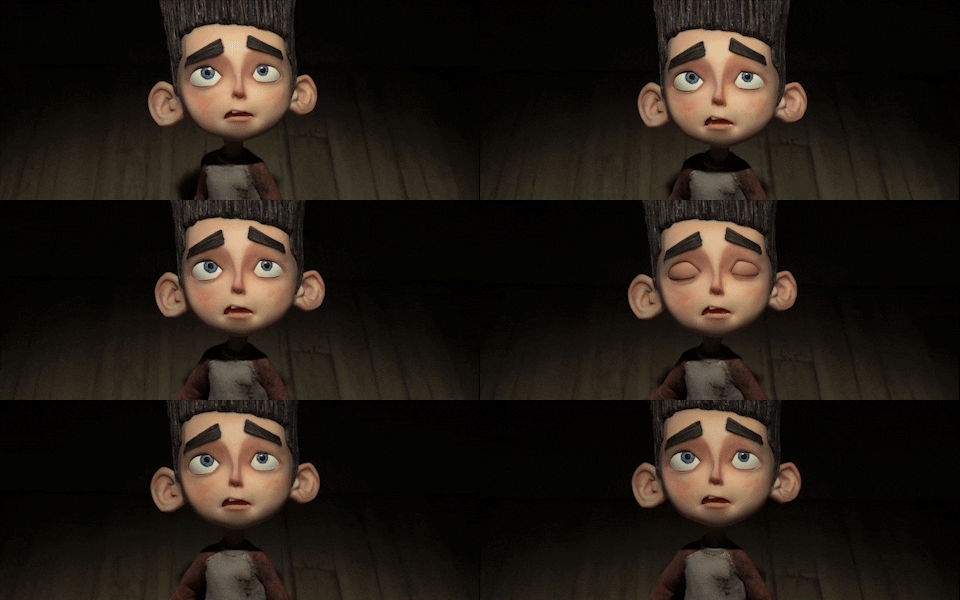
Doubtless, Norman’s experiences could also be viewed as a parallel to a bunch of other conditions –
kids with mental health problems, just as an example, will also often be painfully aware of doing the ‘wrong’ thing in social situations.
And many, many, people, with a whole range of disabilities, will know the pain of being told they’re lying or attention-seeking.
The cruelty, antipathy, or callous apathy, of other people, when you’re just trying to get through a tough time, or even just trying to live your life day-to-day, is something it’s hard to explain to those who’ve not been through it.
People are often not good to those with medical conditions — especially when that condition is chronic; you’d be surprised how often compassion apparently comes with a time-limit.
There’s a moment in this film where Norman’s father is ranting while driving the family home from the school play.
Norman had a paranormal vision mid-way through the play, and ended up screaming and falling off the stage, into the crowd.
Instead of reassuring Norman, his father decides to rant about how he embarrassed them.
In frustration, as they pull up to the house and his father gets out of the car, Norman cries out -
“I didn’t ask to be born this way!”
To which Norman’s father answers, still walking to the house, “Funny, neither did we.”
…And every Queer heart breaks in two. 💔
Norman’s mother tries to soften the devastating blow — to explain that his dad’s just scared. Norman seems to get it — but he also knows he deserves better.
The whole thing is… argh, so wonderfully done!
And it never tries to simplify the emotions for its audience — it accepts that kids are perfectly capable of taking in this scene, and even if they weren’t it wouldn’t harm their ability to follow the plot.
The Queercoding in ParaNorman is very much about how Norman is treated, not how Norman himself acts.
There’s nothing in Norman’s own actions or attitudes to give any indication as to whether he’s Queer or not.
There’s no coding one way or another, since Norman has no discussions of gender or romance at all in this film.
(It’s actually surprisingly refreshing for the small child to not be romantically linked with anyone in this film — there is a female classmate that Norman and his friend Neil talk to, and ask for help with research, but she’s not a love interest for anyone.)
But the way people react to him — especially in his family — will be uncomfortably familiar for Queer viewers.
Obviously, the ‘born this way’ moment speaks for itself (I hope.)
But there’s also Norman’s father trying to make him stop with ‘this freakishness’ which his mother tries to soften by calling him ‘sensitive’ — often used as a code-word for feminine or effeminate. (Gosh darnit toxic masculinity! This is why we can’t have nice things.)
‘They did not see how it was the thinnest of tricks: if a thing frightens you, call it something else. They did not see that to classify a thing away from fearfulness rather shows fear, than any lack of it.’
- Beth Underdown, The Witchfinder’s Sister
And there’s a fear that Norman will turn out like his eccentric uncle on his mother’s side
– who lives alone in the woods, has a long beard, and wears hunting gear. He can also see ghosts.
Worth giving a note, here, is that there is a canonically Gay side-character in ParaNorman (somewhat revolutionary in a family film, all by itself,) —
— although we only find that out at the end.
I don’t consider Queer IDs to be SPOILERS, and often these ‘reveal’ moments are cheap at best, but I actually found it quite satisfying because it’s a play on expectations, as well as tropes within the horror genre, and is done quite well imho.
Our Gay character is a stereotypical high-school American football player, the brother of Norman’s friend, Neil. He’s a jock — cars, weights, etc.
Norman’s sister had been trying to seduce Mitch for most of the film in the typical teen horror movie way, and him talking to her about his boyfriend is a delicious, casual, moment (again, imho — I’m sure there’ll be people who disagree,) and makes perfect sense for Mitch’s character, without the need to resort to exaggeration or stereotyping.
The people around Norman don’t understand him — which makes them scared, and in turn makes them lash out at him, makes them persecute him.
Transgender kids in particular may well know what that feels like.
The complete lack of understanding from Cis (non-Trans) adults, and the Transphobic propaganda and anti-Trans laws that continue to bubble in the UK, the US, and other countries, has often been compared — rightly so, in my opinion — to a witch-hunt.
Which brings us back to the witch-trial, and fear. And what fear sets into motion.
That’s the central message here — fear makes you do terrible things. Even to little kids.
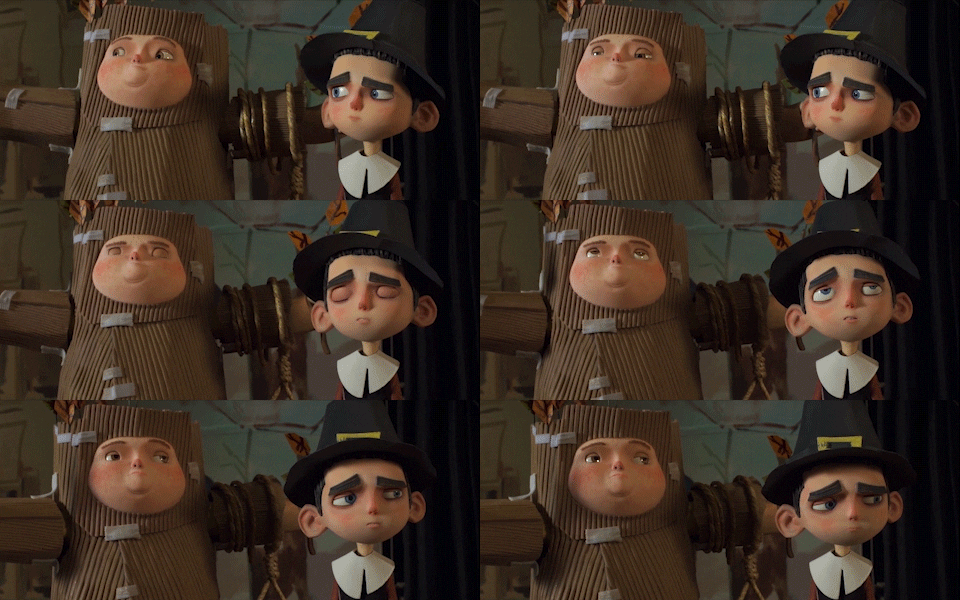
The witch’s history has been misremembered — changed to make the Puritan town elders seem more righteous.
She was never the stereotypical (and misogynistic, not to mention ageist,) figure of the old hag on a broomstick.
She was a small child. Who spoke to the dead.
And so the town elders? Sentenced her to death, and executed her.
‘I have learned that the acknowledged history that belongs to the daylight, that is not the only history. Turn over the stone and you will find another history, wriggling to escape.’
- Beth Underdown, The Witchfinder’s Sister
And when Norman confronts them —
because zombies — did I neglect to mention that? Yeah, the town elders are zombies now
— they have a simple and heartbreakingly terrible reasoning behind their decision:
They were afraid of her.
…They didn’t understand her. So they killed her.
Marginalised people everywhere are shivering reading that.
Because the collective history of humanity has seen this play out time and time again.
ParaNorman though, is ultimately a story of breaking the cycle of hurt, trauma, and fear.
Yes, it takes extremely little before the townspeople turn into an angry mob, baying for blood. But all it takes is a few people willing to stand with you to make the tide turn.
And those people don’t have to be do-or-die friends. They don’t even have to particularly like you — they just have to recognise what’s right. And stand by you.
Sometimes, all the witch needs is for someone to sympathise with her — to recognise her humanity and all the unspeakable wrong that was done.
Sometimes, we just need to remember that lashing out doesn’t stop the pain — it just feeds it.
New to Medium? Thinking of becoming a member?
You can get unlimited access to all stories on Medium when you become a Medium member.
You can become a member using the link below, which also gives me commission on your membership fees, allowing me to earn income doing what I love:
Originally published at https://www.dorareads.co.uk.


