
Wisdom from a Life-long Learner
Career & life advice from Chris, a retired executive director of process architecture
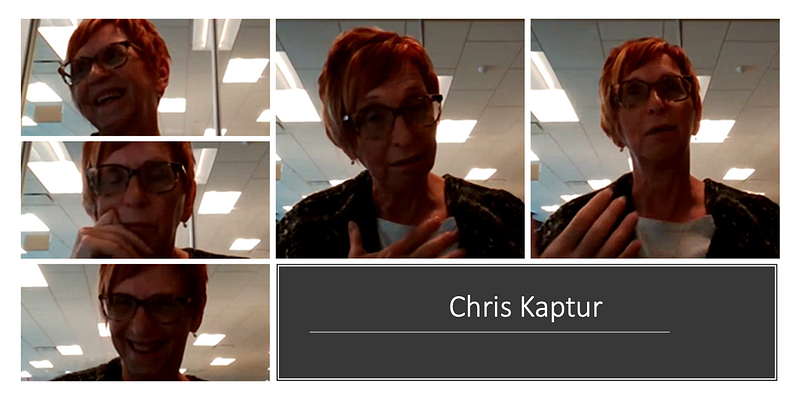
One of my childhood fascinations is learning about people and their lives, how they grew and achieved remarkable things in their lives. I am starting an interview series with the people around us to explore their growth journey, what worked for them and the wisdom they offer.
You can also watch the video of the interview.
In this first interview, you will meet with Chris (Christine Kaptur). I interviewed her the day before she retired. She is one of the most humble persons I have ever meet. She had her own babysitting business at the age of 12 years. She is now 68 years old with 56 years of working experience. Her lifelong experience is valuable for anyone who is looking to achieve excellence in his or her career.
“I’m 68 years old. I’ve been working since I was 12, so you know, your life experience always grows, grows, grows.” — Chris
Without further delay, let me introduce you to Chris, retired executive director at AdventHealth.
#1 — You are retiring tomorrow. How does it feel?
There’s a lot of different emotions I’ve been feeling. When I first turned in my notice that I would be retiring six weeks ago, I pushed off a lot of it, like, oh, it’s far away. I don’t have to think about it. But now that it’s one day, I have a mix of emotions, excitement, sadness.
I am scared because I’ll be living on a fixed income. Even though I have a retirement, you’re not making the same amount of money.
I am scared that what I do makes a difference and makes me feel like I’m contributing, and then you start thinking, what will I do when I retire?
How am I going to stay relevant? Are my friends going to Remember me? All the friendships I’ve made.
What are you planning to do on Monday?
I’m going to sleep in without an alarm clock. That’ll feel nice.
People that I have talked to, especially people that are retired at a younger age. They find at the six-month mark where they’re bored, and that’s where they start looking at seriously what to do, and so I have a friend that did retire, and now she’s working part-time. She just could not stand not doing anything. Her husband has a business, and so he did give her little things to do. But yeah, she went back to work part-time.
What will you miss the most?
I think it’s problem-solving. I love taking something dumb and trying to fix it. That’s why I love to be a process architect.
And then just help in making our testing for AIT better. From a patient safety perspective, Jackie and I keep a log of the major incidents and others that we hear about that could potentially harm a patient and have an IT component. Some of those are related to testing or not testing adequately.
So that push for quality, making things better, that’s what helped drive me. It’s always wanting to make something better. I will miss that.
#2 — Please share your career journey.
You had your own babysitting business?
I’m the eldest of five children. I had my own babysitting business at the age of 12 years. I used to be able to buy my own school clothes, winter coats, and shoes. My parents didn’t have to worry about taking care of me. When I was 15, I got a job in a flower shop. So yeah, I’ve always worked.
At age 15, Chris got a job at the flower shop. What happened next?
Our high school had a program with the local hospital William Beaumont Hospital, Royal Oak (link), and it was a program as a nursing aide. It was a co-op program, so we got to learn how to be nurse assistants.
I did that in my senior year and then from there, and I worked at Beaumont Hospital, and then that’s when I decided, well, I was enrolled in pre-med, but I decided that nursing was better for me as a person. So then I went to nursing school, and then from there, that was my career.
You started with nursing, and then how did you end up retiring as the director?
That’s because nursing is very broad. It’s a great profession, and there are avenues that you can branch off to as a nurse. So I started in critical care. I did nursing for probably a good 10–12 years.
And then, from there, I went to infection control epidemiology. I did that for probably ten years, and then I got tired of being cold in Michigan and moved down here. That’s how I started working at Florida Hospital in infection control, and from there, patient safety, process improvement, and IT; the process architect role is about process improvement.
What was your thought process when you were offered a director position
So it was a stair-step, assistant director then director.
It was like, oh wow, it’s something new I would learn, like patient safety because I was getting tired of infection control. I just devoured everything and wanted to learn as much as I could. I put that program together for the Central Florida division. We started our own patient safety Officer community. So we did a lot of good things together. Then I get bored, but I don’t get easily bored.
How long have you been in the director role?
I’ve been a director at Advent Health twice. When I first came, Jayne Bassler hired me. She was the director of quality at Central Florida Division South, and she needed an infection control manager.
And then, through my time, her being my leader, she gave me more and more responsibility. She gave me patient safety, and then I became a director. Then I ended up having process improvement. So then, I became an executive director.
But my mother’s health was failing. My daughter was a junior in high school getting ready to be a senior, and it was hard working 14–15 hour days. And then have all that responsibility, and when there was an opening in IT, under Linda Terrell, as a process architect, I just thought that was the best position for me, where I could handle more. I could take care of my family and myself. I had to take care of my mom. She took care of my daughter while I was working and, that was also awesome.
It was great to get a project, and there is a start and a finish, and you feel that sense of accomplishment. Whereas when I was on the operational side and I had infection control. You’re constantly telling people to wash their hands. You’re constantly telling people, and they don’t listen, and so it’s kind of like it becomes a vicious circle over time. So in IT, you get that sense of accomplishment when a project is done, and I love that.
And then just over time because I’ve been in IT for 11 years, and then a couple of years ago, I was promoted to the director role. I was a senior manager when I moved over to IT.
What is the most significant difference between you being a manager and being a director?
I would say that, in some ways, you’re in more meetings and you don’t have as much direct interaction with your team.
You get to make more decisions as a director, but you also have to be careful in your decision-making. You have to make sure you’re weighing everything that you’re looking at from a high level, and you’re collecting all of the information you can so you can make a good decision because you need to understand the impact of your decision.
#3— What do you think worked for you? To get two promotions to become an Executive Director.
I had a great mentor and coach, Jayney. She was great to work for and always gave me these growth opportunities. Now a lot, you know, and she always reminds me that this is because of me, right?
I’m a very self-directed person. I’m very driven. I came from an academic research background, and I’ve always had that discipline of reading literature and always learning, so I think that’s what helps a person grow.
It’s not just somebody handing you a promotion. You do have to earn that. I think that’s what Jayne saw in me is that I was always out there, hungry, wanting to learn more, wanting to take on more responsibility, and so that’s how I was able to get promoted.
There’s a lot of work you have to do on your own.
Do you feel you made the right choices with career transitions?
I always feel that God directed my path. He even directed my path down here. Every night I thank God for directing my path and having opened up my ears to hear because I have had such a rich professional career.
I went from critical care to the OR and the recovery room. I could have gone to CRNA school. I could have been a nurse anesthetist. Some of my colleagues tried to get me to go there, but it was not what I wanted to do. Why would I want to put people to sleep for a living? I like to talk to her to people. I don’t want somebody sleeping.
It was just things that come. I did have opportunities up there. After I left the recovery room, one of my art directors said, hey, I need a pre-OP testing center, can you open that up and I did that. So when an opportunity presented itself, and I really looked at it, I had to answer. There was a gut check and heart check that I had to make. Again, I genuinely believe God guided me.
#4 — How do you organize your day-to-day life?
I think because I was a critical care nurse, that’s just a skill I probably had, but I got honed at being a nurse. You have to be organized.
I anticipate. My mind is always going to anticipate “what could happen.” I try always to scan the environment to see, to anticipate what could happen.
I’ll tell you when I did infection control, and it always happened on a Friday afternoon that the lab would call you and tell you that you have a positive sputum culture for somebody with TB, and then you would have to stop everything you did. You’d have to go to the patient's chart and look at all the caregivers that took care of that patient. People that were exposed potentially to that patient and you would have to write up the exposure list, and then you’d have to tell people they have to get tested. Or even if it were chickenpox or measles, there was something you always had to do.
So you have to make sure that you don’t procrastinate because something like that is going to come on a Friday afternoon and that you should get done for Monday aren’t going to get done.
How do you conquer procrastination?
It’s just in my head, again, it’s a game because you have a list of what you have to do, and as soon as you accomplish something worth the reward for me, that’s positive feedback.
Do you make a task list on paper or computer?
I do. I do both, It doesn’t matter to me.
Sometimes I wake up in the middle of the night and say, Oh my God, I think of something that I forgot, and I’ll write it down. I keep paper on my nightstand. What I try to do, I take something and say I have to remember to do this, and I make it as a schedule in outlook to work.
#5 — What did you do to keep yourself up-to-date?
Well, I read a lot so, and then I’m also getting a lot of newsletters. I would read anything from the Institute of Health Care Improvement. Arc (AdventHealth Intranet) has a Health IT site, and I read some of the articles from there.
I think I got that reading discipline from my infection control background. When I was in Detroit, my boss was x-nun. She had two master's degrees, and she was very much into learning and research. She always gave all of us articles to read. So again, it’s that discipline, and I’ll get going out there and reading.
There’s tons of stuff out there, whether it’s a TED Talk, its website, or just even reading books.
Malcolm Malcolm Gladwell’s a perfect example of “Tipping Point” He has written many books, but there’s a lot of books out there to read. That’s part of your personal growth.
Do you read physical books, Kindle or Audiobooks?
I like physical books. I do have a Nook, I might use it at night before I go to bed, but I love having my hands on a book.
Lori does audiobooks. So when she gets in the car, she turns those on audiobooks. So that’s one way that you’re driving and learning at the same time.
The other thing I listen to that helps keep me focused and calm is I listen to 88.3 the Z. I love that station, and I love the music because it’s very positive and faith-centered.
#6 — How does Chris colleague describe her
This interview would not have been complete without hearing from some of Chris’s colleagues.
Jayne, Senior Vice President, is a renounced leader at the AdventHealth and had a tremendous impact on Chris’s life. They have mutual respect for each other. Following is what Jayne said about Chris.
“I would share that Chris was not only a leader I was privileged to work within Quality/Infection Prevention and IT whose skills I respected, but she also became a true friend because of our shared values of integrity, transparency, and directness…mixed with a good dose of humor!” — Jayne
Leilani, Director of Project Management, is one of Chris’s colleagues and describes her as a radiant, positive, and wise person.
“While I’ve only been with the organization for a few months, I can definitely say Chris is an amazing person and has mentored me well in the ways of AIT. I know she’s made a tremendous impact on the lives of many across AdventHealth over the course of her 20 years with the company. She’s a radiant, positive, and wise person who is passionate about passing on her knowledge that devotion to our patients and understanding their needs is what keeps us in business.” — Leilani
Angie, Manager of the Testing Center, reported to Chris and embrace Chris’s positivity through her day.
“It was a privilege working under Chris Kaptur. Not only was she a high-performing devoted leader in MIS/AIT, but she was also an excellent mentor. My mentor, for several years, was a trusted advisor on everything professionally and personally. I found her to be a caring friend who always had my best interest in mind. Coaching me as a manager, ensuring I recognized opportunity — not challenges. Chris was, happy and optimistic at work — all the time. Some referred to her as being a Pollyanna or always looking through rose-colored glasses. But I could always rely on her positive vibe to get me through tough days at work. We accomplished a lot of work in the last year of her tenure. Chris gave her hands to serve patients, and her heart to serve her team.” — Angie
Takeaways
It was my privilege to work with Chris and I am extremely excited to bring her story in front of you. There is a lot you could learn from her experience.
“Push for quality, making things better, that’s what helped drive me. It’s always wanting to make something better. I will miss that.” — Chris
Chris’s life exemplifies the output of lifelong learning and hard work. Hard work and hunger to do more will create new opportunities for you.
“I’m a very self-directed person. I’m very driven, always learning, and so I think that’s what helps a person grow too. It’s not just somebody handing you a promotion. You do have to earn that. I was always out there, hungry, wanting to learn more, wanting to take on more responsibility, and so that’s how I was able to get promoted. There’s a lot of work you have to do on your own.” — Chris
Chris takes failure and mistakes as part of life and suggests that we learn from them and move on.
“If God wanted me to be perfect, he would have made me that way in the 1st place and so he didn’t. So I have to accept that I’m a human being and I make mistakes and own up to them and learn from them, as painful as it is.” — Chris
Please share what part of her story inspired you the most. What advice will you implement in your life?
Originally published at https://authorvinod.com/wisdom-from-a-life-long-learner/


