
Wiring Plants So They Can Tell Us What They Want
Translating plant language to understand what they would tell us if they could

When I or my partner walk around our yard we look at the plants and wonder things like, do they need to be watered? Are they getting enough fertilizer? Are the slugs bothering them?
There’s all sorts of magazines and online resources that will tell you to look for this or that. Or if you see the leaves turn this colour it means they need this nutrient or there’s too much of that one.
But what if the plants could just tell us what they want?
“Hey, I’m thirsty! Can you please water me now!”
A couple of years ago, a company in Brazil attached sensors to trees in commercial forests to monitor their growth. The data could be transmitted to smartphones and tell them when it’s time to harvest the trees.
Hmmm, that’s interesting but that’s not plants telling us what they want.
That’s plants telling us what we want!
Similar but not the same thing at all.
It is, however, a step in the right direction. Hooking up technology to transmit signals from plants that we can easily read.
So a team in Greece headed by project leader Aggelos Bletsas decided to see if they could hook up technology to plants.
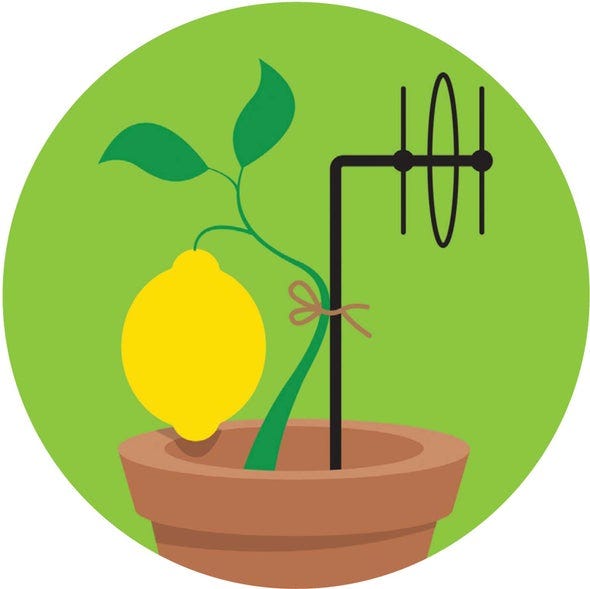
Based at the Technical University of Crete, they combined a humidity sensor, antennas, a transistor, an FM radio station and a smartphone.
So what’s the deal? How can all that stuff tell us what plants want?
First, they attached an antenna to a lemon growing on a lemon tree.
Then they inserted the humidity sensor into the lemon and attached the transistor to the antenna.
The transistor uses the antenna to pick up an FM radio station signal sent by an FM station app on the smartphone.
Hooking up technology to transmit signals from plants that we can easily read
So everything is all wired up and connected. Now what?
The FM signal from the radio station is delivered to the transistor by the antenna, which is affected by the plant’s moisture level. Things like wet soil or high humidity in the atmosphere will alter the plant’s moisture level.
The humidity sensor inside the lemon “tells” the transistor whether to turn on or off. So if you program it to switch off the transistor when the plant’s moisture is high, no FM signal will be sent to the radio receiver on the smartphone. And if the moisture level is low, the signal is sent.

Bingo. If you hear the station playing, it’s time to water the plants. If you don’t hear the radio, you can ignore them.
And the best thing about it is it’s cheap! Really cheap! A single sensor cost all of $3.40 at the time their article was published.
And without going into details, it’s actually the lemon itself that is supplying the power.
If you like lots of technical jargon and math equations, you can check out the paper they published that describes it.
It’s got a great title!
If you think about all the possibilities for future applications, this is probably just the tip of an agricultural technological iceberg.
Bletsas and his colleagues are calling it “The Internet of Plants”.
Until next time,
Rich
Want to increase your signal-to-noise ratio? Then Subscribe to my newsletter and get a free, fun ebook!