
Window to Heaven
IV
Read: Part I, Part II, Part III
Face in the Gravel
Darkness dropped before Hardin took the exit off Interstate 81. Minutes later, hardtop turned to gravel where thick growth woods closed in on both sides of the state-maintained road, running through land he owned. In deference to the occasional deer, whippoorwill, or owl that flitted across his headlights, he kept his speed down. When he turned off the road, he’d be in the long driveway leading to his house, a place where he could hole up, and tend his wounds, or try. But home? He didn’t think of his house as home.
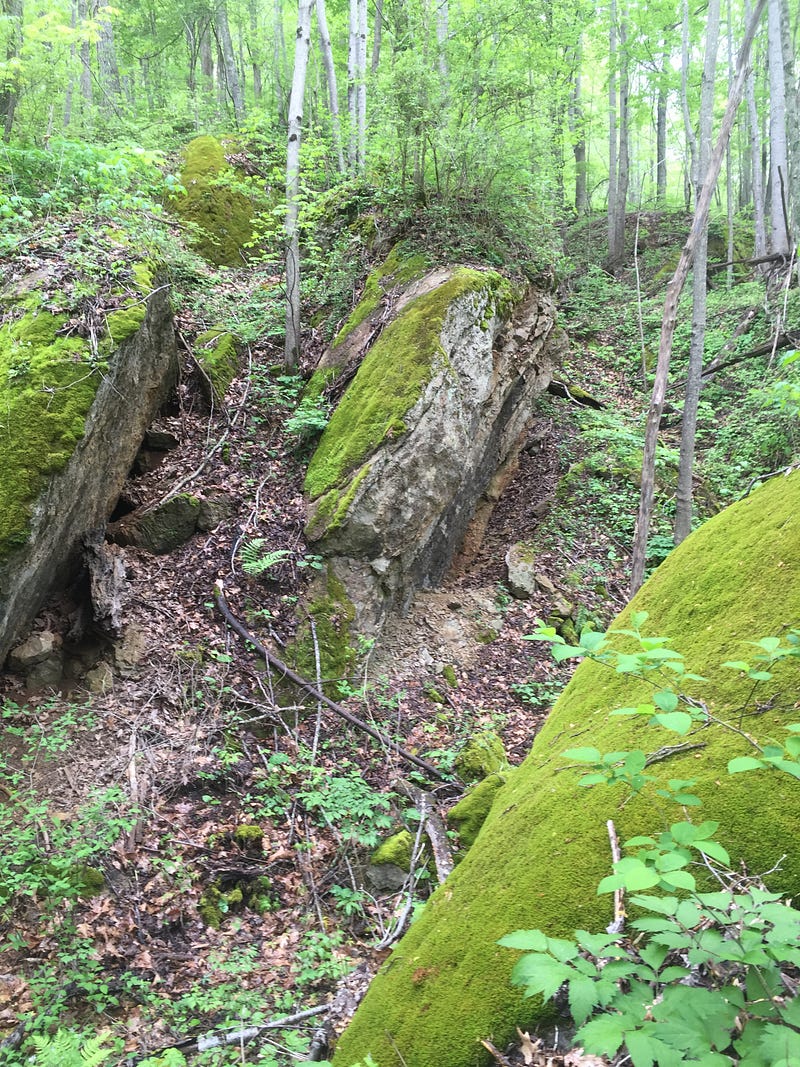
Home meant the fields, the ones he had worked as a child, the trees, the river, and the massive moss and fern covered rock structures of the wild broken parts that couldn’t be farmed, the places that healed and hid him. A house, or any building, necessary structures though they were, insulated a man from the very elements that created him, made him what he was.
He told himself more than once, ride it out. Six weeks, you won’t remember her name. He already knew better than that.
Blue lights popped up in his rear view mirror, and he eased over to the narrow shoulder. To be caught in a traffic stop out here surprised him. The action was on the Interstate, and the deputies rarely came into these gravel roads at night unless called. He hadn’t met the patrol car in oncoming traffic, which meant that this officer had lain in wait, the way a Game Warden might for spotlighters.
This wasn’t going to go well.
He’d done his best, actually, to be friendly to the deputies, and encourage them to spend time on the roads fronting his properties. Most of them, if they would never say it, didn’t like being this deep in the mountains and the dark forests. They liked the bright lights, the little diners, the truck stops, and in truth, that was where most of the drugs, petty thievery, prostitution, and the ubiquitous motor vehicle violations were.
Something about the unrelenting darkness in this unpopulated expanse of country did something to most men’s souls, especially at night, and it really was a waste of the officer’s time. They might wait an hour or more this time of night without seeing any traffic whatsoever. The working people holed themselves up in their secure, little houses, and rarely went out into the dark.
Through his rear view mirror, he watched a young woman in uniform step out of the car and slip her baton in its ring.
Creases: his first impression was sharp creases. Everything of her suggested she took a deep, professional pride in having her uniform just right. She wasn’t a familiar face, not that he knew very many of the new officers. Most of the ones he knew were long retired. Times were changing. It surprised him that Sandy would allow a young woman to patrol these roads alone. Maybe with the new rules he had no choice. It wasn’t his problem anyway.
The girl stepped up to his open window, frowned, and asked the predictable, “Sir, have you been drinking?”
He noted immediately the absence of the thick mountain drawl in her speech and the measured purposeful movements. This one had been educated at a university, and she had worked hard to look and sound like she came from somewhere the hell else; it spoke to ambition, and it jarred him.
The unexplained, no matter how innocuous, set him on edge. Sheriff’s department employees didn’t enunciate like newscasters. Had he not understood that it wasn’t the sheriff’s department’s policy not to hire outsiders, he would have never guessed she could have been from the county.
In the light from her patrol car’s headlights, he read her gold name tag, R. Model. He wondered what the R. stood for. It might not be such great timing to ask.
“That bad?” He might as well laugh. In the mildest tone he could manage, he asked, “Is there anything I could say to convince you otherwise, Ma’am?”
“No, Sir.”
He looked at her young, unlined face, waiting. He’d be a long time before he hit his bed tonight. He did note the favorable impression she gave: alert, clean-cut, well-groomed, and pretty, not that any of that had a thing to do with him.
Beyond the small umbrella of light from her flashlight, and the headlights of her patrol car, everything on both sides of the road was dark forest. With the wall of darkness was a wall of sound: the katydids, a screech owl, and the incessant call of the whippoorwill. Lightning bugs blinked on and off. His world. Safety and familiarity lay for him just outside this small circle of light.
“Step out of your vehicle please, Sir.”
With his height, six-feet, the distance to the ground from the seat of the F250 amounted to a fair drop. Before he made it halfway down, he lost a little of his balance and lurched slightly forward.
When he did, R. Model stepped in and nailed him in the stomach with her baton, a practiced motion he never saw coming. When he went down, hard enough to burn his face in the gravel, her knees slammed into his back. In pain, he rolled into a fetal position, his hands clutching his gut, which dumped her off his back.
She jabbed her stick into his kidney and straddled him again.
“Roll over on your stomach and put your hands behind your back.”
Somewhere outside of the consuming veil of pain, the anger in her voice penetrated. He filed the question of why for later. His response, to ball tighter into the fetal position, contradicted her command and elicited another jab in the kidney.
He croaked in pain, barely finding his voice, but knowing he had to, if he meant to avoid being hit again. “All right. All right.”
With two hard, cold snaps, she had him cuffed.
A slender knee pressed against the center of his back as small hands worked their way around his body. Her hand twisted as she found the right angle to remove the .45 from behind his right hip.
“Illegal weapon.”
He moaned.
The crunch of gravel told him she was standing. “You ruined my uniform trousers.”
He couldn’t respond.
“I’m charging you with resisting arrest, assaulting an officer, an illegal concealed weapon, and drunk driving.”
He still couldn’t talk.
“Get up.”
Croaking out the words between waves of pain, and trying to work himself deeper into a ball, he asked, “Can you give me a second to collect myself?”
“You’ll get up.”
She hooked the baton in the chain linking the cuffs and twisted. It hurt. Enough that he made it to his knees almost without realizing it.
“Stand.”
No argument this time. With a grunt, he forced himself up from his knees. It hurt more.
Spread fingers behind his bicep, she directed him toward the squad car. To walk standing anywhere near upright hurt too much. Whether it amounted to temporary pain or an injury of consequence he couldn’t tell. When she turned him to place him in the back, the light of the open door put her face inches from his.
Her expression folded in on itself and crumbled, and he knew then, saw it in the color draining from her cheeks, that she’d never hurt anyone before, not like this.
She blurted. “Oh my God . . . you’re hurt.”
When he saw her shock, he couldn’t help himself, and he said, “It’s nothing. I’ve been hit hundreds of times.”
“I didn’t know.”
“It’s different. You couldn’t have.”
“I’m, I’m — ”
“Don’t say it. Don’t apologize. It’s unnecessary. I can read how you feel.”
At this intrusion, she shrank back into her professional front.
“You don’t have to tell me that. Simple human expression of sympathy for pain isn’t an admission of culpability. I know that. I have a law degree.”
“Oh, God. I’d laugh if it didn’t hurt so much. Why am I not surprised?”
“After we do the breath test, I’ll take you to the hospital if you feel you need it.”
“I doubt I will, but in any event we can skip the breath test and head straight to the hospital for a blood test.”
An odd piece of information he’d picked up: when a suspect blew into the breathalyzer, or whatever the hell they called it, another officer just as eager for the conviction would be in charge of reading the dials. A blood test, if more invasive, was administered by an indifferent technician at the hospital who would interpret the results. Had she not been in a bit of shock after witnessing the aftermath of her stick in his gut, he would have expected her to resist his exercise of his right to the blood test with more vigor.
“If that’s what you want.”
The enormity of the divide R. Model had just crossed began to sink in.
He watched the change in her with curiosity. No amount of classroom time and training could prepare a person for the first time they hurt another human being. For Hardin, it hadn’t been that way. He’d seen so much blood at such a young age that he couldn’t remember a time when it hadn’t been an accepted part of his life, which he couldn’t blame on anyone; he had too eagerly embraced that tumble into the blackness. On this day he was merely reaping what he had sown. Justice meant nothing. He never expected justice, only the inevitability of the circularity of experience.
The finality of R. Model shutting the door on him, the concussion of the air being forced out of the confined space as light went to darkness did something to him. Was this the prelude to how it was going to end: light to darkness?
They started toward town.