
William — The Forerunner of Modern Philosophy
The Man from Ockham
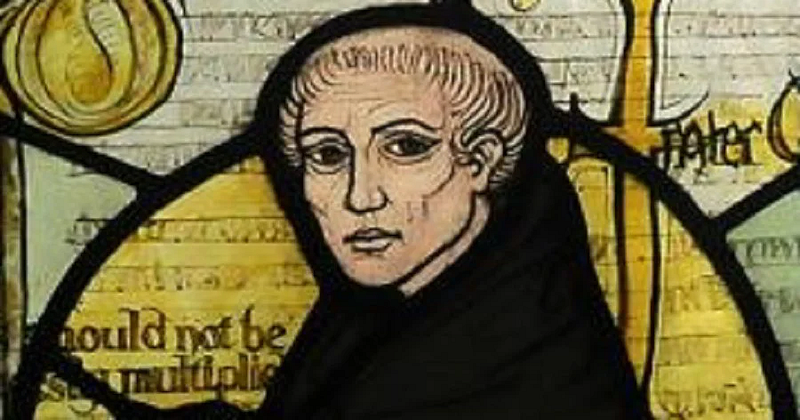
William (ca. 1287–ca. 1347) is often referred to as “Ockham” or “Occam.” He was born in the village of Ockham, England, but his name is William, so we will call him by his name. William was a Franciscan monk and a radical thinker for his time — so radical he was excommunicated by Pope John XXII. The Church was not concerned about William’s philosophy but about his condemnation of corruption and excessive wealth in the Church. He even declared that the pope was a heretic for the latter’s un-Christian behavior of attacking the monastic doctrine of poverty.
William’s philosophy centered on the principles of nominalism — the idea that universals are just names without reality — and voluntarism — the idea that the will preceded the intellect. On the basis of these principles, he concluded that God’s omnipotence is fundamental to the universe, everything in God’s creation is contingent, and the human mind is active and able to understand the creation through observation rather than through reason.
William’s philosophy was a direct refutation of Scholasticism, a philosophical school that developed in response to the recovered works of Aristotle. Scholasticism emerged from the writings of Thomas Aquinas (1225–1274), who synthesized Catholic theology and ancient philosophy. As mentioned, the Western European philosophers had long known about Aristotle’s logic, and Thomas demonstrated how Aristotle’s natural philosophy, new to Christian Europe, is compatible with Christian philosophy.
Thomas’s biggest influence on Scholasticism was his interpretation of Aristotle’s idea of a final cause. Like Aristotle, Thomas said that every event, whether it is a stone falling or a flower blossoming, occurs because there is an end toward which it is directed. It was easy for Thomas to synthesize Aristotle’s final cause with the sovereignty of the omnipotent Christian God. It is God who designed the hierarchy of creation and imbued all objects with their dynamics of potentialities and actualities with natural purposes.
Scholasticism applied Aristotle’s logic to the questions of what objects’ final causes were. The assumption was that God had set down the final cause of every object, which human minds could comprehend by contemplating the substance or essence of the object. For example, God created humans to love God, created horses for humans to ride, created stone to be used to make buildings, created wood to be used for fuel, and so on. We need only know what an object is and we know its final cause.
The problem as William saw it was that the Scholastics made no further inquiries, assuming that through logical contemplation they knew enough about the world and everything in it. He sought to replace what he saw as the empty intellectual vanity of Thomist Scholasticism with a more constructive exploration of the world. At the heart of his philosophy was the conviction that knowledge comes to those who go into the world and seek it — ironically more true to Aristotle than was Scholasticism’s logic. William’s theory of knowledge, being a radical break with the then-dominant Scholasticism, foreshadowed and contributed to modern science.
William’s Theory of Knowledge
William stated that all of our knowledge begins in experience; nothing is known unless it is known intuitively. By intuitive knowledge — meaning directly evident to the mind — William referred to both our sense perceptions of external objects and our awareness of our own thoughts and emotions. Any knowledge not directly related to an object of immediate experience is a derivative knowledge, which he also called “abstract knowledge,” because this type of knowledge is an abstraction of original experience.
William’s impetus for his epistemology (theory of knowledge) was to clarify our thinking. Part of his project was establishing detailed rules of reasoning, a basic logic, but here we will discuss his rules for what it makes sense for us to reason about. The centerpiece of those rules is William’s rejection of universals, the idea that goes back to Plato’s idea of the Forms, and Aristotelian forms, which still influenced most philosophical thought in William’s time. He thought that by eliminating universals from our thought, we can think more clearly.
William’s epistemological reasoning is that when we perceive an object, our senses cause an image in the mind. Our minds intuitively and naturally know certain things about our mental image of the object, for example, that this tree exists, that it is green, and so on. What’s most important about William’s conception is that perceiving and knowing these basic judgments about objects is natural in and of itself. That is what the human mind does naturally and self-sufficiently, without need of universals such as the Forms.
What about universals? William explained that we invent names (words) to refer to our mental images, and each culture invents its own words for them. We invent names to refer to particular individuals, like “Plato,” and we invent names to refer to abstract ideas like “tree,” “circle,” “dog,” and “green.” We abstract from mental images ideas such as green that we use to describe a characteristic of an object: “that tree is green.”
Scholastics in William’s day said that greenness is a universal form. William replies that greenness is no more than an abstract mental image to which we have given a name. The abstract idea of greenness is a useful concept, but it exists only in our minds and in our language. William says that abstract ideas seem to be universals because they are indistinct, general representations of qualities or objects of kind (for example, all trees are kinds of tree). These abstract ideas are not universals, William says, because they lack any reality of their own outside our minds.
Put another way, when we say, “That tree is green,” we are not saying that there is an additional reality, greenness, beyond that particular tree. The name “green” refers to the mental image that stands for our many experiences of particular objects that have the quality of greenness. William’s important conclusion to this line of reasoning is that mental images and the names we attach to them are all that we need to explain our thinking about objects. There are no universals, no Platonic Forms, and we have no need to postulate that they exist. The idea that universals are not entities but merely names, is called “nominalism,” from the Latin nominalis, meaning pertaining to a name or names. William was the foremost nominalist in philosophy, although his position is now universally (no pun intended) accepted in philosophy.
William’s method of reasoning came to be known as “Ockham’s razor,” although he never used the term. The principles behind Ockham’s razor are that the simpler of two explanations is more probably true and that we should not needlessly assume the existence of additional entities. In other words, we cut away with the razor of rational thinking the unnecessary notion of universals. Mental images and our names for them is a simpler explanation for human thinking. The idea of universals is not needed to explain our perception and knowledge, so we cut away the idea.
William went even further to state that universals do not exist even in the mind of God. This was in contradiction to Ibn Sina, who argued that God thought first the universal Forms and used them to create all of the particular objects. William’s idea is that in the creation, God had in mind individuals, not humanity. God didn’t create humanity; God created particular, individual people. Because we have the reason that God gave us, we think about particular objects by using mental signs or names.
The Contingent Universe
The idea that God created particulars not universals is the point at which William’s nominalism connects with his voluntarism — the idea of an active, free will. His conception of voluntarism has significant implications for God, the universe, and us.
Ibn Sina stated that God created the world according to logical necessity, a view accepted by most Christian philosophers, most notably Thomas. In a similar vein, many scholars in William’s time had accepted Ibn Rushd’s argument that God could not be said to have decided to create the universe and then perform the act of creation because God being eternal and thus outside of time could not be said to have a gap between decision and action. This means that it cannot be said that God has will or desire as we humans have within time. God, being without limit, also cannot be said to have had once not been the creator and then after acting been the creator; thus, the universe must be an eternal creation of God (think emanation like in Plotinus’s cosmology). Thus, the eternal universe is the way that it is by logical necessity.
That view meant that God could not will that things be other than they are; God was limited and subject to what logic dictates, and some Christian philosophers found that unacceptable. John Duns Scotus (ca. 1265–1308) was one of the latter philosophers. He adopted Augustine’s conviction that the will precedes the intellect and concluded that this meant that both God and humans are freed from following logical necessity. William agreed that God created as God wanted to create and was not limited by logical necessity. God’s creation is not governed by logical necessity; everything is contingent to God’s will. Things are the way they are because God chose to create them that way, and God could have chosen to make things be otherwise.
This is no mere theological argument for William. In fact, it has more to do with us than with God. It means that if the universe is not governed by logical necessity, then we cannot understand it through logic. Logic is a separate sphere from the phenomena we perceive in the world. The world is contingent and, therefore, logic tells us nothing about the world.
The contingency of creation forces us to give up hope that we can capture the structure of reality through logical deduction. Even causation — that we perceive event x followed by event y and therefore we assume that x causes y — is called into question. William observes that we never experience the supposed causal power within x that causes y, and we also never perceive necessity. There may be a cause-and-effect relation, but we cannot know this for certain because we can perceive only probable relationships. God maintains the uniformity of the universe, but God’s will is not limited by logic, so God can act otherwise and has the power to produce y without it coming from x.
William wasn’t against logic but warned us to limit logic to matters on which it is sensible to use it. Logic cannot tell us about the world and can only help us construct propositions about our mental ideas. The world is contingent; therefore, the important implication for us is that knowledge of the world can be attained only through experience. You want to understand the world? Get out there and perceive it! The Scholastic notion that we can logically reason to what must be the case is a fruitless endeavor. The philosopher must instead observe and catalogue facts about the world. We then act on our God-given potential to reason actively about our observations to understand the world. Logic can help us order our ideas, but logic can never establish facts, not even about God.
William rejected efforts to establish logical proofs of God’s existence. He countered that it may be possible to accept God’s existence through experience or through faith, but not through logic. Arguments for the existence of God are empty and worthless. William does admit the truth revelation of Scripture on God and morality. What is right and wrong is also contingent on God’s will; why couldn’t God have decreed that murder is righteous? Similarly, William leaves all questions of theology to divine revelation.
William’s contingent universe without universals separates natural philosophy from logically necessary causation. This sets observation over logical contemplation, leading to modern philosophy and science. In William’s universe, logic tells us nothing about how the world is; the truth is found by the individual who searches and uses reason to understand sense experiences.
Political Theory
William was concerned over corruption and excessive wealth in the Church. After he was excommunicated, he felt free to develop a radical new view of society. He declared that the Church should not own land, which should belong solely to earthly rulers (the idea in William’s time was that land belonged to the king or Church). He said that people had the right to select their rulers and that those rulers were obligated to serve the interests of the people, not their own. William also called for the separation of Church and state. These ideas that are now basic to our conception of a good society were developed by a monk in the 1300s.


