
William Blake and the Life-Renewing Power of Imagination
Where’s the fun in seeing things the way they really are?
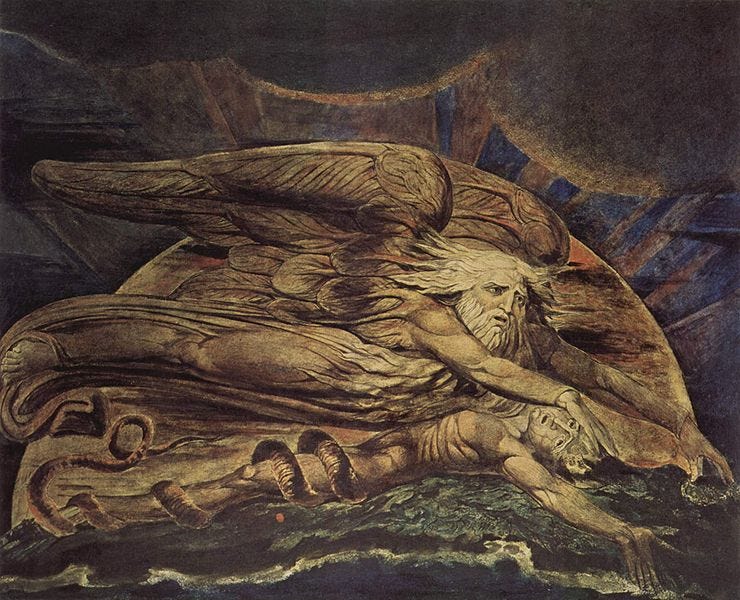
Arise and drink your bliss, William Blake said. For everything that lives is holy. He was right. But what else would you expect from a man who first saw God when he was four years old?
We wake up every day and reboot the program.
There’s money to be made turning ourselves into machines. Swaggering productivity hacks and Insta-entrepreneurs crowd shoulder to shoulder on your phone, convincing you that at its core, the world is nothing but numbers. When Blake drew Isaac Newton, he portrayed him as a muscular giant bending over a compass, his powerful intellect focused wholly and purely on what can be measured.
We owe Newton everything. The miraculous advances of science have come through the flinty intellect of people like him, who saw science and mathematics as the hidden song the universe sings.
But there are other songs too. The majestic music William Blake heard as angels sang from the trees. Because without imagination, science is blind and art is crippled.
Without the ability to see things as they aren’t, as they could be, as perhaps they ought to be, we would never have left the savannah where humans were born. And without the ability to imagine, even today, our blissful, holy world becomes lost to us completely.
Allestone is an island nation.
A map exists, tracing the directional flow of the rivers to the coast, the musical swell of the mountains, the major cities and seaports and the highways that connect them. Allestone has its own language, with a definitive dictionary. It has a long and storied history.
Allestone doesn’t exist. At least, not in the normal sense. It was invented by an astonishingly gifted six-year-old named Thomas Malkin, who died before he could finish writing the comic opera set in the country he invented.
Malkin’s achievement is unusual in degree, not in kind. All children do this. Perhaps not with the same obsessive level of detail, the same illusory grandeur. But we all, as kids, remade the world in the febrile space behind our eyes.
We conjured deserts out of sandpits and dense jungles out of suburban lawns. Trees talked to us. The groaning earth enfolded a million stories all around us, and all we had to do was reach out and take one in our hand, gentle as capturing a dandelion seed.
Any dog owner can tell you that animals don’t stop playing just because they become adults. But we do. Dollars wrap themselves around our wrists, and hollow hallways spring up where meadows used to flower.
It’s not that we stop imagining. We don’t. But we stop believing in our imagination. Our creativity gets turned to other uses, to making money or establishing a brand or scheming against our rivals. Even worse, it becomes devoted to neurosis, to worrying about things that may never happen, to hearing a bristling growl in every patch of sacred darkness.
There’s more at stake than the simple joy of childhood fantasies. When people lose their ability to imagine, they lose a large part of what makes them human. Everyone is creative, but that creativity manifests itself in different ways.
Used correctly, imagination can make the world as beautiful as the mystical visions of ecstatic poets. When you stop seeing things as they are, everything that lives becomes holy. And everything, absolutely everything, is alive.
We forget that.
After all, nothing is less magical, less redolent of the infinitely unfolding chain of miracles we are a part of, than the background chatter we distract ourselves with. The bare white wall and the flashing phone screen. The TV barking orders while the dishes pile up.
A true visionary could see the sacred even in these things, but that would take greater creative powers than most of us possess. Dante’s map of hell shows a conical pit, the scooped-out inverse of the mountain of Purgatory where Earthly Paradise sits. If you look closely, right down at the bottom there, you’ll find your bedroom.
Just as imagination can turn a prison into paradise, it can just as easily turn heaven into hell. Because when you forget to feel grateful for the holy bliss that surrounds you, vibrating under the thin cover of each transitory moment, the world becomes instantly ugly and mean. A tree is just a tree, not some overgrown flower breathing out life stitched together from scraps of sunlight. A puddle is just a puddle, not a bright scrap torn from the sky.
Life without imagination quickly becomes a joyless slog through one gray room after another. When we live at all, we live on our imaginations.
The story of Thomas Malkin and his extraordinary imagination comes to us through his father’s memoir. And that book has been preserved in the artistic consciousness not because of Allestone, but because the preface of the book supplies a lot of information about the life and work of William Blake, who drew the cover. Disregarded as a lunatic in his own time, Blake — the Tyger guy, the dark Satanic mills guy — has enjoyed an afterlife as the English language’s greatest visionary poet. And Blake’s gifts, both in poetry and in visual art, came from his ecstatic imagination.
These things are easy to say from here.
The sun is warm enough to dry my clothes while I wear them, but not hot enough to burn. My sunburned knees are safely tucked under the shade of a picnic table. The silver-skinned lake shines like a leaping fish and whispers happily as it sprawls at last on the soft mud of the beach.
Who could fail to be grateful for this? It’s a picture postcard come to life, an Instagram post without the suffocating narcissism. Not everyone cares for the outdoors. But there is a deep silver thread running along the oldest part of our spines that makes us find water beautiful. Even the submerged trees are happy.
The trick — one I continually fail to master — is to feel the same sense of peace and unity with the world in less gorgeous surroundings. The wearying grind of the cubicle. The clatter and hiss of the coffee shop. The halogen hell of the supermarket.
Imagination can help. To not see things as they first appear is a method of pulling back the cover of the world to see the radiance underneath. Why should the moon be a cold and lifeless lump of rock, when it could be an ardent lover trailing after the blushing sun? Why should the trees be pushed around by the indifferent wind, when they could be dancing like dervishes to the beat of a drum too old and slow for us to hear?
This may seem like a childish game. But what is life if not a game we play? Devoid of purpose, doomed to end in silence, what else could it possibly be?
Few of us are visionaries.
Most of us go through life in a fog. Not because we’re stupid or lazy or weak-minded. It’s because we need to survive. Our stomachs grew our magnificent brains just for that reason, to keep themselves fed.
Lose yourself in the rapture of existence, and you may not bother to reproduce. Mystics make poor parents. Children’s laughter is alien to monastery walls.
See the sunlight dancing on the lake as a smiling invitation, and you may wind up lost in cold and airless depths, drifting on the current while weeds clutch your ankles. Just because the world is beautiful doesn’t mean it’s safe.
But few of us are in daily danger. We need go no further than the fridge or the grocery store for our next meal. Our comfortable lives, more secure than any other group of people has ever had, have different dangers. Emptiness. Meaninglessness. Suicide.
Under all the pillowy layers of pleasure we’ve wrapped around ourselves, darkness lurks. An inability to see the glory of the world kills more of us than weather and wilderness ever could.
Imagination built the world around us.
Every ship and skyscraper started life in somebody’s head. Every masterpiece began as a bright spark in the thick warm folds of some swarming brain.
Vincent van Gogh saw the starry skies of Saint-Remy-de-Provence as a swirling storm of color and light glimpsed through the window of an insane asylum. And now we hang his vision in the bathroom to make our friends think we have taste.
Imagination births the world. It’s imagination that can give it back to us. It’s our passport to realms of gold.
Chairs rattle as skeptics clear their throats.
In case you still think this is a silly game, a pointless parlor trick that has nothing to do with reality, consider this.
We see a tiny portion of the light that exists. We hear just a fraction of all sounds. We don’t live in the real world. We inhabit a pale reflection of it created by electrochemical signals in our brains. Our senses are just a tiny crack for us to peer out of, the gap in the twitching curtains that allows only a sliver of hot outdoor light to fall on the dusty carpet inside.
You can’t live in the real world. If you saw fully everything that’s going on around you in the most seemingly mundane moment, the gray vaults of your brain would collapse under the weight of glory.
What you experience is a construct. The grass isn’t green. The sky isn’t blue. When we lack words for something, we can’t even see it.
From that perspective, Allestone is as real as Albania or Argentina. The world you think you live in lives inside you, existing only in the crackling synapses of your gray matter. And mine.
You imagine the world into existence every time you open your eyes. So do I.
The world the visionary poets and mystics imagined is this one, fundamentally. It’s just a little bit brighter. A little bit holier. A little bit more radiant and beautiful and sacred. And if a six-year-old child could conjure an entire nation out of a dreary London sky, you can make your own world a masterpiece too.


