
William applied to 5,000 jobs.
And no one replied.

*This article is inspired by Mary applied to 5,000 job offers by Michal Malewicz, and it uses the same structure in the beginning that Michal created. I present a different perspective. :)
Meet William
He’s “not just an aspiring ux content designer, but a passionate advocate for users’ rights.”
He also loves writing, home renovations, and taking long naps (who doesn’t?!).
He graduated with a bachelor’s degree in English from a top school, completed a super successful internship at a growing tech start-up, created a portfolio to showcase his impressive accomplishments, and decided that it’s time! Time for what, you ask?
Of course, it’s time to finally show everyone what he’s made of. He‘s got a simple, but detailed resume that highlights his professional achievements. It’s showtime!
Aspiring content designer looking to make tech more human by creating simple-to-use and conversational user experiences. Sounds good?

William starts applying for jobs
With his portfolio up-to-date and a detailed resume on hand, he’s now ready to take on the job market.
Day one
He submitted 20 applications. No one replied.
One week
He submitted another 100 applications. No one replied.
One month
500 total applications submitted. Zero replies.
Two months
He changed his resume to make it more ATS-friendly and he revised his portfolio with his end-user (hiring managers) in mind. Zero replies.
Six months
At this point he’s applied to 3,000 jobs. One recruiter reached out to him, but he wasn’t selected. He seeks feedback on his resume and portfolio from industry veterans on LinkedIn.
One year
The number of junior content design roles has been steadily dropping. He expands his search and starts applying for jobs adjacent to content design (like copywriting) to get his foot in the door. The only jobs available are for Leads, Directors, and Seniors. He continues to read articles, practice his skills, and network with industry veterans.
16 months
He revises his LinkedIn, his resume, and his portfolio again.
1 and 1/2 years
He has applied for 5,000 jobs. And nothing.
This looks bad, but let’s ask William what he thinks happened here.
The job market sucks! No one wants to hire me.
That’s an easy excuse… or is it?

He did all the right things
You’ve probably heard something like: if you keep doing the same thing and keep getting the same result, why do you keep doing it?
But what’s it called when you do something for a while, then you try something different, and you keep doing different things hoping to get your desired outcome? Perseverance?
Whatever it’s called, that’s what William did.
The job market sucks
It’s time we acknowledge the problems in the job market and stop blaming it on little experience and bad resumes.
No entry level jobs
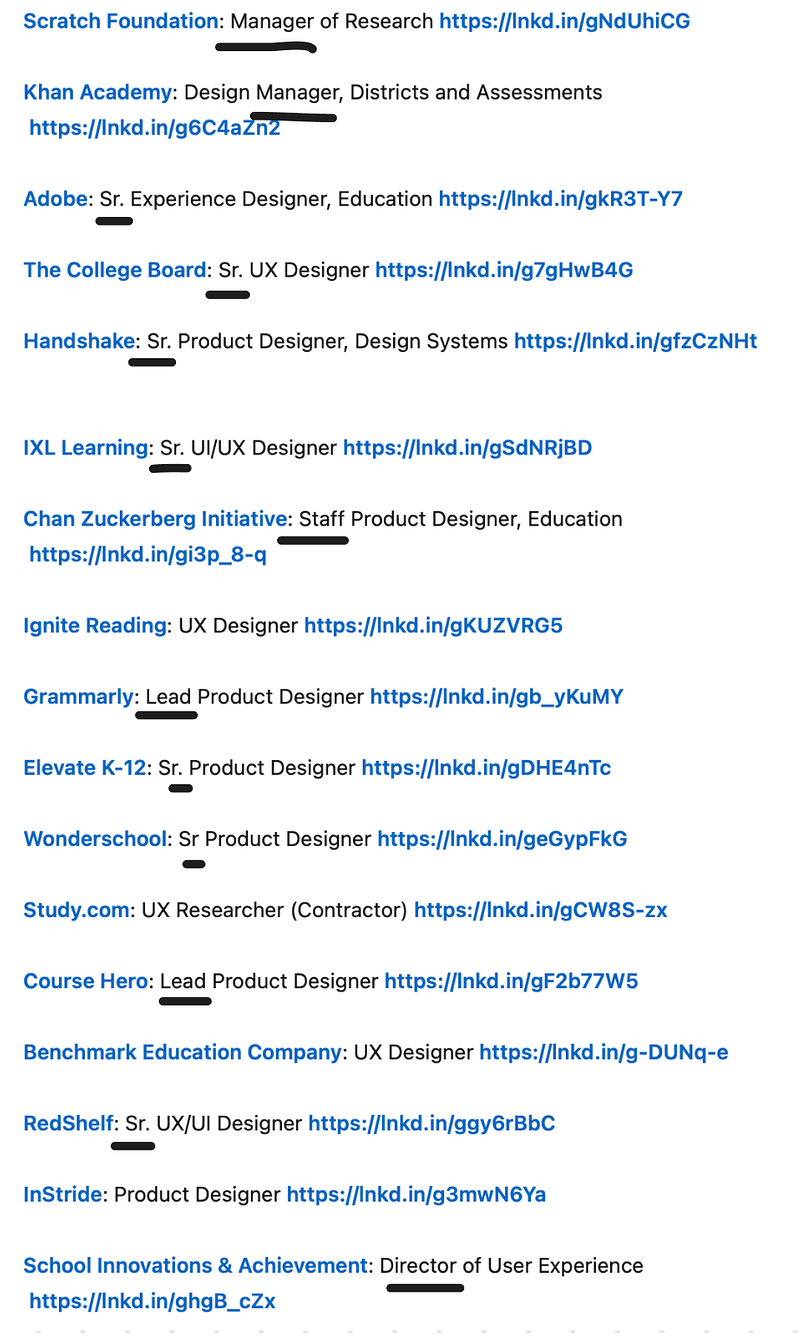
There’s none. Take a look at this post that UX in EDTech shared on LinkedIn (also note that NONE of them are for content design):
You cherrypicked that! Did I? Take a look at the search results on LinkedIn when I search for content design and select the entry-level filter:
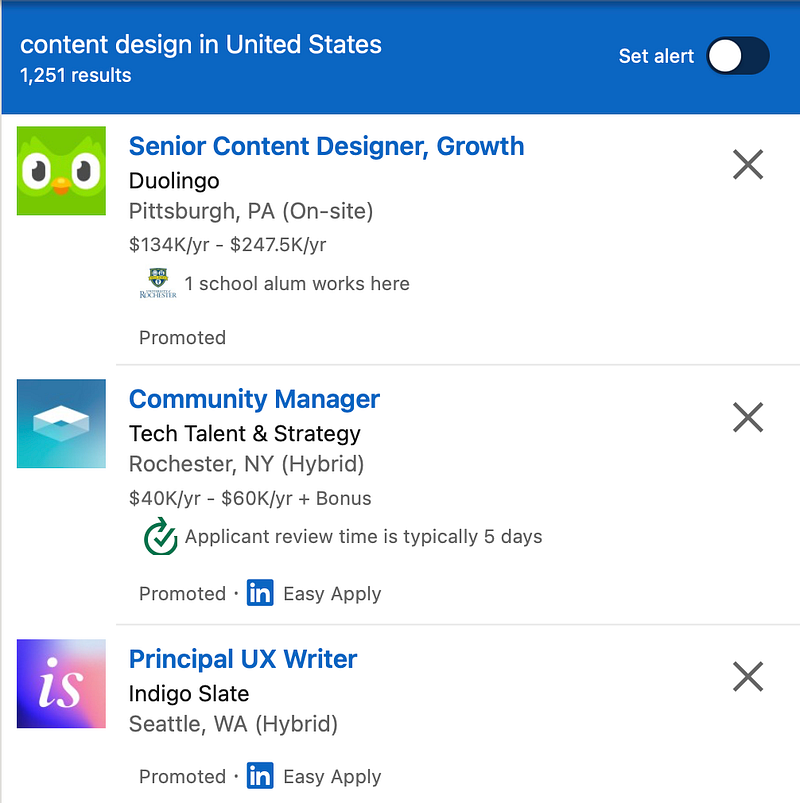
When you select the entry-level filter, senior jobs still show up. And it’s not because there’s no entry-level roles so they fill in the void with other available jobs. It’s because companies deliberately assign the entry-level tags to their senior-level job postings. Don’t believe me?
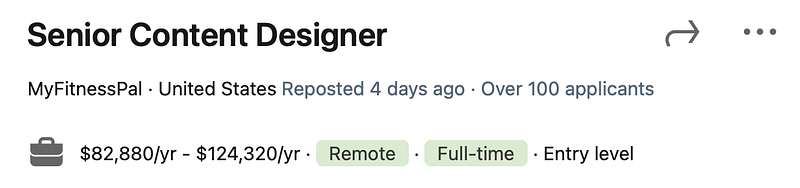
This showed up when I filtered my search because it has the entry-level tag, but notice the job title says Senior. Now, I can only think of two reasons for that:
(a) This is a result of poor UX for companies trying to post jobs on LinkedIn.
(b) Companies deliberately do this.
For the nonexistent number of entry-level jobs that do exist, they require 3–5 years of experience. I don’t know whose bright idea it was to look for entry-level talent that have years of experience. Those people don’t exist; that’s the whole point of entry-level. No experience. Duh.
Agencies and recruiters are gatekeepers
It’s no secret that I loathe recruitment agencies. This is how a situation with a recruiter plays out:
Recruiter: Hey, William! I stumbled across your profile/resume, and I think you’d be the perfect fit for this entry-level position I’m trying to fill for one of our clients. Interested in setting up a time to chat?
William: Sure, but what’s the position? And how much does it pay?
Recruiter: It’s for a content design position.
William: Great, what’s the salary range?
Recruiter: I can’t give out that information without a phone call.
William: Okay, can you at least tell me what company it’s for?
Recruiter: No, I can’t tell you that either. Are you available to chat Thursday morning?
William: Sure.
On the phone:
Recruiter: How many years of experience do you have with content design?
William: Just one.
Recruiter: Hm, okay. That might be difficult.
William: You said this was for an entry-level position, right?
Recruiter: Yeah, but our client really prefers three years of experience.
William: Okay… I did complete a really successful internship where my content design work increased the website traffic by 30% and increased the click-through rate for push notifications by 19%.
Recruiter: Wow, that’s impressive. Do you have any certificates?
William: No, but I have a bachelor’s degree.
Recruiter: Yeah, that might be difficult too. They really want the candidates to have this specific certification.
Later:
Recruiter: Hi William. I just wanted to let you know that I think you’re a little light on experience for this role, but I wish you luck.
William: I’d really love a chance to speak to the hiring manager. I think if we could have a conversation, they’d be impressed with what I could bring to the table.
Recruiter: I’m sorry. With your experience level, I just can’t put you through to the next round.

If you’ve experienced that before with a recruiter, I hope you found this to be relatable and that you found some relief in knowing that you’re not the only one.
If you haven’t experienced this with a recruiter, I hope it opened your eyes to what’s really going on in the job market.
But if not, let’s discuss. What was wrong with this situation?
- The recruiter said she stumbled across his profile/resume and that he was perfect for the position. But he ended up not having enough experience for the role. Did she even look at his resume/profile? If she did, she would have known how much experience he had.
- No transparency. The only reason recruiters don’t give out company names and salary ranges is because they want to make a commission off you and don’t want you to go directly to the company and apply for the job yourself.
- An entry-level position should not require years of experience. That’s the whole point of ENTRY-level.
- Recruiters often don’t know what they’re recruiting for. William had an impressive internship experience that would make him valuable for any entry-level role. The hiring manager probably mentioned a certificate as a throwaway comment, and now this recruiter is going to throw out anyone who doesn’t have that certificate regardless of the other accolades they have. If William was talking directly to the hiring manager, he likely would have sparked a whole new conversation with those stats he shared. The hiring manager would’ve been impressed and interested to learn more. (“Wow, tell me about that project!” or “Wow, how did you do that?”)
Takeaway? The recruiter was a brick wall standing in the way of a great opportunity. What a waste of time.
Friction
Another big problem in the job market is friction. Companies love to create as much friction in the application process as possible. By friction, I mean, they make it unnecessarily difficult to apply to a job at their company.

Friction comes in many forms. Here are some examples:
- Requiring an applicant to create an account. Imagine having to create an account for every job you apply for. Do you know how many useless application portal accounts people would need to make? Speaking of which, did you know that companies who use Workday require you to create a whole new account for their company, even if you’ve used Workday to apply to other companies in the past? I have 20+ Workday accounts.
- Uploading a resume only to be required to fill in all the information on the next page. What’s the point? I might as well write my cover letter twice from scratch too.
- Cover letters. This may have been useful in the past, but the job market has much more competition than it did 50 years ago. It’s hard to get a professional job. People don’t have time to plan out, write, and revise a cover letter for every job they apply to.
- Similarly, people can’t possibly tailor their resume for each job they apply to either. On top of paying bills, taking care of kids/pets, and working the job you hate right now, if you had to tailor your resume to each job you apply to, you’d only end up applying to 2 jobs a day!
- Personality/aptitude tests. 10–15 minutes wasted every single time.
- Take-home assignments. Are they afraid you’re a Frank Abagnale conning his way through life? Companies should be able to determine your level of expertise in an interview (NOT a screening with a recruiter). If they can’t, then they’re not asking the right questions.
Anti-remote work
Companies love to pretend that they want employees in the office because it fosters greater collaboration and work relationships. Then, they put you in a cubicle and you only talk to people in meetings that take place on Zoom anyways.
Companies want to pay people less for remote work as if the job is any different because it takes place in your home instead of the office. I might be doing laundry on my lunch break, but I still need to get the same things done for work regardless of whether I’m at the office or at home.
They want you in the office because they (1) are old school and close-minded (2) are paying for an office lease and (3) are excited to micromanage you.
Look what happens to the number of jobs (1,246) when you select the remote filter on LinkedIn:

Cut by half! And it’s usually by more than that!
But, repeatedly, studies show that remote work is just as productive, if not more productive, leads to happier employees, and a healthier work environment and work/life balance.
Unfair pay
The federal minimum wage ($7.25) hasn’t increased since 2009. 15 years! Meanwhile inflation, inflation, inflation.
According to Carbon Collective Investment, $1 in 2009 is now $1.40 in 2024. That’s a 40% increase.
But, Bryan, minimum wage doesn’t typically apply to professional, white collar jobs. True, but it’s the same concept. The price of everything is increasing and wages are not — at least not at an equal rate.
So, why does anyone want to apply for a job that only leaves them with $100 leftover every month after paying their bills?
There’s been minuscule attempts to apply pressure on companies including pay transparency laws, but what good is pay transparency when companies are allowed to write $0 to $500,000 in their job descriptions? Companies just want the most work from employees for the least cost.
Now what?
I don’t know. You tell me. What do we have to do to overcome these obstacles in the job market? I’d like to say things get better, but I’m at the beginning of my career, still in the middle of the mess.
What are some problems you face in the job market that I didn’t mention?
If you’re a designer, check out the author of the original article, Michal Malewicz. He writes about design and marketing.
If you’re a word wizard like me, check out this cool article, This is the Difference Between Good & Great Copy by Kushagra Oberoi.
Thought this article was interesting? Leave a clap, comment, and follow for more. I write about design, the workforce, and other miscellaneous things.
Here’s one of my most popular articles:
Interested in learning more about me? Check out my profile for more articles and my website for my content design work.