
Willful Ignorance: When Bliss Becomes a Crime
Why we succumb to willful ignorance and how we can overcome it
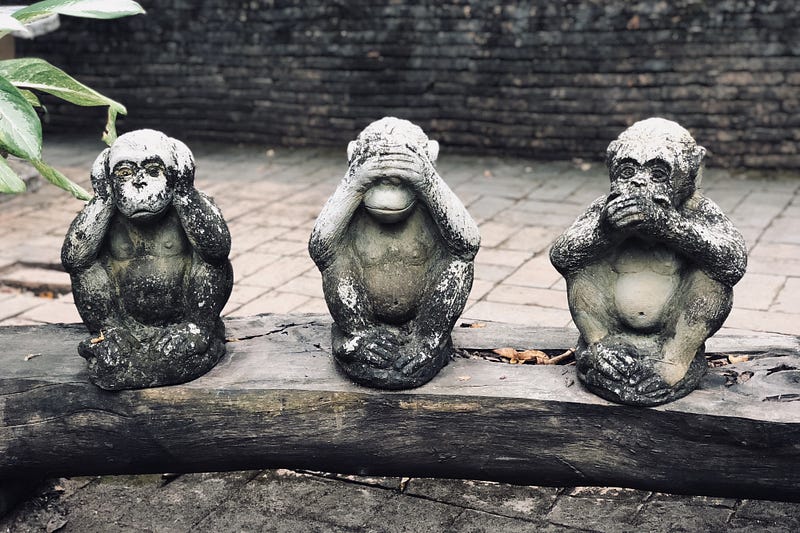
Have you ever shared disturbing news, yet everyone refuses to listen?
“I don’t want to know.”
“The last time I read an article like that I was traumatized.”
Let me introduce you to willful ignorance, the point where bliss becomes a crime. Like Yuval Noah Harari says in his book, 21 Lessons for the 21st Century, one of the biggest problems we face nowadays is our increasingly complex world.
Millions of years ago, when we were hunter-gatherers, morality was simple. If someone stole the food you’d gathered for your family, it was unfair. It was easy to see it was unfair. The cause-effect relationship was simple, straightforward.
Now, though, we can live peacefully, filled with good intentions, and still contribute to corporations that violate human rights or partake in animal cruelty. Now, it’s almost impossible to know the source of our clothes, food, and electricity.
“The system is structured in such a way that those who make no effort to know can remain in blissful ignorance, and those who do make an effort will find it very hard to discover the truth.”
— Yuval Noah Harari
I’ve never stolen anything, but I’ve bought from stores that exploit Chinese children. I’ve never hurt a fly, but I’ve eaten food that results from the cruel subjugation of billions of animals. I’ve never had harmful intentions, yet I’m actively contributing to climate collapse.
Sound familiar?
Little by little, I’ve come to learn certain dark truths about the world. The one most appalling, though, is the widespread practice of willful ignorance. Like Harari says, “the greatest crimes in modern history resulted not just from hatred and greed but even more so from ignorance and indifference.”
Why We Choose Willful Ignorance
In her book, Willful Blindness: Why We Ignore the Obvious at Our Peril, Margaret Heffernan explains the reasons why we choose, unconsciously or not, to ignore things we could and should know.
“We mostly admit the information that makes us feel great about ourselves, while conveniently filtering whatever unsettles our fragile egos and most vital beliefs.”
— Margaret Heffernan
In other words, we don’t want to feel bad. Learning that some things might be harmful — considering we might need to change — is uncomfortable. And Humans crave comfort. Our need for familiarity makes us blind to what threatens our status quo and angry at whoever dares to challenge our beliefs.
We claim that if our intentions are good, then it’s enough, but like Harari says, “in a world where everything is interconnected, the supreme moral imperative becomes the imperative to know.”
Sometimes this proves impossible. There are too many fake news and naysayers. But we must at least make an honest effort to learn the truth, regardless of how painful it maybe. It’s our responsibility to uncover our own biases and search for the truth.
But how can we do that?
Searching for the Truth
Our willful ignorance isn’t a terminal diagnosis. Though it’s a consequence of our evolution — our brain doesn’t like change — we can combat it with attention and intention.
“The very fact that willful blindness is willed, that it is a product of a rich mix of experience, knowledge, thinking, neurons, and neuroses, is what gives us the capacity to change it. Like Lear, we can learn to see better, not just because our brain changes but because we do. As all wisdom does, seeing starts with simple questions: What could I know, should I know, that I don’t know? Just what am I missing here?” — Margaret Heffernan
Nevertheless, because of the rise of social media, fake news are more common than ever. It’s becoming increasingly hard to find the truth.
Does this mean we should quit? Should we accept the state of the world and succumb to a state of guilt-ridden ignorance?
No.
Though it’s impossible to act as detectives for everything we want to know, we must try to find reliable information sources. Harari’s advice for this is: “if you want reliable information, pay good money for it. If you get your news for free, you might well be the product.”
For anyone who’s watched Netflix’s The Social Dilemma, this will be exceedingly clear.
Secondly, Harari encourages us to read relevant scientific literature for important issues, ensuring they are peer-reviewed and from a well-reputed institution.
Once you have new information, don’t shy away from it. The worst thing that can happen is the expansion of your world knowledge. On the other hand, though, you could change the world.
Keep your eyes open.