
Will You Make the World a Better Place?
It’s a simple, almost cliché, question — but its answer has profound consequences.
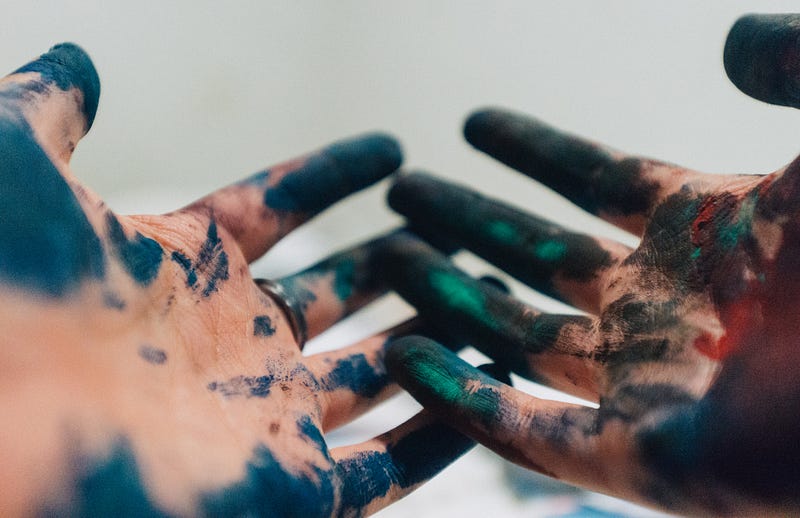
We created the world we live in. Everything from the form and function of our furniture to the international borders between our beautiful countries. People imagined and created these things. They didn’t grow from the ground, and no god created them.
It’s easy to forget this. Our brains can’t afford to spend their energy considering every facet of our daily lives again and again. So we come to accept things as they are. Like chairs we don't want stolen, we screw these aspects of life down to the floor of our minds and they become the scenes in which we play out our days.
When we step back and take a conscious look, we become aware of the utter vastness of the created world. I’m not talking about trees, rocks, and rodents. I’m talking about trampolines, racecars, and radiology. Humans have been busy.
And the scale is incredible.
Of course, with this power also comes the ability to harm. In Origin Story, David Christian imagines a team of alien scientists orbiting earth and studying humans over thousands of years. He writes:
“[S]tarting from the end of the last ice age, ten thousand years ago, [the aliens] would have noticed human numbers growing fast. They would also have watched as humans began to change their environments to suit them better by burning down forests, diverting rivers, plowing the land, and building towns and cities.
In the past two hundred years, human numbers grew to over seven billion, and our species began to transform the oceans, the land, and the air. Human-built roads, canals, and railways snaked across the continents, linking thousands of human-built cities with populations in the millions. Vast ships navigated the oceans, and planes ferried goods and people through the air and across the continents.
Just a hundred years ago, in glowing filaments and patches, Earth started lighting up at night. The aliens’ instruments would also have shown that oceans were getting more acidic, the atmosphere was warming, coral reefs were dying, and polar ice caps were shrinking. Biodiversity was declining so fast that some of the alien biologists might have wondered if this was the start of another mass extinction.”
Seeing human history through the eyes of these alien scientists doesn’t just show the devastating damage that human beings have done to the planet, it also shows the incredible power of human beings to imagine a world and make it happen.
I share this quote because, although this essay is intentionally and decidedly optimistic, I want to leave a reminder here on the screen of our potential, and often, propensity, to use our creative power to the detriment of our fellow people and our future planet.
But the good news is that you are a human being. You are Homo Sapien. And that means that within you there is infinitesimal potential for imagination and positive invention. I’m not just talking about painting and poetry. I’m talking about putting $100 in the tip jar, picking up garbage in your neighbourhood, and petitioning for the world’s next great idea.
We can change the world for the better. This is not hyperbole. The only question is one of degree. Will you change the world for 1 person or for 1 billion? I’m not sure. But change is change. And, by the way, all it would take to change 8 billion people’s day for the better is each person doing one nice thing for one other person.
The problem is not that we’re powerless. The problem is that we’ve put our trust in the concreteness of the way things are and forgotten that the world that exists is the one that we made.
The world that will exist is the one we are making right now.
“We can only live the changes we wish to see: we cannot think our way to humanity. Every one of us, every group, must become the model of that which we desire to create.” -Ivan Illich, Philosopher and Priest
We might feel as though we’re not responsible for the way things are. But, of course, we all are. Again, it’s to one degree or another, but we all are.
Responsibility can make us feel guilty about the way things are and lead us to inaction, or it can make us feel empowered by a positive, optimistic vision of the way things can be and lead us to action.
Here’s the thing. The way things were is not the way things are, and the way things are doesn’t have to be the way things will be. Our world is malleable. We shape it every day, in big ways and small. It’s up to us to create the world that we want.
We make the world. The question is… will it be a better place?
It’s a simple question, but the answer has profound consequences.
Hi, I’m Michael. Thanks for reading this article! It represents day 21 of my 30-day writing project. If you enjoyed it, you may also like this article I wrote:
I hope you’re safe and well.


