
Will We Call Teachers “Heroes” on Facebook When COVID-19 Strikes?
Schools are reopening; so what happens next?
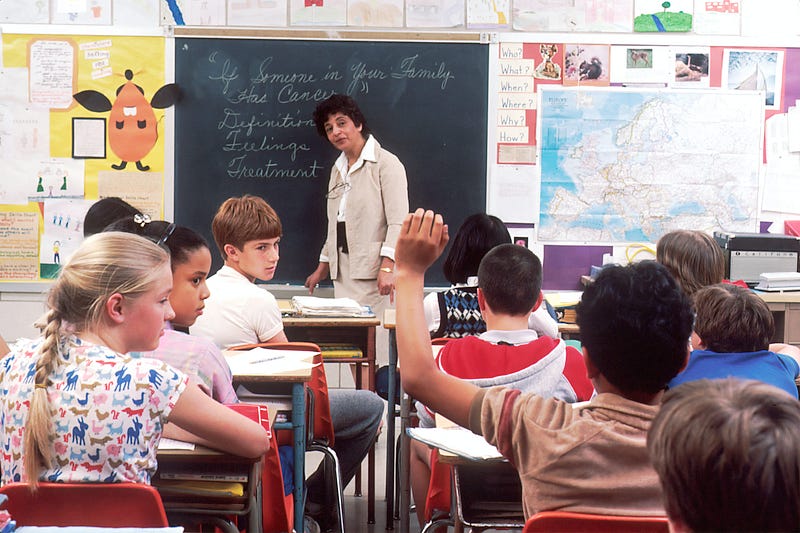
Can we talk about school teachers? We need to talk now! With 70,000 new COVID-19 daily cases, parents want to know how we safely open schools? The White House has spoken, and the kids are going back to school. While many debate student safety, we can not forget the adults standing at the classroom’s head. Without healthy teachers, we have no education system.
Will our country invest the financial resources to keep our teachers safe? Judging from how the US is handling healthcare workers, it appears the answer is a resounding no.
European countries, such as Germany and Sweden, have successfully opened schools. But they are averaging 100 cases a day, while we are finding 70,000. To make it worse, the CDC Director Robert Redfield reports we are only catching 1/10 cases due to our inadequate testing capacity.
The American Academy of Pediatrics released guidelines supporting school reopening “with a goal of having students physically present in school.”
Studies indicate children are approximately 50% less likely than adults to become infected after exposure to COVID-19. But what about the adults working in the schools? Teachers, custodial staff, cafeteria workers, bus drivers, and other essential employees need to be kept safe.
We have two choices. We can follow risk mitigation guidelines to create the safest possible environment or pretend the problem does not exist. Right now, the US is choosing the path of denial.
The CDC’s K-12 Schools Readiness and Planning Tool outlines a plan to reopen schools and get kids back in the classroom safely, but the White House categorizes the evidence-based plan as too restrictive.
I see a different problem certain to doom the implementation.
The CDC’s plan is nine pages.
We are Americans, and we don’t like to read. The guideline, filled with checklists and action items, calls for leadership and accountability. These are not America’s current strengths.
Page 1 of the plan is listed here.
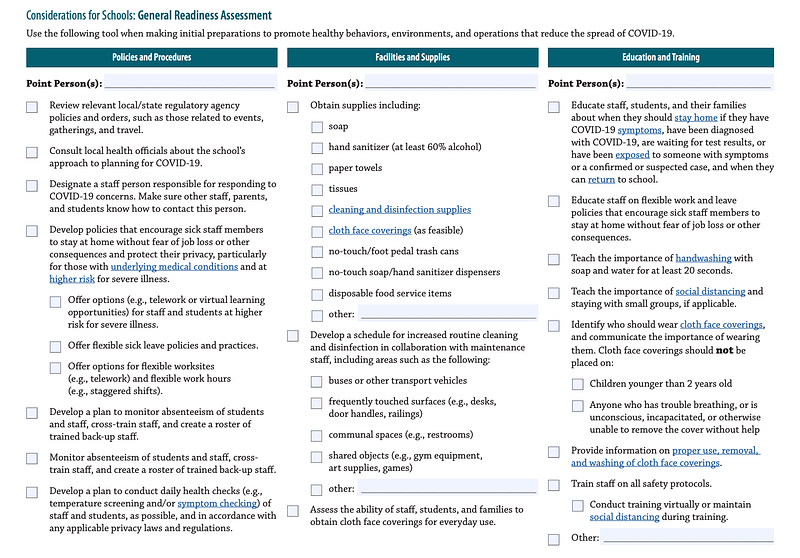
Be honest. How many readers studied each step listed above? The CDC’s plan includes eight more pages just like it. Do we all need to read the fine print and study the details? Probably not. But our political leaders do.
They must.
Or we are all in trouble.
Implementing the CDC’s plan would be extraordinarily difficult and expensive. Americans should be willing to pay the price to do the right thing. We must do what it takes to keep our children and teachers safe.
But we probably won’t.
It is easier to look the other way.

It's more convenient to pretend COVID-19 is a hoax, a mild infection like the flu, or a leftist conspiracy plot. Besides, social distancing is a hassle, and those freedom-killing masks are just so uncomfortable.
Comfort is what we seek. We are tired of bad news, case counts, and death rates. We want to stop feeling scared.
Every parent wants children back in the classroom. Teachers long to see the children’s smiling faces. Grandparents count down the days until they can cheer from the football stands, band concert, or choir performance.
We have a moment of bipartisan agreement. We all want the same thing.
But, the pandemic is not under control. Reopening without a plan will be disastrous.
Disaster avoidance is possible if we learn from our past mistakes. When the pandemic hit, healthcare workers were left out. Our country did not invest in PPE (personal protective equipment, and healthcare workers are still paying the price.
We are months into the pandemic, and healthcare Facebook groups still report a lack of PPE (personal protective equipment). Nurses wore trash bags to keep themselves safe.
My mother’s friends knitted masks to send to workers in need. Our medical practice started a community organization to help get cloth, washable, reusable face covers to our patients. To help, we recruited local sewing groups on Facebook.
While seeing the community unite demonstrates kindness is more contagious than the pandemic, the truth is doctors and nurses should not have to find their own protective equipment.
Bandanas, knitted face masks, and Facebook groups can not be how The United States of America manages a global pandemic. We need a national plan to fight COVID-19.
In some ways, things have improved. Our hospitals now have masks. Each week, we write our last name with a black sharpie on a brown paper lunch sack where we store our weekly allotment of N95 masks.
Trash bags. Sharpies. Brown lunch sacks. Bandanas.
Without national action, these are the items to bring to “Meet the Teacher Night” when schools open this fall.
The federal, state, and local governments CAN prevent what happened in healthcare from reaching our education professionals. But it will be hard and expensive.
Money and effort are required to implement mitigation steps to achieve success. Investment in ventilation systems, handwashing stations, hospital-grade cleaning protocols, and scaled up testing capacity are the first steps. Full implementation requires community support.
What happens if we do not create safe schools?
Teacher infections will follow a predictable pattern. About 80% will be asymptomatic or have a mild infection. Approximately 20% will get sick enough to require hospitalization. Unless we discover more effective treatments, some will die.
We must face this reality now.
We can not ignore science. Our teachers deserve better than an October surprise. By then, it will be too late. All we will have left is reactive platitudes.
How will we handle the tragic news stories of hospitalized teachers?
Will we fill Facebook feeds with posts featuring our “classroom heroes?” Let’s tweet memes thanking them for their service. Starbucks will offer free coffee to teachers on their way to work. Students will film touching and hilarious Tik Tok videos celebrating our educators.
We can draw spectacular and inspirational chalk art in front of the schools. Some artists will even pull the mask up over their nose to keep the chalk dust out. But only for a second, those masks make it so hard to breathe.
We will do these things to make ourselves feel better for not committing to preventing the inevitable.
There is another way…
We do not have to wait until it is too late. We can learn from the mistakes we made in healthcare. Use the bipartisan support for reopening schools to generate the funding and resources required to keep our classroom heroes safe.


