
Will Virtual Reality Education Replace Traditional Schooling
A Close in-depth review on how we can tackle the problem of human interaction through VR during the pandemic times
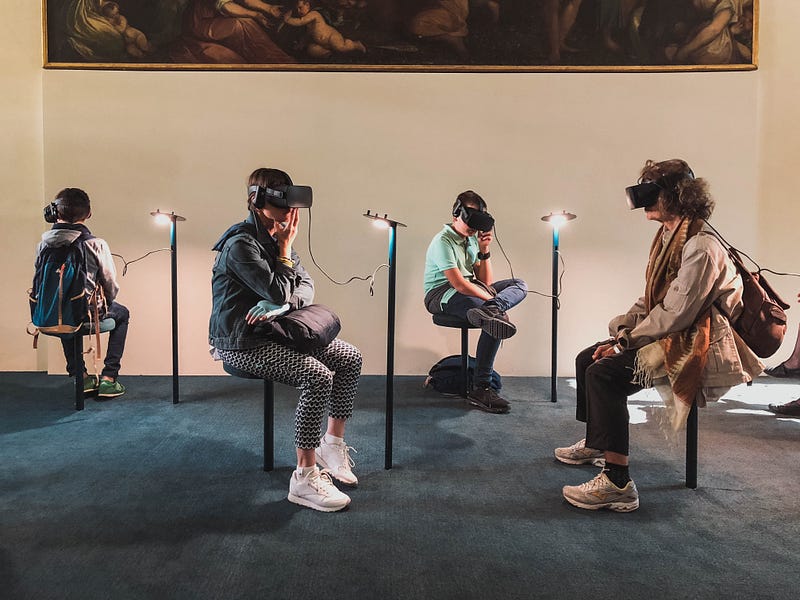
I have researched on VR education for a few years. I first started to develop interfaces and software requirement specification documents for VR projects during an internship that perhaps lasted over a year. During that time in 2017, I was motivated to build my very own VR Classroom prototype. I was enthralled but the challenges and struggles were numerous.
First of all the perception of the public and criticism as to why we don’t need the substitute application in the first place. I discussed with a professor of mine who works in NTNU and he became my supervisor for the project.
During the planning phase of the research phase, the technology had fairly many issues so we minimized the scope so that we can research a single portion of the complete system that we were building on as we were low on the resource as we were self-financing and the costs were significantly high when it comes to research and development of V.R technology.
I am a student who has ADHD, the classroom we were building at first our main focus was to target a single aspect ration of a student’s focus point so that they can interact fairly in the simulation. For that, we built 3-D room-scale environments to test the 360-degree simulations and how a normal user would perceive the classroom.
We had troubles with choosing technology as well, We had built projects on unity and used unreal for scripting games in the past. But for VR, it was a tough challenge but we managed to build our solution and present it to our university board.
We were bashed for using a complex technology solution, as the market cost for the solution was significantly high. It was dumped shortly after. I, therefore, took it upon myself to research a newer way for the user to interact in the environment for that I needed to build a replica of the real thing — a prototype that would work and function as the real classroom.
For that, I used photogrammetry techniques and software to mesh all of the images together. It was really something beautiful. I was able to build a hypothesis around it and present it to the committee.
I saved up all the cost and did it without investing less than 50 USD for the software, and for the digital camera. I ask a friend a favor, to capture 3000, significant shots of an entire classroom. All of the photos were stitched together. Though there were some breakpoints we needed a hypothesis that it can be done.
Even if the actual solution will cost more, we wanted the approval of our board. Most universities were not interested in the solution at first when we showed them our VR prototype. They said when they had LMS, why would they need a virtual reality application for educational classrooms.
Before the pandemic hit, I had saved up enough money to get the equipment myself that had cost me around 4000 USD. But as the pandemic hit, shipping was delayed and I had to get a refund.
Meanwhile, the universities were panicking as they didn’t have any systems to facilitate the interactions of users in a virtual environment. They did have video conferencing applications like zoom, did not have applications that provided interactivity with the user. Institutions are still struggling to keep the students enrolled as they decide to drop out and leave college — growing concerns and tensions rise as we can’t risk the potential of harming our children.
Most people never truly plan ahead, I was adamant towards advising people for years that we need to vest in emerging technologies such as VR, now there perhaps is hope as another field called XR(extended reality) — A mixture VR(virtual reality)+AR(augmented reality)+MR(mixed reality) comes into play. Soon there will be perhaps companies already researching on creating applications that will benefit both the teachers and the students by maximizing the use of avatars in education.
That reality isn’t far, Siemens and 5G are experimenting ways so that the application and technology headache can be removed through the use of Cloud VR, another way of maximizing the use of VR technology through the cloud.
Perhaps the future is not far when we would be able to maximize our education and classrooms through the use of Cloud VR technology. For that reason, I’m due diligently working with other researchers to bridge the gaps between students and classrooms.
For the current time being, I have shifted my focus towards building a workable prototype, due to a recent burnout of my machine and myself I put the project on hold. Because of the shortage of parts, it is hard to manage the solution.
Thus, I am working with a few other researchers on programmable environment research factors at the moment so that I’m able to draw a hypothesis how it will affect students who have ADHD and trying to create an interactive environment that pushes the boundaries of a traditional classroom in a virtual interactive environment that bridges the gap of focus problems in students suffering from ADHD.
I’m hopeful that Cloud VR is the future of modern-day education and it will revolutionize the way we see education as a whole. This field is being researched every day, Cloud XR perhaps might become for everyone. Everyone will contribute to the possibilities of fundamental research and building practical applications in this field.
XR technology is presumably expected to grow to a market of 209 billion dollars by 2023. These devices will become more immersive, as the year’s progress as more and more practical research applications are popping up.
It is not far that we will be experiencing these magnificent technologies in person. The future is exciting, and I will be working to make it there. Will you?
Thank you for reading.
Stay Blessed and Stay Safe!
With Love ❤️