
Will the World’s Population Rise Forever?
What goes up, eventually… reshapes society in surprising and bizarre ways

Overpopulation has been a doomsday topic for centuries. The topic overlaps with food production, resource availability, and more recently environmental sustainability. The anxiety of overpopulation is that numbers would escalate out of control, bringing with it a dystopian meltdown. The rapid explosion of the human race across the planet was successfully predicted by many, but the true, as-yet-realized fallouts were predicted by very, very few.
The effects so far have been counterintuitive, such as disproportionately aging populations, unplanned childlessness, and the breakdown of the family unit. These uncomfortable and little-known truths go deep down into our humanity. What our species is currently going through is a strangely sensitive, societal reshaping. A population tipping point that seeps below our senses like an odourless agent.
“Everything we’re studying demographically has never happened before, never in human history,” says Peter Zeihan, a demographer and geopolitical strategist. “We’ve never seen this sort of decay even in times of war, or genocide, even in times of the Black Death, it’s never happened this fast, it’s never been this wholistic, it’s never happened everywhere.”
Where we are, and how we got here
As of March 2024, the global population is 8.1 billion. It was about 4 million some 12,000 years ago. What caused this enormous and rapid explosion of a single species?
The oldest known fossils of our Homo sapiens lineage date back to around 233,000 years ago, and since then, population increases were — for the most part — very modest. But then around 12,000 years ago, our ancestors distanced themselves from the animal kingdom even further by redesigning life as they knew it with a remarkably profound step: the Agricultural Revolution.
Permanent settlements became the norm, and food supply was more consistent. This ingenuity spawned villages, towns, cities, and civilisations spread across the globe.
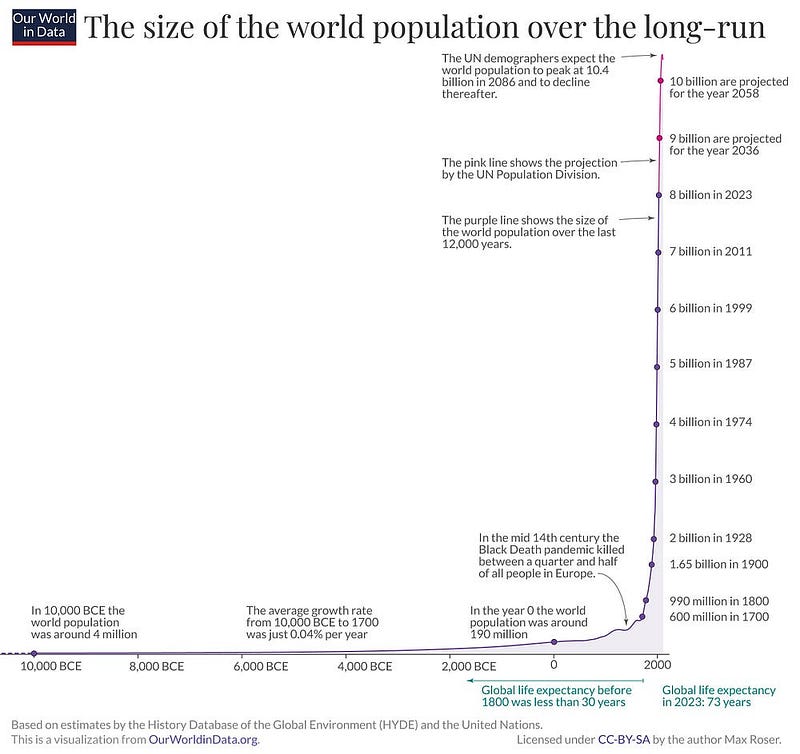
From its inception to the 18th Century, the Agricultural Revolution grew our species from roughly 4 million individuals to 770 million. This increase laid the foundations for humanity spreading over many eras, marked by Stone Age cave paintings, and later the pyramids, the Parthenon, the Colosseum, and to Michelangelo’s masterpiece in the Sistine Chapel, among other markers of progress.
And then another profound step was taken.
From steady, to skyrocketing
Starting around the year 1760, population spiked even more dramatically, owing to another seismic moment of ingenuity. The Industrial Revolution ignited the technological mastery we now collectively benefit from. Machine labour powered with coal, gas, and electricity, exponentially increased our efficiency in every energy consuming domain. Boom. We went from an increase of a billion people requiring nearly 12 millennia (which was already fast), to consecutively increasing by a billion people every 12 years or so.
The multiplication our species started to undergo due to the Industrial Revolution raised alarm amongst intellectuals. “The power of population is so superior to the power in the earth to produce subsistence for man, that premature death must in some shape or other visit the human race.” Thomas Malthus, the Godfather of these alarmists, wrote in 1798. Malthus essentially believed that resource acquisition could not keep up with population growth and human population would spike well beyond the capacity for production resulting in mass starvation.
Malthusian theory has perforated public discourse ever since, and became a prevailing view of humanity’s trajectory, spawning other thinkers alike, most famously Paul Ehrlich centuries later. Ehrlich received notoriety in 1968 after his seminal book, The Population Bomb, was published. He advocated for state-level population manipulation.
“The only hope there is, is that we will be able — at least in the United States — through the political process to get a government that’s courageous enough to say, look, we’re overpopulated and we have to have population control and start moving in that direction,” Ehrlich said in 1970.
Much like Malthus, Ehrlich predicted ever-rising population would lead to famine and the death of hundreds of millions, that global life expectancy would drop, and chaos was only a few decades away. His vantage point was from an ecological standpoint, and from the basis of pollution per capita he used rhetoric such as, “Each American baby born is 50 times the disaster for the world as each Indian baby.”
However, US babies continued to be born in significant numbers, to grow up and build their civilisation, which in the late 20th Century managed to almost triple agricultural food production whilst using the same amount of fertilising inputs, and less land — proving the famine predictions wrong. But these predictions still incited a wave of fear and anxiety throughout public consciousness.
Rather than the apocalyptic nightmare Ehrlich laid out — in which he posited that there would never be seven billion people on planet Earth — a health explosion occurred. Global malnourishment dropped by half since 1990, the spread of communicable/infectious diseases dropped significantly, and life expectancy surged. All the good things you’d want for humans to flourish — happened.
The De-Population Bomb, a term coined by Nicholas Eberstadt, is a much more convincing theory, especially given the real-world examples available to study. Eberstadt studies the progression of populations all over the world and the troubling possible future scenarios. His teachings have caught on and are echoed by many luminaries, including perhaps the biggest of them all, Elon Musk, who said, “The biggest problem the world will face in 20 years is population collapse.”
From skyrocketing, to stopping, to dropping
A population needs a sufficient supply of youth to occupy roles within a society. When, over many generations, the amount of babies born is lower than the previous generation, and this supply is not met, society is left demographically pockmarked, and unforeseen adversity arises. Population collapse refers to these adversities.
To avoid population collapse, an adequate level of replacement natality is required. Replacement level is achieved when the replacement level fertility rate floats at about 2.1 children per woman, per lifetime, in a given population. Our grandparents and great-grandparents met this replacement level with gusto after the Second World War, when the jubilant return of soldiers triggered a verve for life and a sharp increase in fertility around the world. The economics of peacetime, abundant resources, and reliable global trade, played important roles, too, of course.
The total fertility rate in Ireland, 1963, was about four births per woman. This number was similar in rich countries around the world and in the coming decades it dropped for a variety of reasons. The total fertility rate in Ireland is now 1.7, well below replacement level, and is similar for many countries all around the world.
These changes in demographic compositions are best visualised with population pyramids. Below is a graph illustrating three different patterns of population growth.
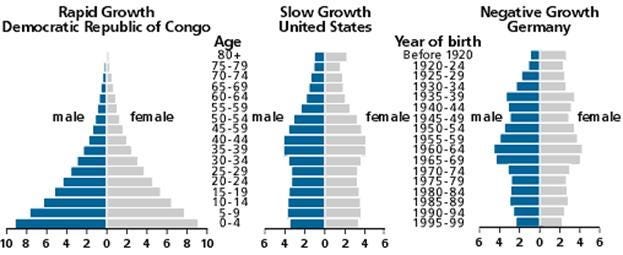
- Rapid Growth shows a high fertility rate with a wide base of young people and a narrow pool of older people, showing a population with a surplus of children to inherit and continuously build society when the elders are not of fit age anymore. This is a highly indicative pattern for most African countries, with Nigeria expected to surpass the United States as the third most populous country in the world by 2050 (behind India and China). Also, some Middle Eastern countries like Syria, who currently have the highest growth rate on the planet.
- Slow Growth is a chimney stack shape showing a roughly replacement level fertility rate, with the middle-age demographic as wide as the younger age group, resulting in a barely sufficient supply of children to maintain society. The United States has been teetering on the verge of negative growth for quite some time now.
- Negative Growth shows a fertility rate way below replacement level, with almost twice as many middle-aged adults as there are children. The lack of youth to sustain a society is exactly the kind of demographic toppling that population collapse refers to. Who is going to work the jobs that keep society running smoothly if there aren’t enough young adults to perform the tasks?
The “birthgap,” as described by Stephen Shaw in his 2023 documentary, is the coming shortfall of working-age adults. For example, in 2020 there were a million 50-year-olds in Italy, and there were approximately 400,000 babies born. In 20 years time when that old cohort enters retirement, and the young cohort enters the workforce, there will be a huge disparity between retirees and workers. If this birth gap was simply a blip anomaly, then it wouldn’t cause commotion, but this has been happening for decades in European countries and Japan, and is spreading across the industrialised world.
Low total fertility rate causes negative growth which causes the birthgap. Italy, with a staggeringly low fertility rate of 1.2 (almost half of what’s considered replacement), are amongst the foremost examples. “It’s not that they ran out of children, that happened 30 years ago, it’s that they’re running out of working-age adults this decade,” said Peter Zeihan, referring to Italy, Germany, and the fate of European countries.

The kids are vanishing
Driving around towns and cities in my own country of Ireland, it’s difficult not to notice the contrast between a few decades ago and today. The streets and parks were once full of kids playing games and kicking balls. Now they’re consistently barren of this feature, like a childhood extinction has occurred. This loss of children at play outside is emblematic of the societal changes that are underway, as Eberstadt puts it, “Population decline is a form of social change.”
A variety of reasons explain declining birth rates, however, it’s a complex problem. Here are some common causations:
- Intense urbanisation: A pre-industrial population structure meant having lots of kids because kids were seen as free labour on the farm. With industrialisation came specialised manufacturing, and factories were always in town. Kids are no longer free labour in town, they’re an expense. This transition from open space agricultural, to densely packed urban zones, sped up tremendously in the late 20th Century.
- Female (non-agricultural) employment: Rural parenting (particularly motherhood) was a lifestyle developed over millennia. The men largely worked the land and the women largely worked the homes. It was an effective formula. City life altered that balance dramatically. 30–60 hour work weeks where both parents are separated from their children requires enormous logistical planning and makes having large families more unlikely.
- Secularism: Contraception, divorce, and abortion, all being readily available and legalised, has contributed to the aspiration and sanctity of family being degraded. Two of the biggest events in a human lifetime have traditionally been pregnancy and marriage, and people are forgoing both far easier than ever before.
- Economic recessions: Birth rate in Ireland fell gradually since the 70s, it experienced an uptick during the Celtic Tiger, economic boom years (2000–2008), but then dropped again when the recession hit. Japan experienced an oil shock in 1974, causing economic upheaval, and their birth rate dropped from that year on. The same thing happened to Italy. Economics plays a role as the cost of living, and thus, caring for a family becomes more and more expensive.
Societies of retirees
When a population pyramid is inverted, what’s left is a shallow pool of children, and a very large cohort of retirees. The nursing homes are full, life savings are stashed away often not being spent, and pensions are exhausting state budgets. The workforce is depleted. The playgrounds are empty and the schools are half-capacity. This is what a society may look like when nearly 40% of it is retired. It is estimated that there will be three retirees for every adult in Japan by 2050.
It all sounds rather grey, but it was actually a period of economic vibrancy that created this paradigm. The post-war Baby Boomers grew up into adults and entered the workforce. There were a lot of them! Although, that cohort and the following cohorts started having fewer kids. This meant, initially, not so many retirees, a huge workforce, and not so many kids. This ‘chimney stack’ population composition led to an unprecedented period of economic boom, as less was spent on the retirees because there weren’t that many of them, and less was spent on the youth because birth rates had declined. The majority of spending went to other infrastructural projects that built society.
The problem is, the birth rate continued to decline, and that large cohort of middle-aged workers eventually entered into retirement. Which is where things are now, or where they’ll be in many countries in the future.
Japan is the most advanced case study of an aging society the world’s demographers are studying. A stark example of this societal metamorphosis is seen in its diaper sales. The volume of baby diapers sold annually is going down, and the volume of adult diapers is going up. It has been reported for over a decade that adult diapers have been outselling baby diapers in Japan. This is one of the counterintuitive and bizarre realities that awaits many industrialised countries.
The sadness of unplanned childlessness
Data scientist Stephen Shaw, whilst making his documentary, Birthgap, claimed that although births are declining dramatically, the ratio of one-child, two-child, three-child, and four-child (or more) families largely remains the same. What has boomed in comparison is the childless women. In Japan 1974, 1 in 20 women were childless. Since 1990, 1 in 3 Japanese women are childless. “There is no trend towards smaller families. People who do become parents are just as likely to go on to have two, three, four, or more children as decades ago. It’s all about having the first child, with childlessness having exploded,” said Shaw.
Shaw suggests the problem is getting people over the line to have their first child. People delay the event until their career, their house, and their life is in perfect order. People freeze their eggs, pushing pregnancy further into the future. The hope and planning and intention is there, but delaying it for too long, often, sadly forgoes it.
In a world filled with everything we could ever dream of, family has fallen way down the list of priorities for many young people. But young people are short-sighted, and youth feels like it will last forever. The average European is living between 79 and 84 years, and this life expectancy is expected to rise. Past the euphoria of youthful bliss, and into the latter half of life, is when family is more important than ever. This isn’t clear when you’re young.
Terra Incognita (Unknown Territory)
A phenomenon to pay attention to during this next phase of societal reshaping is the revolution of family. It has become more and more common for people to end up childless and unmarried, and with this the social bonds that have held our species together since the dawn of those prehistoric communities disintegrate, “This takes us into terra incognita, which gets us beyond the troubles we see with the head count, and into the basic glue of society, with questions about meaning and human existence,” said Nicholas Eberstadt.
China’s marriage and birth rates are currently lower than they were during Mao’s famine where approximately 30 million people starved to death over a two-year period. Japanese projections estimate upwards of 40% of young women may never have children. Japan is often cited as a window to the future for the rest of the industrialised world. “Fewer and fewer Japanese women believe that tomorrow will be better than today. So few that the future existence of the nation is at stake,” said business strategist, Nobuko Kobayashi.
The slowing down of population rise is expected, as it can’t rise forever. The demographic adversities we will have to overcome are hopefully manageable. These present and future burdens, although they’re problems, shouldn’t incite panic in people. Our species’ track record is one of genius and adaptation.
But the intangible impact that population collapse will have on peoples’ hearts is a much more troubling concern and difficult premonition to foresee, to mitigate for, and to ultimately remedy. Family has always been the basic plan for life since the dawn of time, and to toy with that basic plan — at scale — is not without its risks.
Follow Aha! for more amazing science behind life’s most intriguing, strange and unexpected questions.