

Will the “the war puzzle” phenomenon test the resilience of the U.S stocks?
It has been a rocky start to the year & decade for the financial markets as geopolitical risks tested the investors
I wrapped up last year’s performance of the U.S stock market in my previous article. 2019 proved to be a rare year where despite all the economic uncertainty surrounding the trade war and other macroeconomic factors, the returns across a wide spectrum of asset classes had been astounding. Also, some of the historical co-relations between different asset classes broke away from the trend.
2020 started off with a bang, but the calmness of the boat was soon rocked after the exchange of hostilities between the U.S & Iran which destroyed the delicate balance of things in the historically troubled region of the Middle East. The initial reaction, as expected was a steep sell-off in global equities — the investors remained on the edge for the next few days expecting an escalation of the war in the region.
Things calmed down after Iran retaliated yesterday, but at the same affirmed the stance that it did not want a war. With that, the U.S stocks turned around and closed up triple digits today. This is not the first time that the U.S stocks have behaved this way — previous wars, geopolitical risks & escalation of hostilities had seen similar reactions. We will talk about it later but first a look at the performance of the U.S stock market since the last financial crisis.
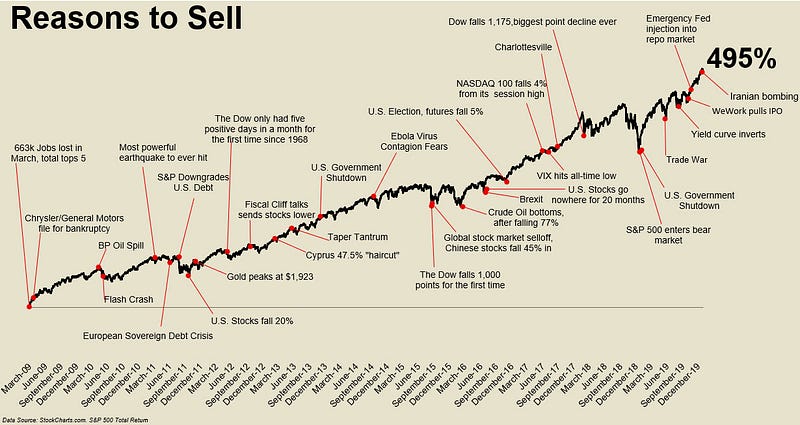
Although there was no major war fought in the last decade or so, there were plenty of occasions, when the market bull ran could have been easily derailed. While there were some meaningful corrections, the longer-term bull trend continued to assert itself as the U.S market entered the 11th year of its bull rally — the longest in the stock market history (Figure 1).
The U.S stock market which bottomed in March 2009 has seen gains of 495% as of today. The chart above depicts numerous catalysts that could have triggered the investors to opt for the safety of assets like Gold, but the market kept grinding higher. Even the two-year-old trade war didn’t buck the long term trend.
Coming back to the geopolitical risks, history dictates that markets hate periods of uncertainty. As we saw in the most recent example, markets remained on the edge from the time the U.S attacked Iranian targets till the time they retaliated. Although the relations are far from being normalized & this is probably going to be a long drawn conflict, markets have taken that in stride and resumed their rally citing fundamentals.
While an average investor might be getting edgy at the prospect of another war breaking out & wiping out their savings, historical data suggests that a breakout of war alone is not enough to trigger a long term sell-off in U.S markets. A study by the Swiss Finance Institute looked at the relationship between the U.S stocks & the military conflicts since World War II (Figure 2).
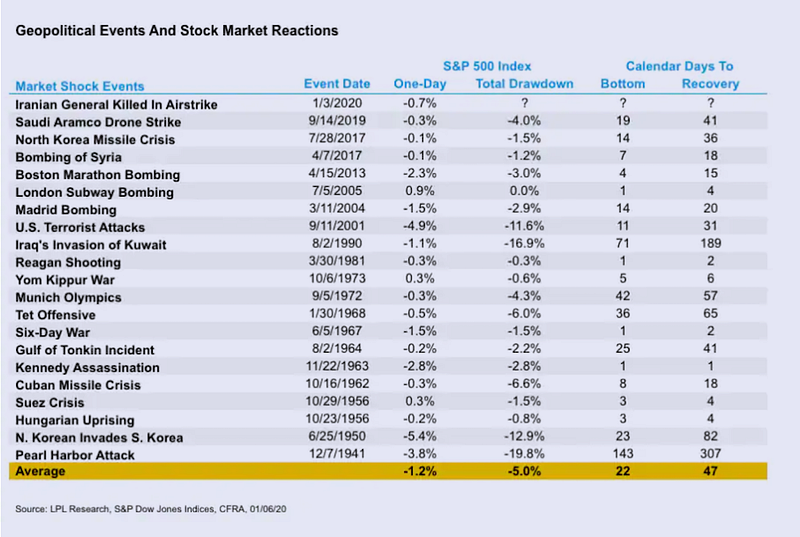
A strange phenomenon emerged from the research. It determined that in the time leading up to a war, an increase in the war likelihood tends to decrease stock prices, but the ultimate outbreak of war increases them. But if the war starts off as a surprise, an eventual outbreak of war in this scenario decreases stock prices. The term coined for this is “the war puzzle,” where there is no clear explanation of why stocks increase significantly once war breaks out after a prelude.
Another extensive study (from 1926 through July 2013) conducted by the President of Armbruster Capital Management concluded that U.S stock market volatility was actually lower during periods of war. Now don’t think I am trying to justify a war in any way, but solely in the case of Iran, the relationship between the two countries has been thorny for the past four decades. For the investors, the certainty of an uncertain relationship between the two countries is enough to ignore the escalation headlines.
Having said that, it is a well-known fact that markets move in cycles and the current linear trajectory is unsustainable. With the current U.S market, the correction is due and will happen at some point in time, but it will probably be triggered by homegrown factors like the housing bubble we saw in 2008. For now, the U.S stock market continues to climb the wall of worries.


