Will the European Union Ban X?
Why the EU’s new AI law could be a huge headache for Elon Musk

Earlier this month, the European Parliament adopted the final version of its much-anticipated Artificial Intelligence Act. The AI Act is a big deal. It’s the first time we’ve seen a comprehensive attempt to ensure AI develops in a safe and human-centric fashion.
Most companies that make AI-driven products likely won’t come in for a great deal of scrutiny. But AI applications that use biometric data, that screen job applicants and monitor employees, or that are used for law enforcement or border control, among other things, will have to clear some pretty high hurdles.
Meanwhile, some AI use cases have been banned outright. For example, “social scoring” — think the Chinese Social Credit System or that terrifying episode of Black Mirror — will be prohibited across the EU. Scraping social media and CCTV footage to build out facial recognition databases is also a no-no.
And then there’s the clause that must have social media platforms frantically calling their lawyers. Under the new law, companies will not be allowed to put on the market any
AI system that deploys subliminal techniques beyond a person’s consciousness in order to materially distort a person’s behaviour in a manner that causes or is likely to cause that person or another person physical or psychological harm.
X (aka the social media platform formerly known as Twitter) is particularly vulnerable. In fact, just a few months ago the European Commission had already opened an investigation into whether X had violated a similar provision of the EU Digital Services Act, which among other things prohibits online platforms from organizing or operating
their online interfaces in a way that deceives or manipulates their users or in a way that otherwise materially distorts or impairs the ability of the users of their service to make free and informed decisions.
Essentially, the allegation would be that the AI in X’s algorithm operates as a subliminal technique, designed to feed you posts and stories that impair your ability to make free decisions, to your physical and psychological detriment.
In this essay, I’m going to explain how we know that Elon Must possessed the intent to create just such a technique, that he has in fact succeeded in creating it, and that it has indeed caused harmful consequences.
Elon to the rescue!
When Elon Musk acquired Twitter in October of 2022, he said his motives were altruistic.
The reason I acquired Twitter is because it is important to the future of civilisation to have a common digital town square, where a wide range of beliefs can be debated in a healthy manner, without resorting to violence.
That is why I bought Twitter. I didn’t do it because it would be easy. I didn’t do it to make more money. I did it to try to help humanity, whom I love.
In private communications with friends and associates, he struck a similar tone. He sought to reassure the investor and Democratic party megadonor Michael Kives: “Twitter is obviously not going to be turned into some right-wing nuthouse. Aiming to be as broadly inclusive as possible.”
But people like Kives and others had good reason to be skeptical. In other private text messages disclosed as part of a lawsuit between Musk and Twitter, we see plenty of evidence that Musk’s friends and associates expected his ownership of Twitter to alter the platform’s ideological flavor.
“Are you going to liberate Twitter from the censorship happy mob?” asked podcaster Joe Rogan.
Another associate, whose name was redacted in the court filing, mused that “It will be a delicate game of letting right-wingers back on Twitter and how to navigate that (especially the boss himself if you are up for that).”
I’m interested to know who sent this message, but “the boss himself” can only mean Donald Trump, whose Twitter ban many hoped Musk would reverse.
When you read through these messages between Musk and other Silicon Valley types (scroll down to Exhibit H), you get the unmistakable impression of a group of people absolutely furious that social media — and Twitter especially — are censoring certain voices in the name of wokeism, of promoting progressive orthodoxy.
And of course, it’s no surprise that they would also see Musk as their standard bearer. Musk doesn’t just flirt with fascists and conspiracy mongers. He gleefully embraces them. A short list of his insane social media posts shows him promoting Pizzagate, the Great Replacement Theory, anti-Semitism, and anti-vax nonsense.
And of course, Musk IRL isn’t much better. This is a guy who runs a company — Tesla — that had to pay $137 million to a Black employee who was repeatedly called the N-word by co-workers who also “had drawn swastikas and scratched a racial epithet in a bathroom stall and left drawings of derogatory caricatures of Black children around the factory.”
A female worker at a Tesla factory described sexual harassment there as “rampant,” and characterized her workplace as more resembling “a crude, archaic construction site or frat house than a cutting-edge company in the heart of the progressive San Francisco Bay area.”
I mention all this because I want it to be clear: when Musk and his friends salivate over restoring freedom of speech to Twitter and banishing the left-wing snowflakes and “censorship mobs,” they are completely deluded. To extreme right-wing ideologues with no concern for facts or truth, any insistence on moderation and evidence will seem like persecution.
Here’s the truth: there never was any anti-conservative bias in social media. That was the conclusion of a 2021 study by researchers at the NYU Stern School of Business. The same year, an internal study at Twitter itself found that, if anything, the platform was amplifying conservative voices over liberal ones.
Night and day
When Musk took control of Twitter, his extreme right-wing bias meant that “promoting free speech” would actually entail unleashing hate speech and conspiracy theories.
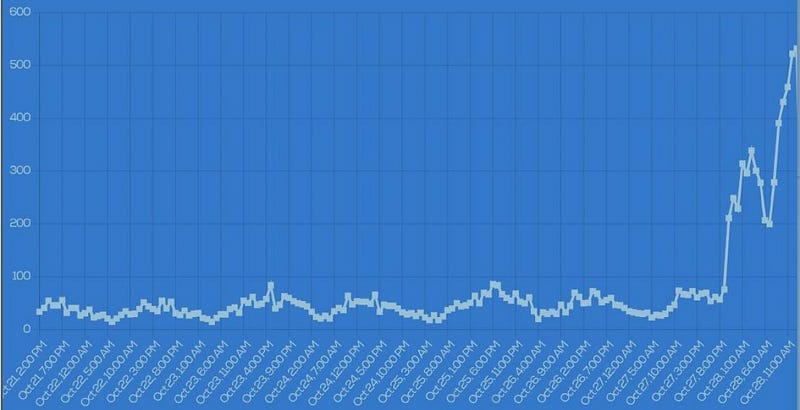
And that’s exactly what happened. Researchers at Montclair State University found that within twelve hours of Musk’s takeover, there was an “immediate, visible, and measurable spike” in vulgar and hostile language on the platform, including obscenities and racial slurs (see graphic below).
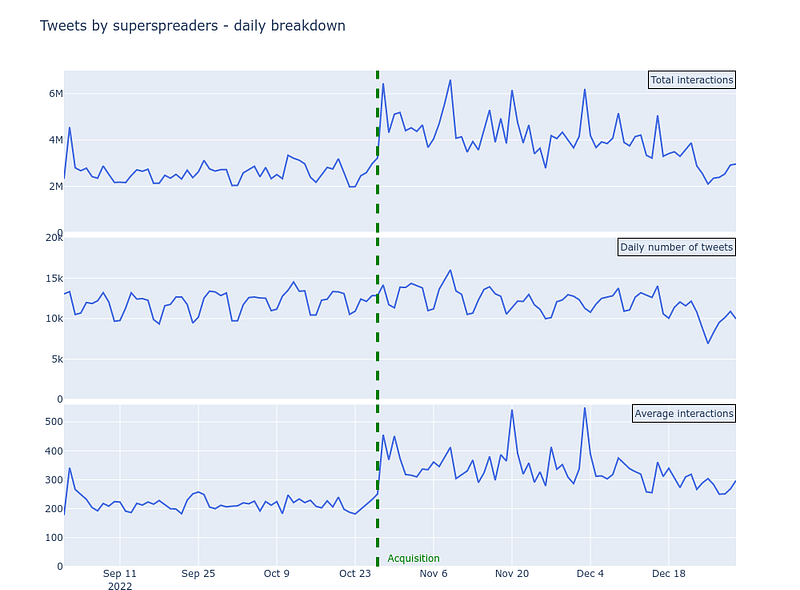
Disinformation also spiked. A study by Health Feedback looked at “misinformation superspreaders,” defined as “accounts that have repeatedly published popular tweets linking to known misinformation.” These include accounts owned by people like the actor Kevin Sorbo, the polemicist Dinesh D’Souza, and anti-vaxxer Robert F. Kennedy, Jr.
The study found that these misinformation superspreaders didn’t post more tweets than they had before, but they suddenly saw a whole lot more amplification and engagement (see graphic below).
Twitter pre- and post-Musk was night and day. Before, Twitter was a social media platform struggling to maintain its integrity for the sake of those users who hoped it might yet be a forum for a thoughtful, reasoned exchange of ideas.
After, it was a cesspool of conspiracies and a hellscape of hate. It’s no wonder advertisers fled in droves, and the company Musk bought for $44 billion in October 2022 was worth just $12.5 billion by January of this year.
Given the strong evidence we’ve already seen that Musk had a motive to turn Twitter into a vehicle for his right-wing ideology, these abrupt shifts in content buttress the inference that he was in fact able to carry out his design.
And it’s further supported by what Musk has done to retaliate against those who have criticized Twitter’s ideological shift. Despite fashioning himself a “free speech absolutist,” when the Center for Countering Digital Hate published several articles documenting the rise in hate speech and anti-vaccine conspiracy theories on Twitter, Musk sued them.
In his opinion dismissing the lawsuit, Judge Charles Breyer laid into Musk with uncharacteristic contempt.
Sometimes it is unclear what is driving a litigation, and only by reading between the lines of a complaint can one attempt to surmise a plaintiff’s true purpose. Other times, a complaint is so unabashedly and vociferously about one thing that there can be no mistaking that purpose. This case represents the latter circumstance. This case is about punishing the Defendants for their speech.
If Musk’s goal had been to promote free speech for the sake of humanity, you’d think he would have welcomed any criticism that would help him do better.
Res ipsa loquitur
So Musk had a plan to turn Twitter into a vehicle for promoting right-wing ideology under the guise of protecting “free speech,” and he largely succeeded. It remains to be shown that the tool he fashioned has caused real harm.
To begin with, let’s acknowledge that there is a large and growing body of evidence that social media usage in general is linked to adverse mental health outcomes.
A good deal of social media’s negative impact on mental health is attributable to cyberbullying, which often consists of just that kind of vulgar, violent, and hateful speech that became so much more common on Twitter once Musk took the reins.
Other studies have shown a very interesting connection between disinformation and the affective content of news stories. In other words, as the authors of one study put it, fake news has “fingerprints” that scientists can detect, and one of those fingerprints is that disinformation is “more emotional (10 times more relying on negative sentiment and 37% more appealing to morality).”
Another fingerprint of fake news is that it takes less cognitive effort to process. And that makes sense. In his 2011 book Thinking Fast and Slow, the late psychologist Daniel Kahneman contrasted the slow, deliberate mode of thinking that relies on reason and analysis, with the fast, automatic mode of reasoning that relies on emotion.
That’s an oversimplification since all rational inferences require emotional coefficients to give them force. And by the same token, all emotions are essentially shortcuts to “inferences” that have been drawn either by repeated exposure of the individual to similar circumstances or by repeated exposure of the species to similar selection pressures.
But the point is that emotion-laden content can short-circuit the reasoning process, leading us to believe we have arrived at sound deductions when we really haven’t. People who spend more time on social media may come away more firm in their convictions, but not because they’ve had to hone their ideas in the crucible of real debate.
One might find some irony in people like Musk and Mark Zuckerberg dreaming of their platforms being “digital public squares” for enlightened discussion. The reality is that “social networks are a source of massive-scale emotional contagion,” because “content that evokes high-arousal emotions is more viral.”
But I don’t think it’s ironic at all. I think Musk, Zuckerberg, and all the rest know perfectly well what they’re selling us, and they know how profitable it is. And for Musk, the profitability of emotionally-driven engagement dovetails with his desire to promote a specific political agenda.
In the law, we say res ipsa loquitur. The thing speaks for itself. Just look at our society, how lonely and angry and polarized we are. Of course, you can’t lay all that at Elon Musk’s feet. He’s no more a supervillain than he is a superhero.
But he bears some responsibility. The evidence is overwhelming that since Musk became its owner, X has exemplified all the worst tendencies of social media platforms. And it has done so because Musk wanted it that way.