
Expanding the definition of yoga and meditation
Will Taylor Swift and Covid19 Resurrect the Record Album?
And how this can be of a benefit to you

When was the last time you listened to an ‘album’ of music?
Our perception of time ‘well spent’ has changed. During the Covid19 pandemic, many people have simplified their existence, living in a smaller sphere with less personal interaction but enjoying the opportunity to explore personal pursuits. Others, face unbelievable stress, working with a diminished support structure, finances, and in particular those in the health industry — the constant stress of being exposed to Covid19.
For both groups, this is a time to rediscover what an album of music really means and how it can be of benefit.
Taylor Swift’s surprise drop of the ‘folklore’ album is the perfect case in point.
Its release wasn’t pre-empted by a strategic reveal of the singles, media hype and teaser videos — it quietly landed on her fans as a collection of music to be consumed — as an album.
The health benefit of listening to music is well documented. When you also consider it a form of Yoga or meditation — wonderful things can happen.
The term yoga, in its simplest Sanskrit definition, means ‘yoke,’ to connect, and is most often used in the context of accessing the god-like qualities within us. To connect with an album of music, and in a broader sense, the mind of the musician(s), can deeply impact a person’s well being.
The ‘asana’ or posture is open for interpretation: Lying on a summer afternoon in a hammock in the shade of old-growth tree, or sprawled on a tumble of pillows in front of a window on a rainy day, the options are endless.
So why does this idea of listening to an album of music seem so foreign, or at least ignored, by so many?
As consumers, the recording industry bombards us with the hits, or the ‘singles’ and we believe only these warrant our attention. This curation creates an artificial construct that with respect to Noam Chomsky, ‘manufactures consent,’ by telling us what we should listen to.
Stephan Jenkins (Third Eye Blind) often comments from the stage that the song ‘Motorcycle Drive By’ was never a single, but is celebrated by their fans. I would not have discovered this song if I hadn’t studied the album, in CD format, as it played on my Sony Discman (yes, it was 1997), when I walked my dog for hours in all weather. The full album, not just the hits, became a personal soundtrack. (A documentary film that recognizes the song’s ‘culture,’ and importance, directed by David Wexler, has just been released.)
Listening to an entire album is easier with today’s technology.
The streaming model of music ownership provides access to complete albums from a variety of artists without the financial commitment.
Then why, in my unscientific survey, did I find only one person who appreciates the essence of a complete album? I see three opposing forces: Time, Greatest Hits Packages and Playlists.
- This time last year, pre Covid19, it may have been difficult to justify spending an hour listening to music. That has changed as the pandemic keeps us in our personal bubbles. Instead of binging on a streaming TV show, tune out, and tune into a different frequency. For those at the opposite end of the spectrum, with precious little time, it is even more important to use this technique to relax and clear your mind.
- The prevalence of greatest hits packages superimposes the singles mentality back on the listener. While these may illustrate an artist’s ability over a career, they aren’t a true photograph or snapshot of that artist in a moment in time. I am more interested in one album when viewed in relation to a collection of work.
- Personal playlists are too easily built on the drag-and-drop technology (“Hey Alexa/Siri add this song to Kevin’s Favorites”), these collections and those that are automatically created by the likes of Hulu or Amazon Music, play on (pun intended) the need for repetition and familiarity. This is not an act of discovery or a relationship with those artists.
My love of the album began with vinyl and continued through CDs.
Are you of an age that you can recall the sense memory of opening a new vinyl record album?
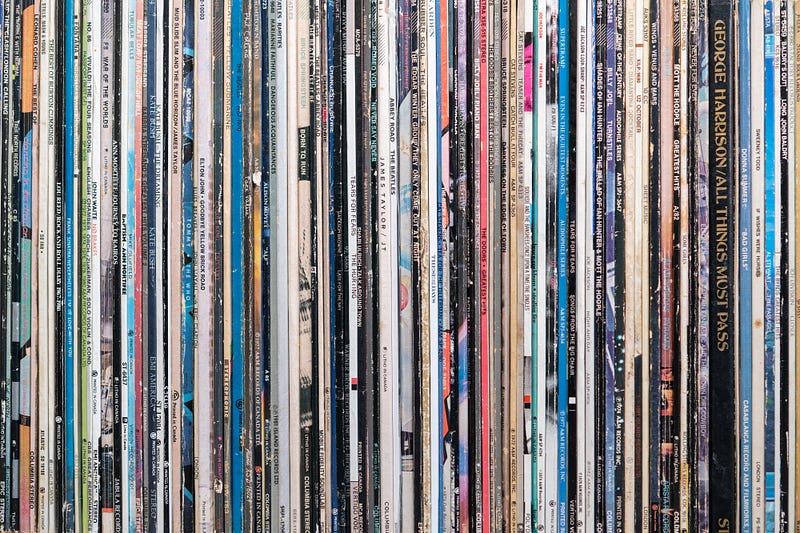
I fondly remember arriving home after a visit to the local record store. The whisper of the plastic wrap once the tear began. The scent of cardboard and vinyl — a new car smell for music lovers. From the inner sleeve, the thin edge of the disc would push against your hand, but don’t touch the pristine surface, every fingerprint will be visible in the shiny black lacquer. If you gently shook the disc, the vinyl would make a stunted thunder sound, a harbinger of the music that will soon bellow from paper coned speakers.
The next step, lift the headphones from around the neck, hear the soft puff of air as the ear pads settle (today’s equivalent would be activating the noise cancelling feature), the world now muffled, is a threshold crossed, the descent begun to an altered state of mind. Then with a gentle pop, the turntable needle drops and finds the grooves where vibrations will be converted into glorious sound.
There are always exceptions. Sometimes an album comprises only filler and is awful. I believe this most often happens with one-hit-wonders or the highly produced and industry curated artists that may or may not write their own material.
At times, a song may seem to demean an artist, leaving you to wonder how it made it onto an album. I have an example of this from Paul McCartney. The album, “Memory Almost Full” ended with a seemingly meaningless track. I then heard an interview where Sir Paul explained:
“[The original last song] brought the party down, [as it] was going to be the last track on the album…but then we thought, but we can’t leave people [like that], [so] we decided we had a little stompy romper called ‘Nod Your Head’…we just have to let them [the listener] off the hook…I think it is good to talk about difficult subjects and then to get off it…and then just rock out.” Transcribed from ‘Memory Almost Full Delux Edition’ Disc Two, Track Four “Paul talks about the music on Memory Almost Full.’
It is important to note that this artist was thinking about the album of music and seeking to achieve an arc in the listening experience by bringing the collection to a satisfying conclusion.
As a listener, you may not try to understand the themes, or study the structure of the album. I know many people who say they never listen to the lyrics. This doesn’t matter, a drumbeat alone can awaken something buried in our soul. I challenge you not to feel different after the immersion of an entire album.
After the release of Taylor Swift’s folklore album, I texted with a friend; she is much younger than I am, a thirtysomething creative woman that I was confident would understand my feelings on this topic. Before I even got to my thesis, she asked me if I’d listened to the ‘whole album.’
She wrote, “I listened from start to finish with earbuds in and have done that multiple times (taken runs to do so) away from distraction to truly listen.”
Her message instructed me to listen for a common theme. “The way three songs interlace, they tell the same story from different angles.”
Accepting her challenge, I reached for my headphones and cued up the album for a deeper inquiry, to let the words be a mantra, and as the fading sound from a bell, the rhythm will take my state of meditation to a different place.
I encourage everyone to do the same.
“Let the music keep our spirits high” Jackson Browne from Before the Deluge from the album Late for the Sky


