
Will Online Streaming Services Become Cable All Over Again?
Consumers are becoming confused with too many options
With the decline of consumers paying for cable, streaming services have become increasingly popular year after year. Online streaming services are platforms in which consumers can watch different shows or movies-on-demand. These services offer a customized experience for the user with different movies, television shows, and new original series on the platform.
Many networks are seeing the increased popularity of these platforms and have started to come out with their own. From 2019 to 2021, there have been ten new platforms that have launched which include Apple TV Plus, Disney Plus, Paramount Plus, and HBO Max. With more to come in 2021 and 2022, it raises the question of how are consumers supposed to afford all of these platforms? Obviously, no one is forcing consumers to purchase all of them, but in my experience, I have noticed that you might need more than one to watch your favorite shows. It makes me wonder if online streaming services are just cable repeating itself?
The Decline of Cable
Most Millennials and Gen Z’s participate in “cord-cutting.” Cord-cutting is not having cable television or a landline phone connection. Most people who participate in cord-cutting would rather user internet-based streaming services. An interesting article by Sarah Perez showcases how the pandemic accelerated cord-cutting. She writes:
The pandemic has accelerated adoption of a number of technologies, from online grocery to multiplatform gaming to streaming services and more. But one industry that has not benefited is traditional pay TV.
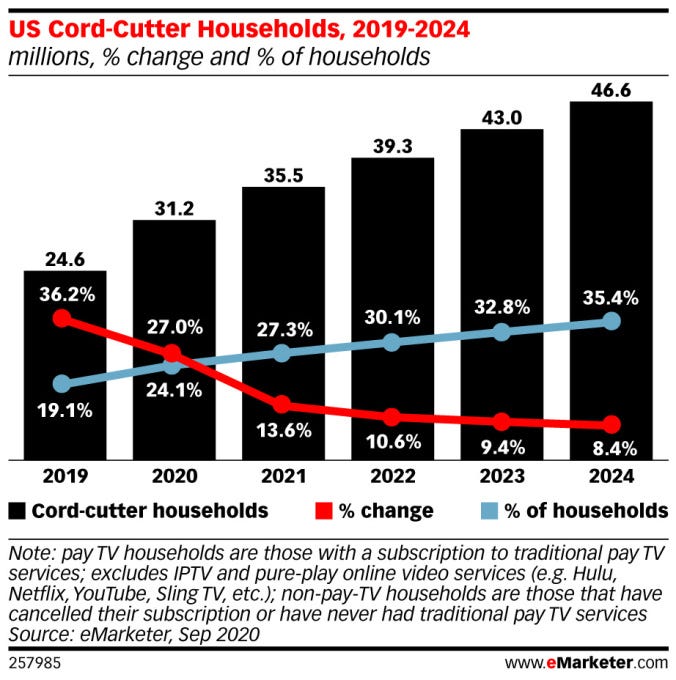
The chart illustrates how consumers are choosing to cut their ties with cable because of the high monthly fees. Streaming services allow the consumer to choose what shows they would actually watch, instead of paying for five hundred channels and only watching ten.
The Pioneers of Streaming Services
The pioneers of streaming services include Netflix, Hulu, Amazon Prime Video, and YouTube.
Netflix was introduced in 1997 by founders Reed Hastings and Marc Randolph when they had the idea of creating a website where customers could pay a monthly fee and receive any DVD they wanted. The DVD would be mailed to your house and could be rented for a certain period of time. At first, Netflix did not succeed so well. They had a negative revenue because people did not want to purchase a DVD player for this new technology. Most people would purchase VHS tapes from Blockbuster and did not want to adapt to the new technology. Furthermore, Netflix stuck to its vision and became one of the most subscribed online streaming platforms. Today Netflix has over 200 million subscribers. Netflix turned from a rental DVD company to an online streaming platform that carries well-known tv shows, movies, and original series. The cost of Netflix is $8.99 for a basic package, $13.00 for standard, and $17.99 for a family package.
Hulu was introduced in 2007 and was a joint venture between AOL, Comcast, Facebook, MSN, Myspace, and Yahoo. Hulu was created as a way to make money off of older television shows. Different networks would grant rights to their television shows and they would be posted on the website. This is similar for most streaming platforms but Hulu is known for having mostly television shows. I think Hulu is the easiest platform to binge-watch your favorite shows all day and not realize that eight hours just passed by. Hulu is one of the cheapest platforms starting at $5.99 a month. It offers different add-on options like adding the network ShowTime for an additional cost.
Amazon Prime Video was introduced in 2007 when Amazon was looking to expand outside of just being a bookseller. It was designed to compete with other streaming services and offered ad-free movies and videos. Like Hulu, they had a clear motive to have tv and movies on their platform. They later started to produced original content like most other platforms.
Google purchased YouTube in 2006 for about $1.65 billion. Ever since then, the platform exploded in popularity. A decade ago, YouTube was a platform that allowed people to uploaded entertaining videos, tutorials, and was one of the first platforms to introduce self-made videos. Now YouTube has become a multi-billion dollar company that is so much more than silly videos. They now produce original shows, integrated AdSense for their creators have different subscription services and generates millions of views every week. Most people watch YouTube for their favorite creators, for original series, and now can watch mainstream tv channels with YouTube TV. Watching creators is free or people have the option of joining their favorite creator's channel membership for a certain price. YouTube Premium and YouTube TV however will cost you an additional monthly price.
The Problem with Too Many Services
With new online streaming services coming out every year most people will have to pick and choose which ones they really want. One of the best perks about online streaming services is, it’s much cheaper than cable. If people have to continue to pay for multiple platforms, then the benefit of a cheaper alternative to cable will be lost.
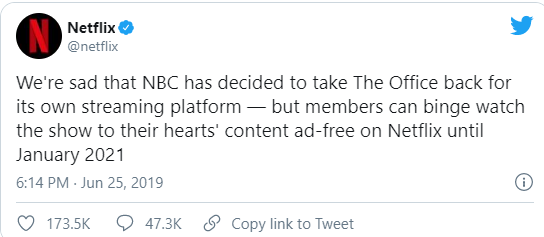
Another issue with too many platforms is the constant changing and removal of different television shows and movies. For example, the show Friends was removed from Netflix at the end of 2019 to be moved to HBO Max. HBO is owned by Warner Media so when Warner Media wanted to create their own online streaming service, it was a no-brainer that Friends must be on there. When the contract ended that gave Netflix the rights to Friends, it was not renewed so it could be placed on HBO Max. A more recent example is the removal of The Office from Netflix. Like Friends, NBC who owns The Office created its own online streaming platform called Peacock.
Will all that being said, consumers are forced to pay for multiple platforms in order to watch their favorite shows. For myself, I pay for five different platforms Netflix, Hulu, Apple TV+, and HBO Max. This is roughly $40 a month. Some platforms, that are not in direct competition with each other, do offer bundles with each other. Hulu, Disney Plus, and ESPN Plus offer a combined package for a monthly cost of about $13. This is a situation in which each of these platforms offers different kinds of videos and joining together would not hurt them. You would not see Netflix and Hulu coming together or Apple TV Plus and HBO Max.
The Future of Streaming Services
With the surplus of online streaming platforms coming into the market, the consumer is becoming overwhelmed with too many options. I believe that the decline of cable will continue and in the future, there will be no such thing as traditional cable. Furthermore, I do believe new companies will be created that will offer bundles of all of these platforms; similarly to how a cable provider offers channels such as NBC, Bravo, MTV, or The Food Network. Instead of the company offering five hundred channels, they will offer however many streaming services there are. I think streaming services will continue to become more advanced and keep rapidly expanding.