
Will Green NFTs Help Save The Planet?
The curent state of the NFT Green Movement
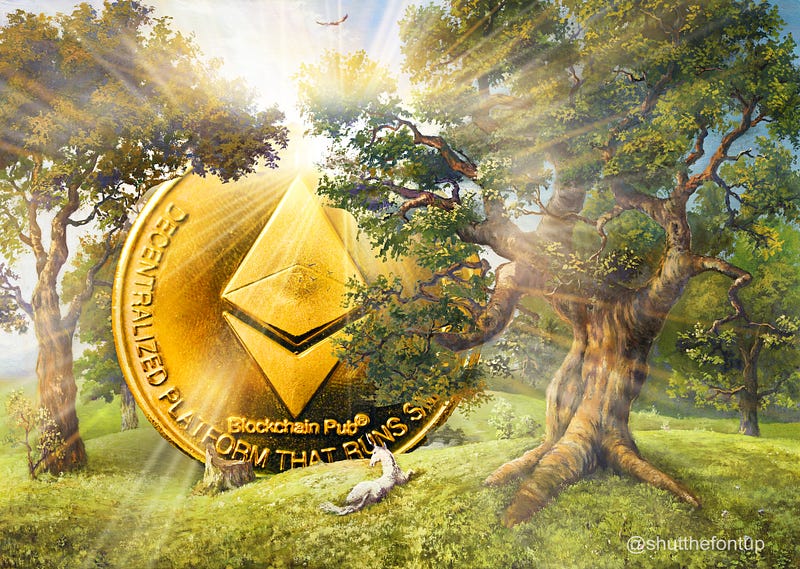
NFT’s are revolutionizing the art world, or so the headlines tell us. The inherent decentralization and security that comes with NFT’s being blockchain based also creates the ability for artists to receive a royalty with every subsequent sale and provides protections from copyright infringement since ownership of intellectual property is immutable on the blockchain. NFT’s also provide a more inclusive scene than traditional Art world institutions.
But these purported benefits come at a cost: large electric consumption. Ethereum mining — which is needed for NFT’s to function — consumes about 26.5 terawatt-hours of electricity a year. This is nearly as much as the entire country of Ireland and its almost 5 million residents. This massive energy demand and subsequent negative environmental impact has led to alarm among the eco-conscious within the Art community. As a result, there is a growing number within the art world confines seeking more eco-friendly alternatives. But before we get into the current state of the green NFT movement let’s take a look at why NFT’s are consuming so much electricity.
One of the key aspects of NFT’s that contribute to their high energy consumption is the consensus protocol of the blockchain that they are listed on. A consensus protocol is the list of rules on a blockchain that stipulate how information is recorded and shared on a blockchain. Two of the most popular consensus protocols used for blockchains are Proof of Work and Proof of Stake. In a nutshell, Proof of Work involves computers on the blockchain solving a complex mathematical puzzle when processing transactions, and Proof of Stake randomly elects computers on the network to process transactions based on network-specific criteria combined with the computer’s staking balance.
To solve the complex mathematical puzzle in Proof of Work requires a lot of computing power and, therefore, large amounts of electricity. In fact, the most popular blockchain that makes use of Proof of Work as its consensus, Bitcoin, currently uses more electricity annually than the whole of Switzerland uses per annum This high energy consumption becomes evident once a blockchain or cryptocurrency scales to a certain point, as is the case with NFT’s at the moment.
A recent study showed that the deployment of a NFT has the average electricity consumption equivalent to the consumption of a single EU resident for 2 months. This is mainly due to the fact that NFT’s are built on blockchains that use Proof of Work as a consensus protocol. Currently, the majority of NFT’s are built using Ethereum which is a leading Proof of Work blockchain. As computers on the Ethereum blockchain, called miners, process transactions on the blockchain the energy consumption increases significantly when the slightest increase in the number of transactions on the blockchain occurs. The NFT craze has led to a large influx of transactions on the Ethereum blockchain as well as other Proof of Work blockchains that are used to create NFT’s.
As noted, this high energy consumption is worrying to artists that don’t want to leave such a high carbon footprint. Many artists are now looking for eco-friendly, “Green”, alternatives for their NFT’s. An alternative to Proof of Work blockchains are Proof of Stake blockchains. These types of blockchains use less electricity than their counterpart since they
don’t rely on a complex mathematical puzzle for their transactions to be processed. Instead, the Proof of Stake blockchains elect computers on the blockchain to process the transactions. Once selected, the computers perform mathematical operations on the groups of unprocessed transactions which are far easier to perform than the mathematical puzzle found in a Proof of Work blockchain. This reduces the power consumption of a Proof of Stake blockchain significantly compared to a Proof of Work blockchain.
There are currently a few “Green” alternatives artists can use to turn their art into an NFT. These alternatives are primarily built on Proof of Stake blockchains, the most popular being the Tezos blockchain. Platforms like the NFT bidding Kalamint platform, or the SVG-focused NFT platform hic et nunc are built on Tezos and not only boast that they are “Green” alternatives but also that they have lower transaction fees. This means that you don’t have to pay excessive fees just to distribute your token on the platform.
The Green NFT movement is still in its early days. Currently, however, most NFT’s are listed on the Ethereum blockchain. Ethereum is in the process of transitioning from a Proof of Work blockchain to a Proof of Stake blockchain which will result in a significant decrease in its energy consumption. A successful transition will be a major victory for the ecology, but as of today no date has been set as to when this switch will be made. In the meantime the Green NFT movement is urging artists to list their NFT’s on platforms that are built on top of the Proof of Stake consensus. Blockchains like Algorand, Tezos, or Polkadot are being explored as alternative blockchains for NFT platforms, with Tezos showing signs of being a prominent advocate for the Green NFT movement.