
Will Dementia Cloud My Memories of My Mother?
As her dementia deepened, so did her stubbornness.
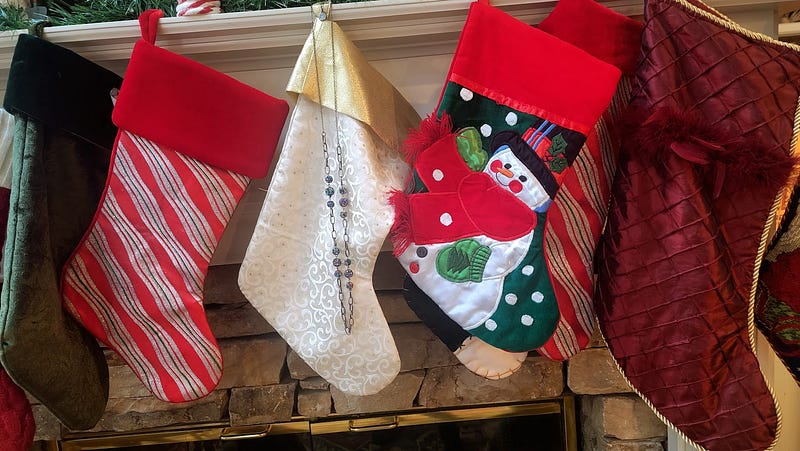
I wore my mother’s necklace to church today. It’s a colorful, sparkly piece that usually isn’t my style, but I ran across it when I was rummaging through my jewelry drawer.
I had put the necklace in her stocking the year she came to live with us, the year she got dementia. I’ve always filled stockings for the adults and kids who spend Christmas Eve in my house, although now there are fewer stockings. My father-in-law died on Christmas Eve in 2015. My mother-in-law and my father died many years before that.
My mother came to live with my spouse and me two weeks before Christmas. She only planned to visit, like she did every year, so I tricked her into staying.
“I need to get home,” she announced after Christmas. “When can you drive me home?”
“After New Year's,” I told her. “Once we take down the tree. ”
As December stretched into January, my answer changed. “When you get well. When the weather is better. When you can cook your own meals. Then I’ll take you home.”
“Let Me Spoil You, Mama”
We plodded along in this manner, me acting as if my mother would eventually go home, until one day I said, “Let me spoil you, Mama. Stay here with me, and let me cook your meals and that favorite chess pie you like. You deserve it.”
She must have been satisfied with this answer because a few days later she announced, “I’ve decided to stay. You can spoil me.” She never mentioned going home again.
But spoiling her got harder. As her dementia deepened, so did her stubbornness. Sometimes, she refused to get out of her chair to use the toilet. Other times, she balked at doctor’s visits or screamed and wailed when I showered her.
I dangled rewards and bribes. We would stop by Chick-fil-A on the way home from the doctor. After her bath, I promised to curl her hair and dab perfume on her wrists. If she used the toilet, I would wrap her in a cuddly blanket and turn on her favorite Westerns.
I regretted the times I lost patience. “You’ve got to get up, Mama! We’re ready to go!” was met with anger and escalating tensions. The only approach was to enter her world; to cajole, be gentle, offer bribes.
We had a routine. Her doctor had said, “Keep her moving. Make sure she exercises,” so I walked with her from room to room. “It’s so pretty,” she would say, lingering as I switched on Christmas tree lights and lighted garland. Sometimes, when the weather was warm, I persuaded her to walk to the end of the driveway, praising her for every dreaded, laborious step.
“What’s Wrong With Mama!”
She began to fabricate outlandish tales. One time when my brother called, she told him she was in prison for robbing a bank. After they finished their conversation and hung up, I counted to ten before my phone rang. It was my brother.
“What’s wrong with Mama! What does she mean, she’s in jail!”
“She’s watching Gunsmoke,” I explained. “She gets involved with the action.”
Another time when my sister dropped by, Mama said, “We’re being stalked. Every time we drive somewhere, a man turns his headlights off and follows us.”
My sister was horrified. She wanted me to call the police. When I told her Mama was making it up, she said, “But she’s so convincing!”
It didn’t do any good to dispute my mother, so I played along. I knew, after breakfast and a nap, she would forget everything she had said.
Mama Loved Me at First
Mama loved me at first. She had always fought fiercely for her children, making sure our lives were not as difficult and deprived as hers had been. But as she deteriorated mentally and physically, her love receded behind the thickening fog of dementia.
“I hate you,” she spat after she became bedridden, when I tried to change her soiled sheets. She thought I was trying to poison her with the pills that were meant to calm her agitation.
“This isn’t really my mother,” I told myself. “It’s the illness.”
I nursed the secret hope that she would regain cognition, if only briefly, before dying. I had heard of that happening. Many people suffering from dementia experience sudden clarity when they are near death, a phenomenon that researchers attribute to a burst of activity in dying brains.
I imagined my mother whispering softly, “I love you.” Or maybe she would simply say, “It’s been a good life, and now I’m ready to go.”
But in Mama’s case, it didn’t happen. I had just given her an Ensure, and she threw it up all over her nightgown. I managed to change her gown as she leaned into me, breath coming in short, soft gasps. Dry and clean again, she stared beyond me, eyes widening at something I couldn’t see. Then death’s pallor, a slow tide, seeped over her features, and she was gone.
This was two years ago. At the time, I wondered how I would remember my mother. Would she revisit me in her dementia, her helplessness, the condition of her last days? Or would I see her throwing open the screen door to welcome me to the family home, moving nimbly across the kitchen as she cooked, taking care of my father with determination and grit that kept him alive for many years after his stroke?
Would she be the mother who dispensed wisdom and common sense that have been guiding principles in my life? Would she be the mother who loved me? Or would I remember the diminished woman of those final, grueling days?
How I Remember Her
I finger the necklace, and a flood of tears cloud my vision. Two years after her death, I have my answer. More and more often, I remember her as the woman she was before age and illness intervened. I realize now that my time caring for her, rather than diminishing love, infused it with an extra layer of tenderness.
Tears come more easily. Rather than being hardened, my heart is softened from the act of caring. It’s a softness that chips away hard veneers and sharpens both sorrow and joy.
Sometime last year, my mother started coming to me in my dreams. She is always in her own home, independent and content. As I approach, she throws open the screen door and welcomes me with open arms. I know she is okay, and she is finally where she wants to be.
Bebe Nicholson is a graduate of the UNC School of Journalism, former newspaper editor, flight attendant, nonprofit director, and publisher of 4 books, the latest being Bebe’s Bladder Book. She has also published a Kindle version of Anna Long Thomas Fuller’s Journal, a Civil War diary that sold out of its first two printings and is no longer available in print form. She and her husband split their time between Georgia and South Carolina. They have three children and 12 grandchildren.


