Will China Launch a Pearl Harbor-Style Attack On The United States?
The flashpoints and the likelihood
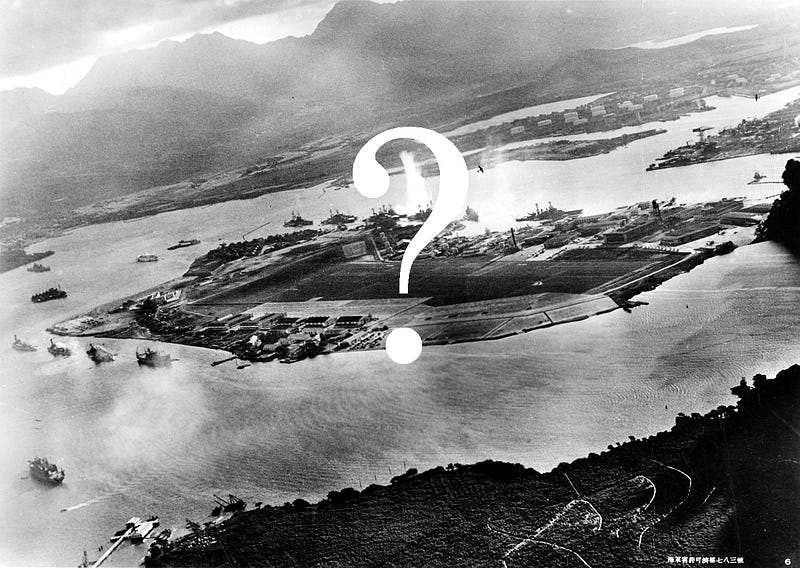
For the first time in recent memory, the United States is at a technological disadvantage regarding the military. While other countries like Russia and China have made notable public advances in the realm of hypersonic missiles, the United States has faltered. This puts the United States at a distinct, and even unique, disadvantage. Since the eruption of the atomic bomb over Hiroshima in 1945, the world has been used to the United States possessing the latest and greatest military technologies. That is no longer the case.
The United States continues to struggle in an uncharacteristic manner when it comes to hypersonic missile technology. The Air Force recently admitted that advanced tests had failed and that they were going to pursue a new direction in hypersonic missile technology. This provides an opening for China that rarely presents itself and has raised the specter of another surprise attack in the same vein as Pearl Harbor.
Hypersonic Ship Killers
The crux of this idea hinges on the YJ-21 anti-ship missile. The YJ-21 is China’s newest hypersonic missile that can be mounted in verticle launch systems on destroyers and even carriers. These missiles travel at Mach 6 and have a terminal velocity of Mach 10. They can even maneuver midflight to avoid deterrents.
Using their extraordinary speed and power, these missiles can, theoretically, sink nearly any ship with a single hit at the waterline. Currently, there are no effective defense mechanisms against such missiles.
Imagine a missile coming in at 4,000 mph with the ability to drop dozens of feet in a single second. One hit will cripple or destroy a vessel. That is what is possible.
Preemptive Strike?
It is no secret that China has designs to reconquer the island of Taiwan. The Chinese Communist Party (CCP) sees Taiwan as a breakaway province that has been in a state of open rebellion since the conclusion of the Chinese Civil War. How far off this potential military action is and whether or not it is inevitable is the subject of much debate. But one thing is clear, if China wants to invade Taiwan, it will likely have to come into conflict with the United States and possibly Japan.
The combination of Chinese military ambitions, the United States’ current hypersonic missile program, and the state of China’s navy raise the possibility of a preemptive strike.
Some experts are raising the alarm that China could exploit the technology gap for a number of reasons. First, the United States has no way to stop hypersonic anti-ship missiles. Second, the technology gap is not likely to hold for long. While the US is lagging behind right now, there is little doubt that they will eventually figure out the secrets to hypersonic missile success. There is growing consternation that a coordinated hypersonic missile strike could cripple or eliminate a large portion of the US naval assets in the Pacific in a short amount of time.
Such an attack could precede an invasion of Taiwan or even happen simultaneously in order to knock the US off balance while the People’s Liberation Army (PLA) crosses the straits.
How Likely Is Such An Attack?
Some experts that I have talked to seem to think that such a strike is a fantasy. China, they tell me, does not need to engage the US militarily. They are waging a cultural and economic war that they feel like they are winning. They don’t need to risk such a provocative strike that would likely lead to World War III.
However, there are schools of thought within political science that say that passing up on such a golden opportunity is folly. Windows like this rarely open, and letting it close could be unforgivable for some hawks within China.
Historically, surprise attacks like the ones conducted by the Japanese are rare.
Failure and the Nuclear Question
The Japanese decision to attack Pearl Harbor ended disastrously for them. The proponents of the attack were subsequently killed. Japan was reduced to rubble, and the old regime was utterly dismantled. Every inch of the Japanese empire was stripped away. China is acutely aware of this and is currently watching Russia’s progress in Ukraine with intensity. If Russia fails in its military goals, it will color future decisions about launching such a broad military invasion in the 21st century. Failure is always an option, and failure on this scale can be destabilizing or even fatal for a ruling regime.
The other part of this equation is the nuclear question. Nuclear weapons are the great equalizer. While the United States might not have hypersonic missile technology yet, they still have plenty of nuclear bombs at their disposal. Hypersonic ship missiles seem quaint in the face of Minuteman intercontinental ballistic missiles loaded with MIRV warheads.
Nuclear weapons kept the Soviet Union in the Cold War long after they fell behind in the military technology race. While the United States has never been as bellicose about using their nuclear weapons as other nations, the threat is still there and it is still a powerful deterrent against any type of military attack against the United States.
Regional Conflict
The only way such a preemptive strike would work against the United States is if China somehow made it clear that the actions were part of a wholly regional conflict. Assets in the Pacific would be hit with the understanding that it is a military necessity for a regional action against Taiwan. If a war spiraled out of control and spilled over from a regional military expedition into a global one, the benefits of a preemptive strike would rapidly evaporate.
Such a containment effort seems difficult to achieve, with many people warning that a strike against the United States would immediately elevate any Chinese designs on Taiwan from local to global.
Verdict
The chance of a preemptive strike against the United States by the CCP is minimal, but it is not zero. There is an opportunity to cripple the United States Navy in Asia and launch a regional military conflict long imagined by Chinese military planners. However, there are serious risks that could outweigh any potential benefits. The question becomes if Taiwan is worth the risk and if the Chinese believe that the hypersonic missile technology is as effective and valuable as some claim.