
Will America Pay to Rebuild Gaza and the West Bank?
Or Will it Pay to Create a Larger Israel?
What Happens When the Shooting Stops?
Most of the focus on the ongoing war between Israel and Hamas is on when there will be a cease-fire. When will the air strikes by Israel on military and civilian targets stop? At what point will the ground surge, which has now extended into central and southern Gaza, be halted?
I won't dismiss the missiles going into Israel from Hamas forces in Gaza and the West Bank, along with the trade of missiles between Hezbollah forces in Lebanon and Israel. This, too, needs to stop. The world is asking when there will be a cease-fire and, more importantly, an end to the war.
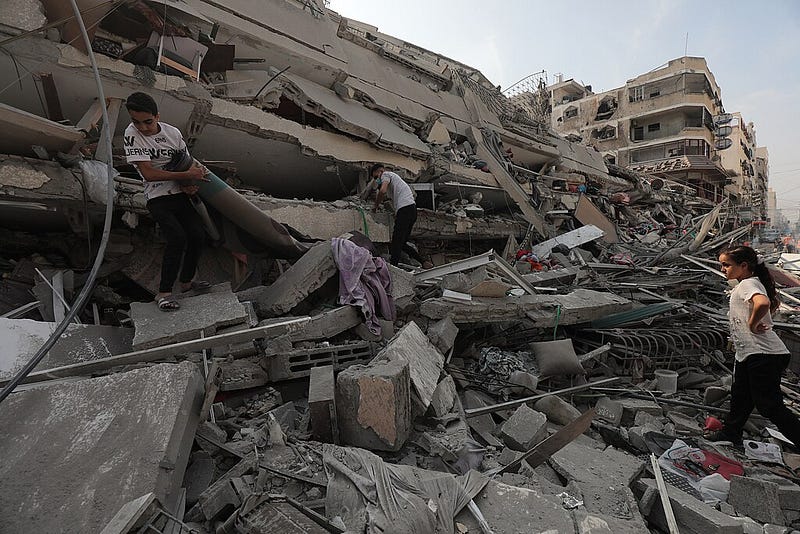
My question is, what happens afterward? Much of Gaza and the West Bank has been reduced to rubble. The infrastructure there has been severely compromised, except for most of the construction projects previously funded by America. Assuming the war eventually ends, will the United States help rebuild Gaza and the West Bank, and will those areas be returned to Palestinian control in any fashion?
One alternative is to provide itself with greater security. Israel will take over some of the land previously held by Palestinians. One could argue their ongoing settlements in the West Bank were already encroaching on Palestinian territory, and any new takeover would be a continuation of existing policy.
A History of Rebuilding
America has a long history of helping nations it's been at war with. After World War II, we initiated the European Recovery Program (ERP), or the Marshall Plan, and sent $13.3 billion (equivalent to $173 billion in 2023) in economic recovery programs to Western European economies. We helped rebuild not only allies like England and France but also Significant amounts went to defeated enemies Germany and Japan.
One could attempt to make the case America isn't a participant in the Israel-Hamas War. That would require ignoring the significant funding and weaponry America provides Israel. America had previously agreed to provide $3.8 billion in military aid to Israel for 2023. An additional $14.5 billion in assistance has been passed by the House of Representatives but stalled in the Senate due to funding for Ukraine opposed by Republicans. Be assured that while Ukraine funding is up in the air, Israel will get its share of the money.
No matter the level of devastation in Palestinian areas in Gaza and West Bank. Whether any aid can be passed bipartisanly to rebuild those areas is questionable. America has given money to Israel but only lip service to the civilians in harm's way in the Middle East.
The Value of a Palestinian Life
The United States has provided aid to Palestinians in the past. It's a pittance compared to what we give to Israel. USAID provided $150 million in 2023 to empower Palestinians to build "thriving and resilient communities."
In an episode of "The West Wing," President Jed Bartlet wonders out loud why a fictional Kudanese life is worth less than an American one. Speechwriter Will Bailey replied, "I don't know, sir, but it is." President Bartlet and his staff faced the reality that American foreign policy is based not on what is right but on what is in our interests.
A Palestinian life is worth less than either an American or Israeli life based on our actions. We are paying Israel to wage this war so that our soldiers don't have to. No American boots on the ground are the justification for the billions provided to Israel to let them do it. American policy ignores the millions of men, women, and children starving to death while foreign aid piles up on the Egyptian border. A recently released American hostage equated all Palestinians with Hamas, and the story ran across the spectrum of American Media. It's permissible to bomb civilians and watch families starve because they are all terrorists, animals, and rapists. We have devalued Palestinian lives to make it easier to look away from the devastation.
After the War
I see no scenario in which Israel doesn't confiscate Palestinian land with no intention of giving it back. Instead of occupying land, they will annex it. There are reasonable logistic concerns about how they keep themselves safe from whatever remains of Hamas. Let's not forget they were taking over Palestinian land with illegal settlements before the war began. Shortly, we won't be talking about pre-1948 borders or pre-1967 borders. We'll be talking about pre-2023 borders when the dust settles.
There are millions of displaced Palestinians with only rubble to return to. Unlike Ukranian refugees, who were openly accepted in many places worldwide. Palestinians. Other Arab countries are reluctant to accept more refugees, believing that Israel will not allow them to return.
“All historical precedent points to the fact that when Palestinians are forced to leave Palestinian territory, they are not allowed to return back. Egypt doesn’t want to be complicit in ethnic cleansing in Gaza.” — H.A. Hellyer, Senior Associate Fellow at the Carnegie Endowment for International Peace
The suggestion that American pressure will cause Israel to bring the war to an early end, relent to a cease-fire, or fall back to pre-war borders rings hollow. Many, if not most, Israeli citizens are concerned about the level of pain inflicted by air strikes and starvation, along with their own losses in battles and some to friendly fire. Israel's war strategy won't be based on the wishes of its citizens or American politicians but on the needs of Benjamin Netanyahu to remain in power. He is blamed for allowing the October 6th attacks in the first place, and many feel he needs an ongoing war to remain Prime Minister.
Unlike the proposed wall on America's border with Mexico that Mexico was supposed to pay for. America will ultimately pay for Israel to confiscate Palestinian land unless it comes down to chasing votes in Michigan with its large Palestinian-American population. We may watch while Palestinians starve because we value little Palestinian life.


