
Will America Choose a Psychopath?
Those who cannot remember the past are condemned to repeat it — George Santayana
Humans, with their powerful cognitive capacity, are the least reasonable of species.
The obvious example of how crazy we humans are when it comes to choosing political leaders is Adolf Hitler, a murderous psychopath but still the duly elected Chancellor of Germany.
Similarly, Donald Trump ran twice for President of the United States of America. Though he lost the popular vote twice, he won the the Presidency in 2016 because of our antidemocratic Electoral College.
Trump is a different beast than Hitler, although people often compare the two. But that doesn’t mean Hitler and Trump don’t overlap in shared psychopathy. How is it that the media rarely explores this question?
Is Trump in fact a psychopath?
Prima facie? Of course he is! But there are tests to determine psychopathy, two of which are the gold standard.¹
- Psychopathy Checklist-Revised (PCL-R) assesses whether an individual exhibits traits and behaviors that could indicate psychopathy. This test is often used to predict the likelihood that a criminal may re-offend, as well as their capacity for rehabilitation.
- Psychopathic Personality Inventory (PPL) is an alternative psychopath test that was introduced in 1996. This test is used to assess psychopathic traits in non-criminal populations.
As it turns out psychopath is not an official diagnosis. It’s pop jargon for a condition called antisocial personality disorder (ASPD).²
What are the symptoms of APSD? Here’s a list.
- behavior that conflicts with social norms
- disregarding or violating the rights of others
- inability to distinguish between right and wrong
- difficulty with showing remorse or empathy
- tendency to lie often
- manipulating and hurting others
- recurring problems with the law
- general disregard toward safety and responsibility
- expressing anger and arrogance on a regular basis
- tendency to engage in behavior that’s reckless, impulsive, or may lead to harmful consequences.
- lack deep emotional connections
- have a superficial charm about them
- be very aggressive
- get very angry sometimes
Sound familiar? Compare the list to Trump’s behavior. How can Trump not be a psychopath?
Let’s talk first about Chainsaw Al Dunlop and the PCL-R test. Dunlop, the former CEO of appliance maker Sunbeam, was ruthless. He is legendary for joyfully closing factories and jubilantly firing employees.
In The Psychopath Test: A Journey Through The Madness Industry, author Jon Ronson administers the Hare (PCL-R) test to Dunlop. According to NPR³,
“So I turned up at his house, and it was full of sculptures of predatory animals,” Ronson says. “And he immediately started to talk about how he believed in the predatory spirit, which was word for word what Bob Hare writes about in the checklist: Look out for their belief in the predatory spirit.”
But Dunlap managed to turn the psychopath test on its head, Ronson says.
“He admitted to many, many items on the checklist, but redefined them as leadership positives,” he says. “So ‘manipulation’ was another way of saying ‘leadership.’ ‘Grandiose sense of self worth’ — which would have been a hard one for him to deny because he was standing underneath a giant oil painting of himself — was, you know, ‘You’ve got to like yourself if you’re going to be a success.’”
Read that carefully: “He redefined them as leadership positives.” If Dunlop had APSD, that’s exactly what you would expect him to do!
Look at the APSD symptoms above, particularly the one about manipulating. Did Dunlop “turn the psychopath test on its head?” Or did he confirm the result by moving the goalposts, exactly as any manipulative psychopath worth his salt would do?
Chainsaw Al may have been willing to take the PCL-R test, but a presidential candidate like Trump isn’t going to do that. So if we want to confirm Trump is a psychopath, we need to take the test for him. And we need to realize that even if the test concluded he is a psychopath, Trump would do everything possible to spin it to his advantage.
Those two gold standard tests are expensive. There are a number of free online tests, which vary in credibility. The most reliable one I found is the Levenson Self-Report Psychopathy Scale (LSRP).
LSRP is not a flawless test. But it’s better than no test at all. So I used it to determine if Donald Trump is a psychopath.
Below is the LSRP test, including the answers I submitted on behalf of Trump.
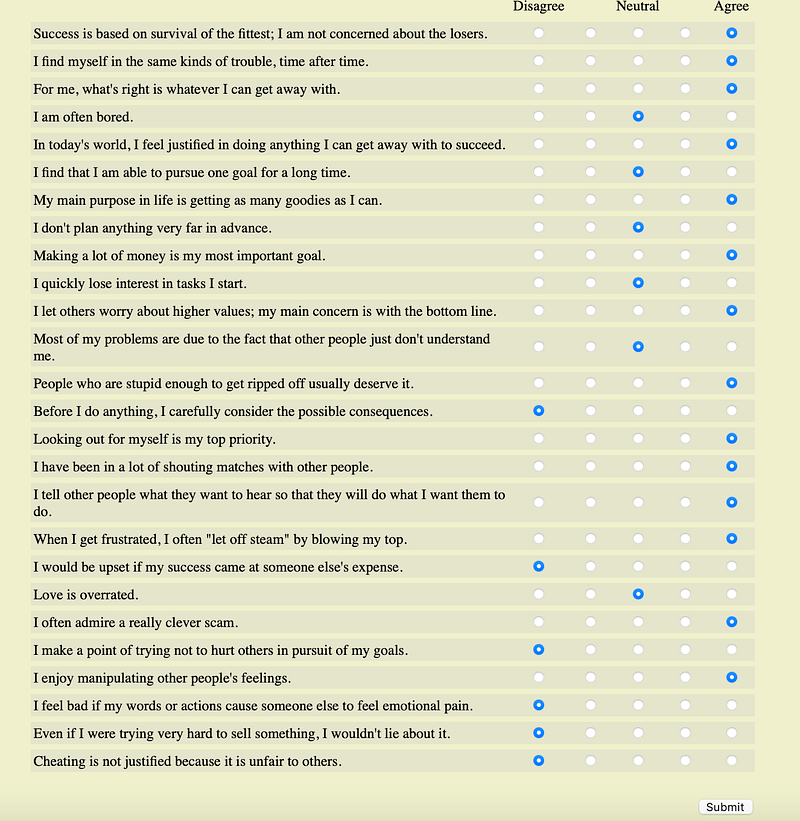
When I wasn’t sure about an answer, I chose “Neutral.”
For instance, does Trump think love is overrated? Probably, but who knows? I erred on the side of caution.
Am I biased? Absolutely. A moderate-to-progressive Democrat, I loathe Donald Trump. That said, I documented reasons for the answers I selected, summarized at the end of this article.
If you disagree with my answers, please comment provided you include citations from a credible media source to justify your disagreement.
Below is the LSRP report on Donald Trump, based on the answers I chose on his behalf.
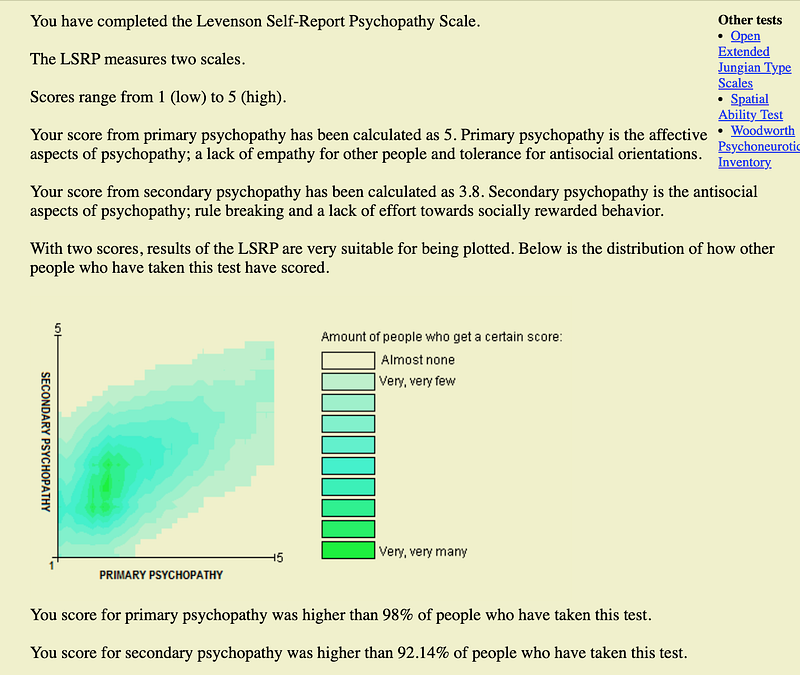
Note there are two scores.
Trump’s primary psychopathy score is 5, or 98th percentile.
His secondary score is 3.8, or 92nd percentile.
Donald Trump is a psychopath.
Does that pass the sniff test? People might confuse psychopaths and serial killers. Though serial killers are probably always psychopaths, the reverse isn’t true.
Serial killers are rare. Psychopaths, much less so. Approximately 1 percent of males are psychopaths.⁴ In 2021, there were nearly 4 billion men⁵, which translates to 40 million male psychopaths.
If there are 40 million male psychopaths, it doesn’t seem at all surprising that Donald Trump is one of them.
Given Donald Trump’s psychopathy, one wonders why his 2024 opponents would talk about anything else. Do you really care how a psychopath would finance Medicare?
If Trump’s MAGA base doesn’t see his psychopathy as a concern, certainly everyone else would conclude he is prima facie unfit for office, regardless of their ideology.
What reasonable person would vote for a psychopath under any pretext?
My opponent Donald Trump is a psychopath.
Could there be a better campaign slogan?
Justification of test answers.
- Trump called US war dead “losers” and “suckers”. He called John McCain “a fucking loser.” — Vox.com
- During a Memorial Day visit to the grave of Homeland Security Secretary John Kelly’s son, who was killed in Afghanistan in 2010, Trump asked why anyone would volunteer to serve in the military. “I don’t get it. What was in it for them?” — Vox.com
- List of Trump’s legal woes shows clear pattern of recidivism: - Guilty of defaming and sexually abusing Jean Carroll (and ironically defamed again the following night on CNN) - Accused by 25 other women of sexual misconduct since the 1970s — Business Insider - Indicted in Southern District of New York for using campaign funds as hush money - New York is suing Trump family’s multi-billion-dollar real estate empire for fraud, trial expected in October 2023 - A Georgia grand jury voted to indict Trump for interference in the 2020 election - DOJ special prosecutor Jack Smith is investigating whether Trump incited the January 6th riots and deliberately blocking the government from recovering classified documents
- Trump at a 2016 rally: ““My whole life I’ve been greedy, greedy, greedy,” he said at a January 2016 rally. “I’ve grabbed all the money I could get. I’m so greedy.” — Washington Post
- On paying taxes: - “I have a write-off. A lot of it is depreciation, which is a wonderful charge,” he said. “I love depreciation.” — NY Times - Michael Cohen testified he remembered Trump “showing him a huge check from the US Treasury some years earlier” and commenting “that he could not believe how stupid the government was for giving someone like him that much money back”. — The Guardian
- Trump on other people’s stupidity: “I think that when you look at that result and when you look at what happened during that election unless you’re a very stupid person, you see what happens. A lot of the people–a lot of the people in this audience and probably maybe a couple that don’t, but most people understand what happened.” — MSN
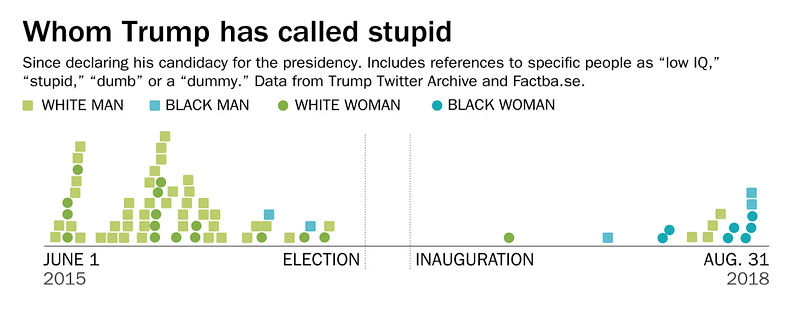
- Trump ignoring consequences of actions, and this is just scratching the surface: - 26 women who have accused Trump of sexual abuse - Preventing the US government from recovering stolen classified documents - Defaming Jean Carroll on CNN the day after he was ordered to pay her $5M for defaming and abusing her - Hosting Kanye West and white supremacist Nick Fuentes for dinner.
- Shouting and rage: - Gen Mark Milley, the chairman of the US joint chiefs of staff, reportedly “yelled” at Trump that he was not ain charge of the federal response to protests for racial justice, prompting Trump to shout: “You can’t fucking talk to me like that!” — The Guardian - “Even by the standards of the Trump White House, where people screamed at one another and President Donald J. Trump screamed at them, the Dec. 18, 2020, meeting became known as an “unhinged” event — and an inflection point in Mr. Trump’s desperate efforts to remain in power after he had lost the election.” — NY Times - Headline: “Trump Reportedly ‘Livid,’ ‘Screaming at Everyone’ over Midterm Results, as Prominent Republicans Speak Out.” — People
- “In 2005, Trump announced an eponymous “university” to teach his real-estate development secrets. Students ponied up as much as $35,000 — some after being suckered in by slick free “seminars” — to learn how to get rich. One ad promised they would “learn from Donald Trump’s handpicked instructors, and that participants would have access to Trump’s real estate ‘secrets.’” In fact, Trump had little to do with the curriculum or the instructors. Many of the “students” have since complained that Trump U. was a scam. At one time, it had some prestigious instructors, but over time the “faculty” became a motley bunch of misfits. (It was also never really a “university” by any definition, and it changed its name to the “Trump Entrepreneur Initiative,” because as it happened, the school was violating New York law by operating without an educational license.) The school shut down in 2010. In November 2016, Trump agreed to settle a series of lawsuits related to the school for $25 million. — The Atlantic
- “In 1981, Trump scooped up a building on Central Park South, reasoning that the existing structure was a dump, but the land it was on would be a great place for luxury condos. Trump’s problem was that the existing tenants were — understandably and predictably — unwilling to let go of their rent-controlled apartments on Central Park. Trump used every trick in the book to get them out. He tried to reverse exceptions the previous landlord had given to knock down walls, threatening eviction. Tenants said he cut off heat and hot water. Building management refused to make repairs; two tenants swore in court that mushrooms grew on their carpet from a leak. Perhaps Trump’s most outlandish move was to place newspaper ads offering to house homeless New Yorkers in empty units — because, as Trump wrote in The Art of the Deal, he didn’t intend to fill units with permanent residents anyway. City officials turned him down, saying the idea did not seem appropriate. Typically, Trump also sued tenants for $150 million when they complained.” — The Atlantic
- Trump on money and tax evasion: “But with me it’s ‘Oh, you did — ’ this is a business thing. I’ve used the laws of this country to pare debt.” — The Atlantic
- “In order to construct his signature Trump Tower, the builder first had to demolish the Bonwit Teller store, an architecturally beloved Art Deco edifice. The work had to be done fast, and so managers hired 200 undocumented Polish workers to tear it down, paying them substandard wages for backbreaking work — $5 per hour, when they were paid at all. The workers didn’t wear hard hats and often slept at the site. When the workers complained about their back pay, they were allegedly threatened with deportation. Trump said he was unaware that illegal immigrants were working at the site. In 1991, a federal judge found Trump and other defendants guilty of conspiring to avoid paying union pension and welfare contributions for the workers. The decision was appealed, with partial victories for both sides, and ultimately settled privately in 1999. In a February GOP debate, Marco Rubio brought up the story to accuse Trump of hypocrisy in his stance on illegal immigration. Meanwhile, Massimo Calabresi shows that testimony under oath shows Trump was aware of illegal immigrants being employed there.”The Atlantic
- “Contractors, waiters, dishwashers, and plumbers who have worked at Trump projects say that his company stiffed them for work, refusing to pay for services rendered. USA Today did a lengthy review, finding that some of those contracts were for hundreds of thousands of dollars, many owed to small businesses that failed or struggled to continue because of unpaid bills. (Trump was also found to have improperly withheld compensation in the undocumented Polish worker controversy.) Trump has offered various excuses, including shoddy workmanship, but the scale of the problem — hundreds of allegations — makes that hard to credit. In some cases, even the lawyers Trump has hired to defend him have sued him for failing to pony up their fees. In one lawsuit, a Trump employee admitted in court that a painter was stiffed because managers determined they had “already paid enough.” The cases are damaging because they show Trump not driving a hard bargain with other businesses, but harming ordinary, hard-working Americans. More recently, several contractors filed $5 million in liens against Trump’s new hotel in Washington, alleging he has not paid them for services rendered.” — The Atlantic
- “Around the same time Donald Trump was operating Trump University, the allegedly fraudulent real-estate seminar for which he’s now being sued, he also franchised his name to Irene and Mike Milin, serial operators of get-rich-quick schemes. Unlike Trump U., Trump did not own the company. Instead, he licensed his name, appearing in an informercial and promising falsely that he would hand-pick instructors. (He made a similar promise with Trump U.) As Jonathan Martin reports, the course materials at Trump Institute consisted in part of textbooks that were plagiarized. The Milins were forced to declare bankruptcy in 2008, in part because of the law-enforcement investigations and lawsuits against their company. Trump Institute continued on for a few years afterward. A Trump aide says he was unaware of the plagiarism, but said he stood by the curriculum.” — The Atlantic
- “The Daily Beast noticed in FEC filings that the Trump campaign spent more than $55,000 buying his own book Crippled America: How to Make America Great Again. (The book has since been retitled Great Again: How to Fix Our Crippled America for the paperback edition.) That means Trump used donor money to his campaign to buy a book, sending the cash back to himself. Copies were given to delegates at the Republican National Convention. The maneuver could break FEC rules, campaign expert Paul S. Ryan told the Beast: “It’s fine for a candidate’s book to be purchased by his committee, but it’s impermissible to receive royalties from the publisher … There’s a well established precedent from the FEC that funds from the campaign account can’t end up in your own pocket.” The Huffington Post also noticed that Trump jacked up rent for campaign offices when he stopped funding his own campaign. — The Atlantic
- “Though Donald Trump often promises to give to charity, his foundation has proven rather skimpy on the gifts over the years — and when it has given, the money has often come from pockets other than Trump’s, including outside donors and even NBC. In the mid-2000s, Trump reconfigured the charity as a pass-through, soliciting donations from others and then giving the money away as though from himself. It appears that the foundation did not have the requisite legal permission from New York State to gather donations. In a few cases, the foundation also reported making donations it had not made. There’s special scrutiny on one $25,000 donation it did give, to a group supporting Florida Attorney General Pam Bondi, which arrived just days before she quashed an investigation into Trump Universityand the Trump Institute. Trump also appears to have used $258,000 in foundation money, most of it given by other donors and not himself, to settle legal disputes, including donations to charity in lieu of paying fines. Trump directed more than $2 million in income to the foundation, and if he didn’t pay taxes on them — his campaign for the most part refused to say — it would be illegal tax-dodging. The foundation appears to have broken IRS rules on “self-dealing” by paying to resolve the legal disputes as well as buying a portrait of Trump and a Tim Tebow helmet that went back to the Trump family. In November, in tax filings posted online, the Trump Foundation said it had violated self-dealing rules in 2015 and in previous, indeterminate, years. On the donation, Trump and Bondi both say there was no quid-pro-quo, but the donation was an illegal one for a charitable nonprofit, and the foundation had to pay a $2,500 fine. Liberal watchdog group Citizens for Responsibility and Ethics in Washington charges other laws may have been broken as well. New York Attorney General Eric Schneiderman has reportedly launched an investigation into the foundation. Schneiderman has also informed the foundation that it is in violation of rules on fundraising and ordered it to quit. Trump has announced plans to close his foundation, but reportedly cannot do so while it is under investigation. — The Atlantic
- Trump’s manipulation tactics include empty words, empty spectacle, discrediting everyone, crediting conspiracy theories, browbeating, attention hogging, and gaslighting. — The Guardian.
¹ Verywellmind ² Healthline ³ NPR ⁴ Psychology Today ⁵ World Bank


