
Wild Architects: Seeing Things from a Bowerbird’s Perspective
Not everything is what it seems to be
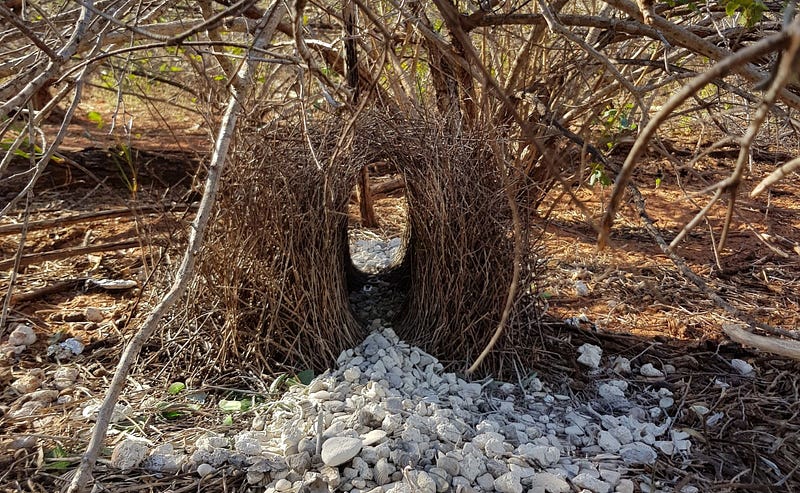
I got down on my hands and knees to examine the bower. There were snail shells bleached white by exposure, quartz pebbles gathered from the floor of a winter-dry creek, and bones of a long-dead bird. The arrangement appeared haphazard, but I was looking at it with human eyes and from a human angle.
So I lay in the warm dirt and rested my chin on folded arms. The sun warmed my back. Ants found the gaps between shirt and pants and took exploratory bites of unprotected skin. Now my line of sight was closer to that of a mid-sized bird. When I stopped categorising by type — shells, rocks, bones — and instead thought of them as part of a whole, the bower began to make sense.
Then the bird returned, and I hoped he would not judge the effort it took to get back up on creaky knees.
He definitely judged.
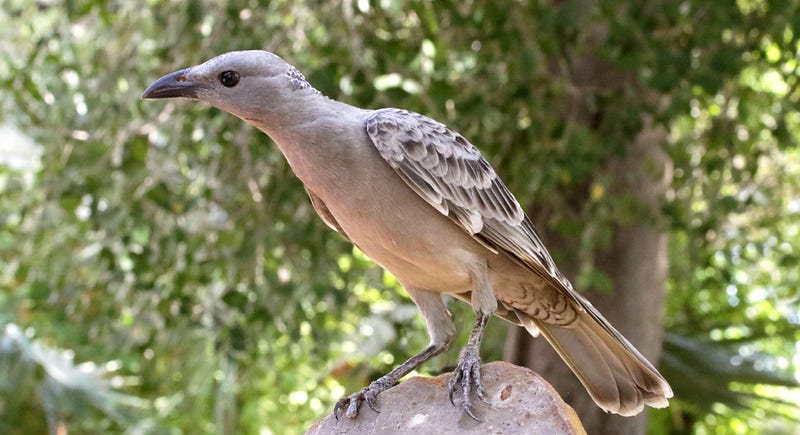
The male Satin Bowerbird has shining blue feathers. The Regent’s plumage is gold and black. But the Great Bowerbird looks like a guest who misread his invitation to a fancy dress party. His head and breast are grey, the colour of a bushfire sky, and there are sooty smudges on his wings. His beak is charcoal. The only bright colour is on the back of his neck — a blaze of cerise that appears when he is showing off for the girls.
But the Great Bowerbird has a sense of style.
Like most others in family Ptilonorhynchidae, the male Great Bowerbird is a collector. First, he collects twigs and vine to construct a courtship display area. He weaves hundreds of them into an avenue or tunnel about 60 to 100 cm (24 to 39 in) long, and with walls 40 cm (16 in) tall. Then he searches for treasures to decorate the bower. He selects them with an architect’s precision.
They must be white or pale grey, although later on he picks up a few green or red pieces for his courtship display. He arranges them in fans spreading out from the construction. Other species might favour blue fruit or yellow flowers or, in the case of the Vogelkop Bowerbird of New Guinea, a rainbow of berries, blossoms, and leaves. But the Great Bowerbird has his plan. His designs are more Gaudi than gaudy.
He arranges them in order of size, with smaller pieces close to the bower. Size increases with distance, so the largest are furthest away. In doing this, he creates an illusion through forced perspective.
Forced perspective plays with size. It tricks the viewer into an incorrect interpretation about what’s in front of them. Filmmakers exploit it — director Peter Jackson used it to make the hobbits look so much smaller than Gandalf — -and so do architects. Forced perspective has been a part of building since the Greeks.
But while I was lying on the ground, trying to view the bower, I still had the wrong perspective. The illusion is aimed at a female bowerbird inspecting the male’s handiwork from inside the bower. From her vantage point, she sees all the shells and pebbles as the same size: the close ones are identical to the distant ones, even though they are obviously smaller when viewed from above. When the male stands in front of her, he poses on the smallest pieces. Does he arrange them so their uniformity does not distract her? Or does their placement make him look bigger?
He also keeps the green or red objects hidden from the female’s field of view. (In the photo at the top of this story, fresh leaves are stashed out of sight to the left of the bower.) When she shows interest, he snatches up the coloured pieces and waves them in front of her. They are vivid against the monochrome backdrop of shells and pebbles. At this time he also flashes his pink neck feathers at her. From the gloom of the bower, the colours must look electric.
Bowerbirds are best known for their collecting and curatorial behaviour, and the term bowerbird is often applied to people — from enthusiastic collectors to obsessive hoarders. But focusing on that segment of the birds’ activities draws attention from their other skills. Bowerbirds are also master architects and expert illusionists. How we see them is a matter of perspective.