
Why You’re Too Late on Medium
We take too much credit for hard work and too little for being early

If I read another article telling you that “you too can make a full-time income on Medium, if only you publish seven times a day,” I’m gonna be sick.
I’m gonna be sick not because I don’t believe in hard work or because I don’t want Medium to provide a full-time living for well-trained, hard-working writers — quite the opposite is true. I’m gonna be sick because everyone telling you to just show up here and post every day omits the one thing that has had a much bigger impact on their success than even the hard work they put in and that has added more positively to their career than it will to yours: timing.
Even if you publish one quality article every single day on Medium, this already-exceptional, steadfast momentum will be dramatically overshadowed by a single, stupid, innocuous little number that doesn’t feel like it should matter at all: the date you signed up on the platform.
Understanding why when you start on Medium matters much more than how fast you go requires some basic knowledge on how markets work, how platforms grow, and how trends become mainstream.
Imagine there is a beach. A beautiful stretch of sand facing sky blue water, with some 200 tourists hanging out there each day. A man who owns an ice cream shop in the city passes by and thinks, “Wow, this is a great spot, let me set up an ice cream stand.” The next day, he starts handing out scoops.
During the first week, the man sells 1,000 scoops of ice cream. He can’t believe it. This is a gold mine! All these tourists are lining up to buy from him, and they all keep coming back the next day. He feels ecstatic. A woman who also owns an ice cream shop in the city passes by and thinks, “Wow, this dude is making bank — and that’s a big beach. Let me set up a stand too.”
You see where this is going. Initially, the opportunity to sell ice cream is attractive and profitable, but as more and more vendors jump on it, competition begins to rise. Each stand covers its own little stretch of the beach, and customers start flocking to the one nearest to them and sampling the different brands. Sellers compare prices and try to undercut their competitors. The market matures, which is great for the tourists but tough for the stand owners.
If this was Microeconomics 101, I’d tell you the whole thing ends with 200 ice cream stands in a row, covering the whole beach, each one serving a single customer. Prices race towards zero and, eventually, the first shops start packing their bags until, even later, only a few profitable players remain.
But this isn’t Microeconomics 101. Medium is not a beach and capitalism is not a zero-sum game. Of course, a beach with ice cream stands is more attractive than one without, meaning the number of tourists also grows. Maybe, those 20 remaining stands will service 1,000 tourists instead of 200. That’s still good business but definitely not as great as that first, magic week of the first stand.
Lucky for you and I, Medium offers something no beach will ever afford for a sustained period of time: exponential growth and network effects.
When Medium launched in 2011, it had zero visitors. Now, it has north of 100 million each month. Some of those visitors turn into users and some of those users into paying Members, meaning they come back again and again. The more users, the more writers will provide them with ideas, and this seesaw of more-demand-more-supply has been going back and forth for a long time.
In that sense, each additional person using Medium makes the overall platform better — they’ll either read or write, offering an incentive for the other party to gain a benefit in the form of knowledge, help, entertainment, comfort, time, money, or attention. Those are network effects. The pie grows for everybody.
What’s also special about Medium is that this exponential growth fueled by network effects trickles down to the writers setting up shop on their platform. We’re the ice cream vendors, but, unlike our colleagues at the beach, the longer we’re around, the more we’ll benefit from the overall growth of the platform.
Imagine that, during his first week with incredible sales, the first stand owner had offered a free membership. Maybe, it’d give returning customers a 10% discount once a week or a say in choosing what flavor he’d bring the next day. Whichever creative way he might have used to make it work, by drawing as many customers as he could closer to himself and his business, he would have built a competitive advantage. New stands piling in would have had to do more than just sell ice cream. “What’ll your membership do for me?”
In open markets, loyalty is a tough game. You have to continue to innovate to keep users coming back. On Medium and for us as writers, luckily, loyalty is somewhat simplified: You just have to keep writing good stuff. Innovation still matters, but even if you find a pace and style that’s comfortable for you yet somewhat repetitive, chances are, your follower count will grow nicely over the years. There’ll be some turnover and some folks will get bored, but you can make a mean living churning out listicles — if only you were first on the beach.
Way back in 1991, Geoffrey Moore explained that, in order to reach full maturity, new markets must cross a chasm, a gap between early adopters and mainstream consumers. If your product doesn’t eventually click with the people who usually prefer sticking to what they know, it’ll never become a mass market hit.
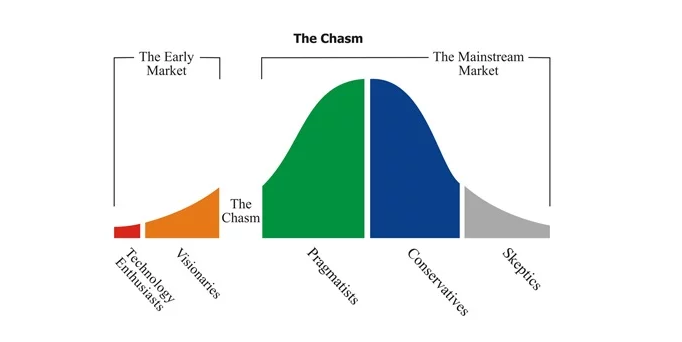
Clearly, Medium is now a mass market hit. It’s one of the top 300 websites in the world. We may not have reached the last conservatives and skeptics, but we’re definitely not a small group of hardcore techies and visionaries anymore.
For today’s startups, the trial by fire that is crossing the chasm is heavily accelerated. What used to take decades now takes years, sometimes months. This provides a great opportunity for ice cream vendors of all kinds, planting their flag on platforms that eventually become consumer darlings: You can afford to be too early.
Take Facebook, for example. If you made an effort to become an influencer on the platform in 2005 or 2006, chances are, you didn’t see much traction. They only launched Pages in 2007. If you stuck with it, however, and captured the insane growth patch from 2008–2012, you likely came out on top.
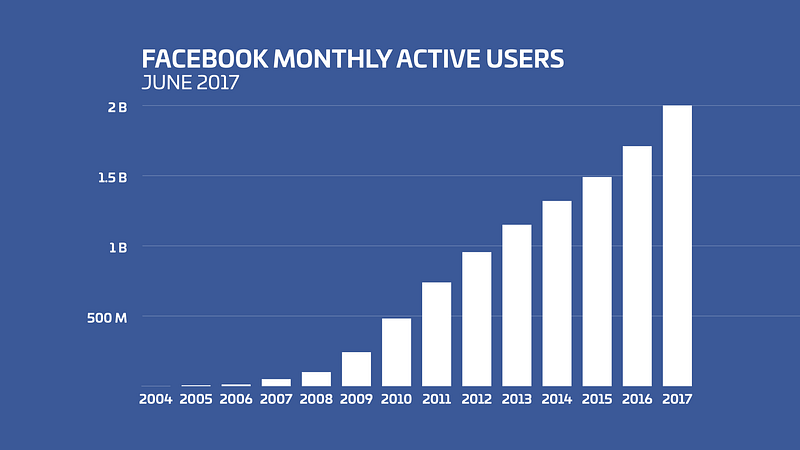
In those four years, Facebook quadrupled its monthly active users. In the eight years that have followed, they’ve just over doubled that number. That’s twice the growth in half the time making for a growth rate that’s four times higher.
Someone who showed up on Facebook in 2012 could of course still do well but will likely have seen much slower growth than someone who started in 2008. Not because they weren’t good or didn’t work hard but because they didn’t catch the wave right after Facebook crossed the chasm.
In 2016, I made an Instagram account and took it to over 1,000 followers in 11 days just by posting quotes. After almost a year of doing the same on an account launched in 2019, I have just over 300. Competition matters. Market growth matters. It’s foolish to not factor them into the equation.
I started writing on Medium in 2014. I was here early. I got lucky in when I found it and then I stuck around. I waited until we crossed the chasm.
In 2015, I had 100 followers. In 2016, I had 1,000. In 2017, I hit 15,000, then 30,000 by the end of 2018, and now, another year later, I’m at 50,000.
You can’t possibly look at my follower count on Medium without looking at that 15x growth spurt in 2017. That wasn’t all me. Sure, I was here, but I benefitted immensely from all the new tourists showing up on the beach. It is much easier to draw in newly arriving readers when you’re one of 50 interesting writers on the platform rather than one of 500.
This becomes evident when you look at the growth of some of the top rising stars on Medium throughout the years.
Tobias van Schneider posted 56 times in 2016. He went from 30k to 80k followers. Kris Gage started strong in summer 2017 and went on the sickest 18-month run you can imagine. She wrote over 500 posts until the end of 2018 — and good luck trying to find one with less than 3k claps. Yet, by that time, she also acquired just over 50k followers. 57k to be exact.
Kris posted ten times more than Tobias, had more engagement on her posts, and sustained publishing over a longer period of time — but in 2018, Medium simply didn’t grow as much as it did in 2016. If you look at the rising stars of 2019, this becomes even clearer. Stellar writers like Shannon Ashley and Michael Thompson grew to 300k monthly views and beyond, and yet, they acquired “just” 20–25k followers throughout year.
These are fantastic results and all of these people deserve more readers still, but it goes to show that, as platforms mature, growth gets harder for everyone, and first-movers benefit the most from this dynamic.
A great writer starting in 2020 will take longer to reach 10k followers than a mediocre one did in 2016. This isn’t fair, but it’s still true. On top of hard work, perseverance, and continued adaptation, maybe more so than all of the former combined, you need impeccable timing to grow in a maturing market.
Anyone telling you otherwise or guaranteeing you’ll see certain numbers after a certain amount of time if only you publish a lot is selling you a pipedream because they’re unaware of how much they’ve benefitted from external forces outside of their control.
Chances are, you’d be much better off putting in work on TikTok or some other new platform where you can still afford to be early and mediocre in case you’re new to creating in general. Take the early years to get better, to master your craft, and then wait for the gap to close, the tide to rise, the tourists to pile in. Of course, if you want to be a writer, TikTok may not be an option — but there are always options for writers.
To be clear: If you want to be a full-time writer, writing a lot, writing consistently, and constantly reinventing yourself are necessities. They’re not negotiable. Where you practice those necessities, however, matters equally as much, if not more. The platforms you choose to put your writing stake in the ground will have a large impact on how your writing career will unfold. Place your bets accordingly, and don’t get seduced by whatever’s sexy and en vogue.
The number of writers with the experience and following to join Medium and pull 100k+ views within weeks is in the single digits. Sean Kernan can do that. He’s been writing for four years. He has 250k followers on Quora. He’s established, works hard, and can adapt quickly. Just look at his profile. The man knows what he’s doing. He’s a pro. If you’re learning the game itself and figuring out the platform at the same time, you can’t expect to hit it out of the park after four weeks.
None of this is to say that writing on Medium isn’t a wonderful way to learn the craft, meet great people, have a lot of fun, and work towards something meaningful including a nice side income with more potential. It’s my favorite place on the internet, and I hope many more people will give it a chance whether they want to read or write or just study its dynamics. I hope you’re one of them, but I hope you’ll come and stay for the right reasons.
If you’re here because someone told you it’s easy money, a fast path to full-time writing, or something you can hack with a few tricks, let this be the slap in your face to snap you out of it: Whether it’s Mike or Kris or me or Sean or Shannon or any writer you don’t know who signed up on Medium yesterday…
We were here first — and that’s nothing you can replicate.