
Why You’re Drowning from Laziness
5 life lessons to combat laziness that carried me through medical school

Laziness is my kryptonite. I’ve struggled with unproductivity since I was a child, but through trial and error, I found a system that works for me.
Our population is at an unfair disadvantage when combating laziness. There are far too many distractions and shortcuts in everything we do. Imagine what it would have been like 100 years ago, living without cell phones, TVs, unlimited streaming services, and unlimited access to free knowledge? Sometimes I wonder if I would have been far more successful being born in a previous century.
I couldn’t keep fighting against my laziness without being systematic. Some years went by where I felt my inactivity lead to depression, the depression lead to unproductivity, and the circle propagated day in and day out.
I would wake up in the morning with goals for the day, open my computer or book to accomplish those goals, and get distracted within 5 minutes. My mind frequently yearned for an easy way out in everything I did, and my work suffered for that reason. I had no life purpose.
In high school, I decided I wanted to be a doctor. A neurosurgeon to be specific. I was captivated by this dream, and I couldn’t think of anything else. Soon I learned that a neurosurgeon’s lifestyle is relentless. Time is always short, there are too many responsibilities to count, and each neurosurgeon has to prioritize their everyday tasks. There is simply no time to waste if I wanted to become a successful neurosurgeon.
As I enter my 4th year of medical school, that dream slowly becomes a reality. I must’ve done something right over a decade to get to this point.
The tips for avoiding laziness did not occur overnight. In fact, it took me through my second year of medical school to figure out how to keep myself from falling into a rut and entering the cycle of unproductivity and depression.
1. Discover your sleep habits
I was not born a morning person. In fact, in my teenage years, if someone didn’t wake me up by noon, I probably would’ve kept sleeping through the day. However, believe me, that the morning hours are the most mentally clear and productive hours of the day.
There’s a difference when having to get up early for work compared to rising early for self-motivated goals. I never struggled to get up at 5am for my gap-year job between my undergraduate and graduate education. Surprisingly, I didn’t mind rising at 4am for my surgical rotation in medical school. But if I needed to work on a research project during the weekend, I convinced myself that an extra few hours of sleep was worth it.
I feel sluggish when waking up late. My focus is drastically worse because my mind starts to focus on all “to-dos” while knowing that there are fewer hours in the day to accomplish my tasks. The rest of the day spirals downward from there as I fail to put forth my best effort for each task at hand.
I had to start slowly. If I was used to waking up at 8am, I tried rising an hour earlier for a month. Then wind the alarm back another hour the following month. Now, I have no trouble waking at 5am or earlier if needed. In fact, my body asks to wake up that early, and I feel better throughout the day.
Improving my sleep hygiene drastically improved my productivity. A study showed that improving sleep hygiene leads to improved sleep practices, which contributes to sleep quality. I found that the number of hours I slept was not related to a sense of restfulness. Instead, I trained my body to consistently fall asleep at 11pm and rise at 5am. That worked wonders for my productivity.
“The day is 24 hours; 6 hours we sleep, so you have left 18 hours. So don’t ever give me this thing “I’m working 12 hours so I don’t have time to exercise and to work out.” Or “I don’t have time to study another language” and all these kind of things. 18 hours; so utilize the 18 hours, that’s what I’ve always believed in, and I feel like that’s the only way you can get ahead.”
Arnold Schwarzenegger
Most importantly, go to bed with a goal and wake up with a purpose.
2. Pomodoro Technique
The Pomodoro technique is a time management strategy developed in the 1990s to abstain from distraction.
The general structure of Pomodoro works like this:
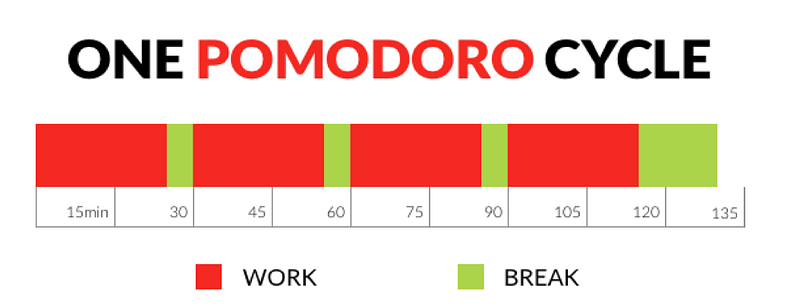
1. 4 blocks of 25-minute work periods
2. 5-minute breaks in between the work periods
3. 25–30-minute break after completion of the 4 work period
I never follow the original Pomodoro technique. The 25-minute blocks are far too short when a particular task requires 3–4 hours of my time. I also found that I can easily hold focus for 50 minutes, albeit I check the time on my timer during a working period.
I wish I had known about the Pomodoro technique in college, I would’ve have performed better and had more free time. My Pomodoro use started when I studied for my first medical licensing exam (called Step 1). For this exam, I had 6 weeks to review everything learned in the first 2-years of medical school. My study schedule was 6-days per week, from 7am until 9pm. Using the Forest app as my Pomodoro timer, I logged over 360 hours of focused study time in 6 weeks.
I never fathomed the capability to stare at a computer screen or textbook for that many hours. But, using the Pomodoro technique and rising early in the morning allowed me to avoid laziness and perform well on Step 1.
Using the Pomodoro technique isn’t limited to work. You could adapt it for any task or activity. For instance, if you want to decrease movie snacking during a Netflix binge, simply set a 50-minute timer and only allow yourself to snack during your 5-minute break from the film.
If you want to reduce eye strain while pleasure reading on the weekend, rest your eyes by avoiding screens and text during your 5-minute break.
You get the idea.
3. Intermittent fasting
How did a diet plan help control my laziness?

If you’re like me and were accustomed to eating breakfast your entire life, then fasting in the morning is incredibly tricky. I needed to summon my deepest will power to stave off the hunger. My body adjusted to morning fasts in several weeks. Still, the morning exercise of invoking my will power to resist opening the fridge remains.
Intermittent fasting helps manage my laziness. It forces me to do something mentally unpleasant, leading to a sense of reward when the fast is over at lunchtime. The thought process of controlling my impulses leads to resiliency, which is essential in preventing feelings of procrastination.
Controlling your mind from impulsive tasks first thing in the morning leads to “good” habits. When I have an impulse to get distracted, I remind myself that I controlled my urge to eat this morning. With that, I can ignore this impulse to be distracted. Intermitted fasting built my resiliency and has helped my mental focus and clarity.
Intermittent fasting is only one example of building mental resiliency. For some, resiliency may come from taking a cold early morning shower or meditating for 10 minutes. For others, it may be a morning run or stretching routine. In any case, the key to any morning routine is to be mindful of the thoughts running through one’s head. Tackle a challenging routine in the morning, and the rest of the day flows smoothly.
David Goggins wrote a somewhat crude yet inspiring book about his journey to mental resiliency, titled “Can’t Hurt Me”. He is a Navy Seal turned Special Forces who explains the power of performing mentally tasking or physically demanding activities to build habits and improve self-control. I found his novel to be inspiring and challenged my own conception of challenging tasks.
4. Dedicated time off
I enjoy being productive and leave my lazy habits in the rearview mirror. However, as a normal human being, there’s a limited mental bandwidth that I tap into before productivity fatigue accumulates.
Saturday is my day off. I use it to reset my mind, forget my to-do list, avoid my Pomodoro timer, and enjoy the fruits of my labor. I find it best to continue my early wake-up time and intermittent fasting routine, but I use one day a week to avoid all work-related responsibilities.
One day a week of rest works for my mind and body, but you may need more. Take the entire weekend off if required. Take the whole weekend and Friday evening if that makes you feel rejuvenated for a productive week ahead. Most importantly, begin to understand how to optimize your mind and body’s function.
Unfortunately, it’s not always easy to take a full day off, especially in medical school, where the work seems limitless. There were months at a time when I didn’t have a single day away from my study material. I began scheduling “fun” activities for my planned days off, and my problem was fixed. By scheduling outings with friends, FaceTime calls with parents, dates with my significant other, it became easier to reset myself over my dedicated time off.
5. Systematic goals
There were years that I tried using to-do apps to plan out my day. Lists never motivated me, and I would let my to-dos roll-over from one day to another. Then I would forget the apps altogether and become frustrated with my inability to stick with my daily goals.
When I reflected on my journey from high school to medical school, something kept me pushing through exams, work responsibilities, volunteering positions, research opportunities, amongst a host of other deadlines. That “push” came from reminders of my ultimate goal to become a neurosurgeon.
In medical school, I began using to-do lists again, but instead of making a jumbled mess of tasks, I linked every to-do with my end goal of becoming a neurosurgeon. I took extra time evaluating how each item and project on my calendar would make me a better surgeon for my future patients.
For example, a research project in undergrad taught me histological and laboratory techniques that could be used in evaluating a patient’s pathological sample. A volunteer experience at the hospital taught me hospitality and communication skills that will inevitably connect me with patients. I linked everything I did to my end-goal, allowing for daily tasks to make sense.
If anything from this list, setting systematic goals helped me the most because it taught me mindfulness and reflection techniques. Rather than moving from task to task like a robot, I have a purpose for everything I do.
Bonus tip
1. The 5-minute rule
If a task takes 5-minutes or less to accomplish, do it now. Don’t put it off because multiple 5-minute tasks add up, which decreases the chances of doing these tasks in the future.
I learned this rule when I first lived on my own. If I just cooked dinner, I would clean the dishes right there and then. If my laundry finished drying, I would fold it immediately. If a letter needed to be mailed, I’d drop it off in the outbox once sealed. I was amazed by how good it felt to finish scheduled work without having any minuscule errands to complete.
Following the 5-minute rule allows me to clear up my short term memory stores from remembering chores and errands.
These tips and life lessons took me years to modify per my lifestyle. Battling laziness is a practice, and it’s essential to maintain this practice daily. Be mindful and reflective of your goals. Adjust your schedule as needed to allow for cognitive reset during time off. Perform a mentally challenging task every morning and keep trying to improve yourself!


