
You Didn’t Decide to Read This
At least not in the way you think you did

Why did you decide to read this article?
Maybe the title sparked some kind of curiosity. Maybe you’re interested in how decisions are made. Maybe you’re bored and this was the first article that crossed your eyes. Whatever the reason, you consciously chose to read it, right?
Wrong.
In a paper published in Nature Neuroscience, researchers conducted an experiment where a series of random letters were shown to willing participants. The participants each had a button under their left and right index fingers, which they were free to press as they wished. They were instructed to watch the series of random letters, consciously choose which button they were going to press while remembering which letter was visible, and then press the corresponding button as soon as they made a decision.
The researchers found, via functional Magnetic Resonance Imaging (fMRI), that the decision was visible in brain activity up to 10 seconds prior to the participant being consciously aware of even settling on a decision. But, that’s not all folks. It wasn’t just any brain activity — it indicated which of the buttons would be pressed.
The subconscious makes decisions long before the conscious mind is aware of them, let alone their outcome. But how much many of our decisions are unconscious?
Turns out, 95%.
And even the decisions that are consciously made, are influenced by the unconscious. Often, deliberation is just justification—reasons disguised as reasoning.
This is nicely illustrated in this handy bit of advice:
If you're torn between two choices of seemingly equal merit, flip a coin. If you're satisfied or relieved by the decision the coin made for you, then go with it. On the other hand, if the reality of the coin toss leaves you uneasy and even makes you wonder why you used a coin toss to decide such an important decision in the first place, then go with the other choice instead. Your "gut feeling" alerted you to the right decision.
But things are never this simple, especially not when it comes to the mind. There are far too many unknown variables for absolute conclusions. Our brains evolved over hundreds of thousands of years and, while each part plays a role, together it’s a cohesive system with many interdependencies. So the line between consciousness and unconsciousness is not that distinct.
But, even if it’s not strictly 95%, regardless of whether a decision is conscious or unconscious, the brain still uses historical information to make it. That information doesn’t have to be true, rational, or even related, but it is necessary. There’s another name for personal historical information: memories.
The thing is, memories are not nearly as reliable as one might think.
Firstly, what people think they see is not what they actually see. Take this example from an article I recently found.
This is what we think we see:

But we actually see this:
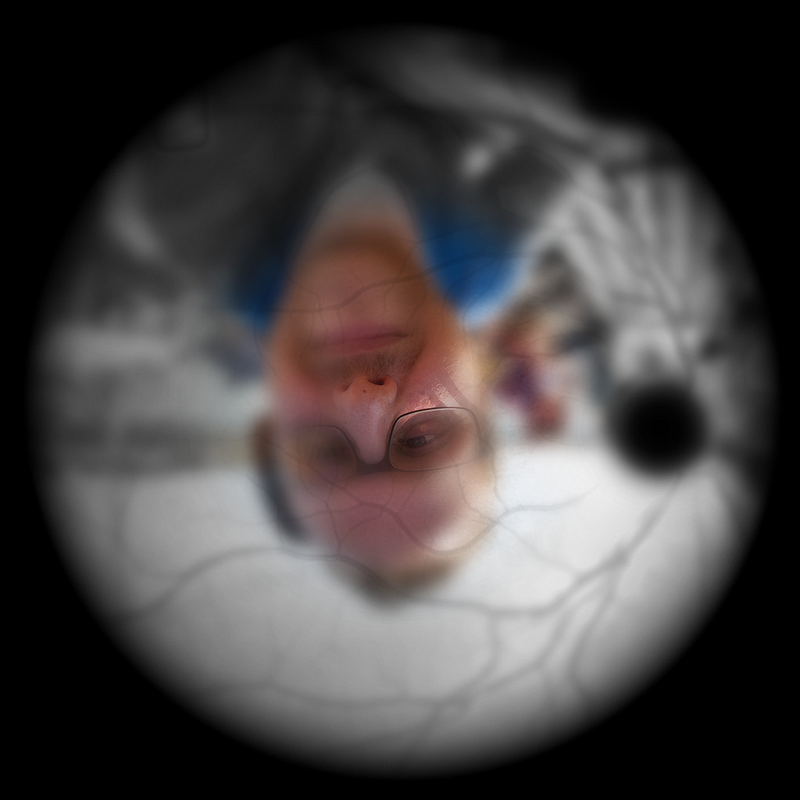

Our brains construct images based on visual memories, a short-term memory bank that helps retain important information, and creates a large margin of error. There’s a great basketball video that illustrates this concept well. If you haven’t seen it, watch it now.
What we focus on gives the brain clues as to what is important. Then, it pretty much makes up the rest. The effect is particularly strong when there is an interruption or a natural change of focus—something magicians leverage to no end. The hand isn’t faster than the eye, it’s just capable of hiding.
Secondly, the brain is not a computer. It doesn’t store memories in a memory reserved part of the brain. It creates neural pathways. It’s more like water creating an impression on land. Every time you recall a memory, you send water down that path, deepening the indent and making riverbanks. The thing is, you’re not going to get the water to run the exact same path every time—it’s going to be messy.
It’s the same with memories. Every time you recall a memory, you’re recreating it, not fetching it. So if you’re in a negative emotional state when you recall something, you’re likely to infuse it with that emotion. And how much does this affect the accuracy of our memories? Well, we forget around 50% of the details.
The annoying part is that our rivers have nice solid banks, regardless of where the first path was. So we’re confident our rivers haven’t changed, whether they run down the original path or not.
Thirdly, we are not aware of all the information we retain. In the book Evolve Your Brain: The Science of Changing Your Mind, Joe Dispenza references research stating that the brain processes about 400 billion bits of information every second. That’s everything, including senses, memories, imagination, etc.
But the conscious mind is only aware of about 2,000 bits of information a second, which are focused exclusively on the awareness of where, when, and how our bodies are. That is, until there is involvement from the frontal lobe, which is integral for uniquely human traits like consciousness and language. The brain is only aware of 0.0000000005% of the information it’s taking in, and then only allocates a portion of that to consciousness.
Most of the information that we gather never gets to see the light of consciousness.
Suddenly, it’s easy to understand why humans are so subjective. Why doctors shouldn’t operate on loved ones, why corporations shouldn’t fund governments, and why a father shouldn’t judge his daughter’s costume competition. Whether we intend to be objective or not, our decisions are compromised.
Luckily, all is not lost. Alex Pouget, associate professor of brain and cognitive sciences at the University of Rochester, argues that the brain actually makes the best decisions possible. And he has research to prove it.
He shows that the brain uses a probabilistic model. In a simple unconscious decision test, subjects were asked to observe a screen with dots moving in various directions. A controlled number of the dots, however, were moving in a specific direction. The subjects were then asked to note the direction. After a period of time, they were suddenly aware of an answer without ever being aware of the calculation process.
This is a probabilistic decision-making model. The unconscious mind monitors the dots until it reaches a confidence-level threshold. When that threshold is reached, the subjects were suddenly aware of the direction of the dots. Then, as they watched, they became more and more comfortable with that decision.
The unconscious collects information until it’s reasonably sure of an answer, without waiting for enough information to be sure of that answer. This is critical because so many decisions do not have the luxury of time. For example, when someone fakes a punch, we flinch. We don’t have time to be sure if the person is going to follow through because, by the time we are, we won’t have time to do anything about it. The brain prefers embarrassment to a black eye.
On a side note, this is yet another example of the dichotomy of probabilistic and deterministic models I wrote about here. The unconscious mind uses probability, whereas the conscious mind uses reason—a deterministic model—to make decisions.
So how do we use this information to improve our decisions? Honestly, I don’t know. I think, given that the overwhelming majority of decisions are made in the unconscious, it is probably important to focus on health to improve the efficacy of those decisions. This means making sure our hormones are balanced, that our brain has the right vitamins, oils and minerals to operate effectively, and that we are generally in shape.
But, for me, it’s a different lens with which to view free will. And now, something that has always been clear, isn’t.
I’ve set a goal to grow to 1,000 subscribers in the next three months—before the end of August. If you’d like to help, and receive some of these articles straight to your inbox, please consider subscribing to our free newsletter.