
Why Your “Black On Black Crime” Argument Doesn’t Work
“Well what about Black on Black crime?” you retort whenever the topics of police brutality and Black Lives Matter come up. Well what about it? Let’s talk.
Let’s talk numbers.
Before we get into why your argument doesn’t work and why it is problematic, let’s go over relative demographics and numbers. According to the 2019 Census, there are approximately 328.2 million people living in the United States. Of that 328.2 million, approximately 60.4% are white (not Hispanic/Latino), 13.4% are Black, 1.3% are American Indian/Alaska Native, 5.9% are Asian, .2% are Native Hawaiian/other Pacific Islander, and 18.3% are Hispanic/Latino. In this census, people had the option to identify as two or more races. 2.7% identified as such.
The sudden “rise” in Black murders by law enforcement caused Washington Post to begin documentation of every fatal shooting by an on-duty cop in the United States. This log also documents the race of the victim and the circumstances of the shooting (armed/unarmed, mental crisis, etc.). The compilation is created by monitoring and obtaining information from local news reports, law enforcement websites, social media, and independent databases. Now you’re probably wondering, “Why not just take information from the FBI and CDC?” Officials of these agencies admit that their data is incomplete. Washington Post’s database is updated regularly and therefore is deemed credible.
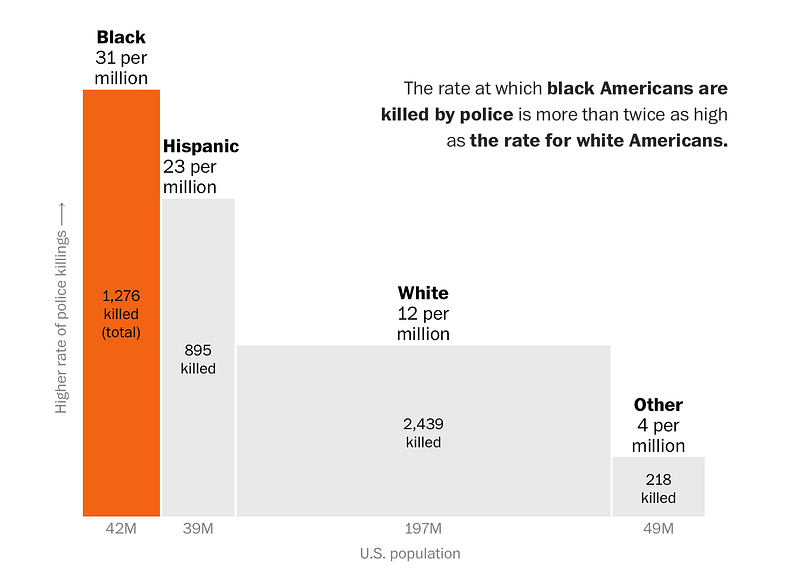
According to Washington Post’s database, .0031% of the Black population is murdered by the police and .0023% of the Hispanic/Latino population is murdered by the police. Meanwhile, .0012% of the White population is murdered by the police. In other words, Black Americans are being killed at a significantly higher rate than White Americans. Why is the rate at which Black Americans are killed by the police more than double than the rate of White Americans even though White Americans make up approximately 60.4% of the US population? To put it differently, out of all of the victims murdered by the police, 26.4% are Black, 18.5% are Hispanic/Latino, and 50% are White. Remember, approximately 13.4% of the population of the United States is Black. In a proportional world, the rate of police killings by race would align with the population demographics.
What is Black on Black crime?
Because this phrase is used as a rebuttal in the discussion of police brutality, we’re going to assume that “Black on Black crime” is defined as when one Black person murders another Black person. When this statement is used as an argument to minimize the magnitude of police brutality, it assumes that killings of Black Americans are only committed by White cops. This is false. Studies show that the murder of Black Americans by police is an institutional problem and that non-White cops are just as likely to murder Black Americans. If the study isn’t enough, see the case of Akai Gurley. While the study explains that non-White cops are just as likely to murder Black Americans, this does not disprove the fact that law enforcement is a predominantly White space. White cops account for approximately 75% of officers so it makes sense that most of these murders are done by White cops.
Why does Black on Black crime exist?
First of all, the purpose of this article is not to disprove that Black on Black crime exists. Because it does. White on White crime also exists. In fact, most homicide victims across the board are killed by people of their own race. “Black on Black crime” is a politically loaded phrase meant to perpetuate the idea that Black people only live a life of violence. Black people do not kill Black people for being Black. Cops kill Black people for being Black, and that’s the problem. Black on Black crime is the result of segregation and poverty.
On December 22, 1970, Chicago Daily Defender columnist, Warner Saunders, wrote about his time prepping to speak on Black and Black crime when he knew absolutely nothing the topic. He researched and researched but there was one experience that served as the only piece of research he really needed. He asked “the local second-story man” why he robbed and beat up Black people considering he was Black himself.
“We go where the business is and where the man ain’t looking. Can you see me going up to Deerfield, black as I am, trying to stick up? The man [police] would be on me so fast I couldn’t get a chewing gum wrapper. Out here the man is too busy whooping them Panthers and giving tickets to mess with me. Anyway, he don’t care if niggers get ripped off. But you can bet he’s watching his ‘thang’ back in his own ‘hood.’”
In short, he commits crimes against other Black people because that’s what the police will let him get away with. This isn’t to say that Black people don’t get “in trouble” for robbing and stealing because they do. However, Black people get questioned as soon as they step foot in a White community because ill-intent is already assumed. Is it because White people recognize that wealth inequality is one of the main ways to keep us down? What is the connection between white supremacy and property? This also isn’t to say that overpolicing doesn’t exist in Black communities. It does. Police are meant to protect and serve the community. When it comes to the safety of Black people, communities are underpoliced. When it comes to petty crimes, Black communities are overpoliced.
But why are people robbing and killing each other in the first place?
When talking about Black on Black crime, one often looks to the dynamic of street gangs as an example. People form and join gangs for multiple reasons. Most of these reasons can be narrowed down to three main categories: the need for necessities, the need for protection, and the need for belonging. It is important to note that Black people are not the only people that join gangs. There are Hispanic/Latinx gangs, Asian gangs, and White gangs. The first street gangs in the United States were White. In fact, they started on the East Coast around 1783 during the end of the American Revolution but more serious gangs started during the early nineteenth century. If you look at the migration patterns of the United States, you will see that the emergence of gangs correlates with them. “Gang emergence in the Northeast and Midwest was fueled by immigration and poverty, first by two waves of poor, largely white families from Europe.” These immigrants, being Irish, Italian, and Jewish, were often discriminated against by Anglo-born Americans. With discrimination comes the lack of necessities, lack of protection, and the lack of belonging. See the parallels? Although these groups still face discrimination, as time progressed, these groups began to be included in the idea of “whiteness” especially when faced with darker minorities.
The origins of gangs were not violent, but when you add in the effects of white supremacy, it becomes so. Not only does that include protecting themselves from direct violence done by White people, but it also includes fighting and killing each other over essentials. When we discuss the violence in Black communities, we have to examine factors such as wealth and education. Wealth and education are closely linked in a constantly occurring cycle. In a nutshell, the less money you have the less educational opportunities you’ll have. The less educational opportunities you have, the less money you’ll make. Yes, there are people that get scholarships but none of that comes close to the majority of people that do not have access to education. Student loans exist, but the average debt for a student is approximately $30,000. Take a scroll on LinkedIn or Indeed. Most jobs require a degree (high school diploma, Bachelors, Masters, etc.), even if it is paying the minimum wage. What happens when you can’t get to school because you have to work to support your family? What happens when you’re not allowed in class simply because you’re late?
Here’s the thing about your argument.
It ignores that Black on Black crime is the effect of the lack of resources which is an effect of racism and discrimination. It ignores the fact the origins of police forces in America stem from slave patrolling. During the colonial times, most law enforcement was, “by definition, white patrolmen watching, catching, or beating black slaves.” We know that White men aren’t the only people that can become cops today, but it should be stressed that this system developed from practices and guidelines that were implemented during the colonial era.
Your argument also assumes Black people condone violence in our community. That is false. It assumes we aren’t mad about Black on Black crime, and it implies that we can’t be mad at police violence because of the violence in our communities. It assumes we can’t be mad at both. Although it is the most familiar organization currently, Black Lives Matter is one of many Black organizations. Black Lives Matter’s mission “is to eradicate white supremacy and build local power to intervene in violence inflicted on Black communities by the state and vigilantes.” Black Lives Matter is an organization that focuses on one Black issue, white supremacy. Mothers/Men Against Senseless Killings (MASK) and The Newark Anti-Violence Coalition are organizations that focus on another Black issue, the murdering of Black people done by other Black people. These organizations have different jobs but all strive to solve Black issues just as police, firemen, and paramedics have different jobs but all intend to “protect and serve” the community. You wouldn’t ask a police officer to put out a fire even though they are supposed to protect and serve because that’s not what they specialize in. So why is that your rebuttal to Black Lives Matter?
Your argument doesn’t work because the idea of “Black on Black” crime only exists because of whiteness. Your argument contradicts the entire reason why you’re even using it in the first place: to prove that Black people actively kill each other for reasons that are not rooted in racism. Although no one is putting a gun to their head and physically making Black people commit crimes, the origins of these crimes stem from the effects of racism and classism which are both important forces of white supremacy.
If your instant reaction to people pushing for justice and the destruction of a system that has roots in white supremacy is “what about Black on Black crime?” then it shows that you are either one of two things. One, you’re a racist white supremacist that wants to keep the system going by using this phrase that is loaded with verbiage and thought to associate Black communities with violence or you’re uneducated in the origins and history of policing, the deep affects of white supremacy, and the actual purpose of the Black Lives Matter Movement. This of course can be intentional. In the case that it is not and it’s the odd chance that you actually do care about Black lives, remember that the phrase itself is dangerous because without an analysis of it and investigation of the origins, the use of the phrase maintains the beliefs of racism and classism which are the driving forces of white supremacy.
In short, your excuse is a contradicting, uneducated, cop out (yes, pun intended).