
Why You Shouldn’t Be Afraid To Lift Weights As A Woman
Mental and physical benefits of traditional strength training
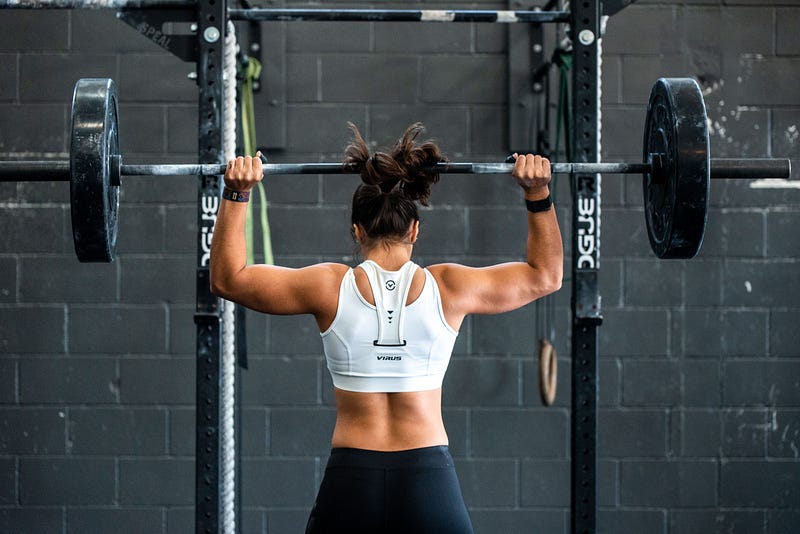
A s women, we’re still held to a societal standard that tells us we should be petite, dainty, lithe. We’re expected to be weaker than men, to need help. If you’re a woman or woman-aligned and into working out, maybe you feel like you should stick to cardio, resistance bands, pilates, and those tiny colourful dumbbells. I’m here to give you some reasons to keep adding those weights.
Feeling strong
Strength is in the name. You’ll not only feel accomplished at the gym or after your home workouts, but you’ll also be able to do more in your day-to-day life. Next time you move, maybe getting the couch or a box full of books down the stairs will seem less daunting. Next time you shop, you’ll confidently pack everything into a crate and carry it inside in one trip. Getting to do these things has mental and emotional perks, too. Maybe you’ve been in the situation on public transport where a man will grab your luggage without even asking, will carry your suitcase down a flight of stairs and make you afraid he’ll disappear with it. Of course they should always ask first, but keeping a firm grip on the handle, saying, “No, thank you”, and then easily storing your bag in the overhead bin will give you some much-needed confidence to navigate these scenarios that can make a regular appearance in your life. Again, it’s not bad to struggle with something heavy, and doesn’t warrant unsolicited assistance, but why should we be barred from these capabilities in the first place? Strength is acquired, not inherent, and if you’d been taught from the start to lift heavy things and help other people with their stuff, it would be second nature for you also. We all lead similar lives, there’s no reason why you shouldn’t be able to get through everything you’re facing on a physical level.
“Bulking up”
Look, estrogen-dominant people do not “bulk-up” that easily, even when strength training regularly and consuming a lot of protein. Then again, what if you gained a little weight in the form of musle mass? What if your shoulders became a bit broader, your arms bigger? Your muscles are allowed to grow. You’re allowed to take up space. Personally, strength training really helps me learn that those things are true. When you focus on how much you can squat rather than, say, how much weight you’ve lost (i.e. how much smaller you’ve become), you’re focusing on achievement, on what your body can do. You’re allowing yourself to make progress, to exist in your full capacity. I never thought I’d be found flexing my biceps for my friends at a party, but I do that sometimes, and even though it’s ironic, it feels like the exact opposite of hiding in the corner.
Challenging yourself
At the same time, strength training is also a continued challenge. As someone who works out at home rather than at the gym (which in the spring of 2020, more of us are doing now than before), I like the fact that I get to have all the control, that I can push myself just hard enough, that I can beat my personal bests. They say the last few reps should be a struggle, and beating that struggle makes you feel amazing. You have to pick the right weight, the right workout routine, so it’s fair to say strength training is a very good way of getting to know your body and its limits. On the flip side of that, you’re also getting real numbers to measure how much stronger you’re getting.
Leading by example
Maybe you have a friend who restricts her calorie intake and gets bored to death because she spends two hours on the treadmill each day. Maybe you have a friend who doesn’t work out at all. Wouldn’t it be nice to show these people how much more fun they could be having, how much more varied exercise can be? Yes, I consider strength training fun. I was someone who didn’t grow up with a good education around exercise. I struggled through the team sports we played at school, never found anything that I wanted to pursue. I still wouldn’t want to play football, because I enjoy lifting weights, pushing myself, and not having anyone else to consider, quite frankly. It’s a great way to relieve stress, too — I discovered it as a university student, and it makes for a great release valve when you’ve been sitting at a desk or in a lecture hall all day.
I consider strength training to be an integral part of anyone’s exercise regime, whether your prime goal be functionality or aesthetics. Don’t limit yourself. If you want to train that way, do it. Everyone can benefit from lifting weights.