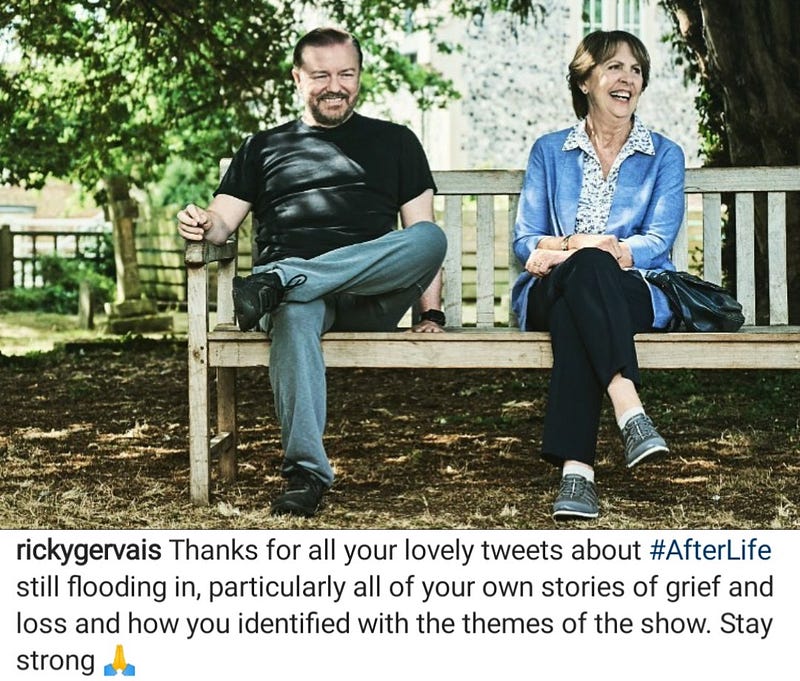
Why You Should Watch Ricky Gervais’ After Life
It’s a terrible time to be alive
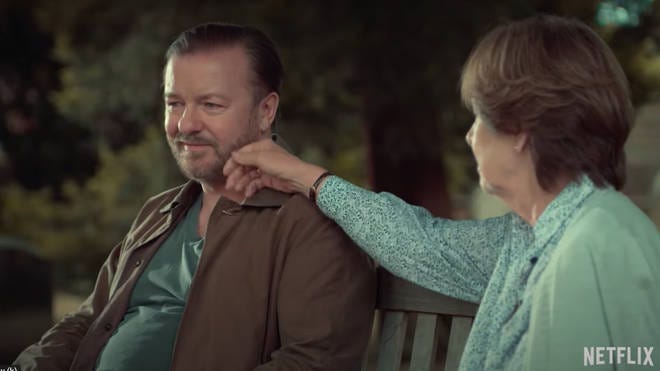
Human existence, at its very core, is all about pain.
We spend most of our time working jobs we hate just so we can afford unsatisfactory possessions. The tedious household chores exhaust us. And in the dark of the night, when we’re alone with our thoughts, we realise that our lives are terribly bleak and pointless.
And that’s talking about the more privileged ones amongst us.
This may not be the same for you, of course. In which case, I’m envious of your colourful life. You’re free to stop reading the article and wander off to do the next fun thing.
But if you were able to relate ever so slightly with that dubious opening statement — boy, do I have a show for you.
1. Beauty in Serenity
What After Life does extremely well is the depiction of everyday life.
It’s not a fast-paced show with exciting plot twists. Neither does it have a star-studded cast. And that is exactly why it’s so good.
The interplay amongst the actors, as well as the story, can be summed up in one word: genuine. The show is painfully real. It doesn’t mask the unwelcome aspects of being alive. More importantly, it does not portray an idealistic world where the cliched “everything will be alright” scenario occurs.
Its rawness and brutal honesty are what makes it relatable.
“One heart is not connected to another through harmony alone. They are, instead, linked deeply through their wounds. Pain linked to pain, fragility to fragility.” — Murakami
2. What vs How
Every story (or TV show, in this instance) has two main components: the what and the how. While we naturally tend to focus on the former, the latter forms the beauty of the narrative that appeals to our subconscious.
After Life overtly focuses on the how. The result is the creation of a melancholic, bittersweet environment within which the story unfolds.
That is not to say that the script itself is not interesting; it’s extremely well written. But as riveting as it is, the aesthetic of the show is empathetically enchanting. It gives you a platform to experience vicariously the lives of its sad and funny characters.
3. Asking the Right Questions
Anton Chekhov advised that a writer’s job is not to solve problems, but to merely state them.
Most TV series/movies tend to take a moral stance, especially when it comes to the issue of mental health. The protagonist uncovers several potential solutions, and more often than not, one of these works out.
After Life is more about shedding light on the incapacitating plight of depression. It raises the problems that innumerable people face without offering a straightforward solution to them.
Anyone who’s suffered from depression knows that it’s a complex set of various issues that does not have a simple cure. It takes time, effort, and patience. To see the protagonist go through that grind, and realise that others are on the same boat, is nothing short of comforting.
In Conclusion
After Life is quite possibly the best drama on Netflix. The story is truthful and the cinematography, dreamy. It’s likely to leave you spellbound.